Ships
- USS Missouri (BB-63) Captain, 2 April 1947 – 23 January 1948
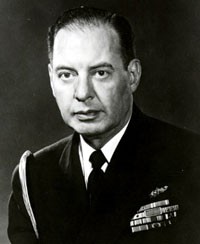
Robert Lee Dennison was born in Warren, Pennsylvania, on 13 April 1901, the son of Ludo W. and Florence Lee Dennison. He prepared at the Kiskiminetas School in Saltsburg and graduated from the United States Naval Academy with the Class of 1923. Engineering held him for the next decade. He completed the Navy’s postgraduate course in diesel engineering at Annapolis in 1929, received a master of science degree from Pennsylvania State College in 1930, and in 1935 earned a doctorate in engineering from Johns Hopkins University. In May 1937 he married Mildred Fenton Mooney Neely of Washington, D.C. They had a daughter and a son.
His early commands were small ships with specialized work. From 1935 to 1937 he commanded the submarine rescue vessel Ortolan, and in 1937 and 1938 the submarine Cuttlefish. In 1940 and 1941 he commanded the destroyer John D. Ford. He then joined the staff of Admiral Thomas C. Hart’s Asiatic Fleet and was with that fleet through the Philippines and Netherlands East Indies campaigns at the start of the Pacific war. After the fleet withdrew, he served as chief of staff in Australian waters.
In August 1942 Dennison became chief of staff to the Commander, Amphibious Force, Pacific Fleet, a command later designated the Ninth Amphibious Force. He shared in the planning and the conduct of the operations that took Attu and Kiska in the Aleutians. Later in 1943 he returned to Washington in the rank of captain, sitting on the Joint War Plans Committee of the Joint Chiefs of Staff and advising the Under Secretary of the Navy. He remained with the war plans committee into 1945. In 1946 and 1947 he was Assistant Chief of Naval Operations for Politico-Military Affairs, coordinating naval policy with foreign policy as the war ended. That work brought him a Gold Star in lieu of a second Legion of Merit.
On 2 April 1947 he took command of the battleship Missouri. The ship already carried a public history. On her deck in Tokyo Bay on 2 September 1945, Chester William Nimitz had signed the Japanese surrender for the United States, with Stuart S. Murray in command and William Frederick Halsey, Jr. among the senior officers present. Dennison’s own tour was a peacetime one. In September 1947 Missouri brought President Harry S. Truman and his family home from Rio de Janeiro. On that passage, about 11 September, Dennison read the summons for the equator-crossing ceremony held for passengers and crew making the crossing for the first time. He gave up command on 23 January 1948.
He was then assigned as Naval Aide to the President and served Truman in that post from 1948 until the administration ended in 1953. He was promoted to rear admiral while he held the job. The aide’s work kept him beside the President on travel, on naval and maritime questions, and in the daily business between the White House and the Navy. The two men stayed friends after both had left office, a tie that lasted until Truman’s death in 1972. During the Revolt of the Admirals, Dennison, an Academy classmate of Arleigh Burke, asked the President to look into Burke’s case. Burke’s career went on, and he later became Chief of Naval Operations.
Fleet command followed the White House years. Dennison commanded the First Fleet in the Pacific from 1956 to 1958. Promoted to admiral in 1959, he next led United States Naval Forces, Eastern Atlantic and Mediterranean. From 28 February 1960 to 30 April 1963 he was Commander in Chief, Atlantic, Commander in Chief of the Atlantic Fleet, and NATO’s Supreme Allied Commander, Atlantic. The tour covered the Bay of Pigs landing in 1961 and the Cuban Missile Crisis in 1962, when the Atlantic forces carried out the naval quarantine of Cuba. He retired from active duty in 1963. His decorations included the Navy Distinguished Service Medal and the Legion of Merit.
From 1963 to 1973 he was an executive with Copley Newspapers. Admiral Dennison died of a pulmonary embolism on 14 March 1980 at Bethesda Naval Hospital in Maryland. He was 78.