Ships
- USS Grayling (SS-209) Flag, not her captain, 31 December 1941
- USS Missouri (BB-63) Flag, not her captain, 2 September 1945
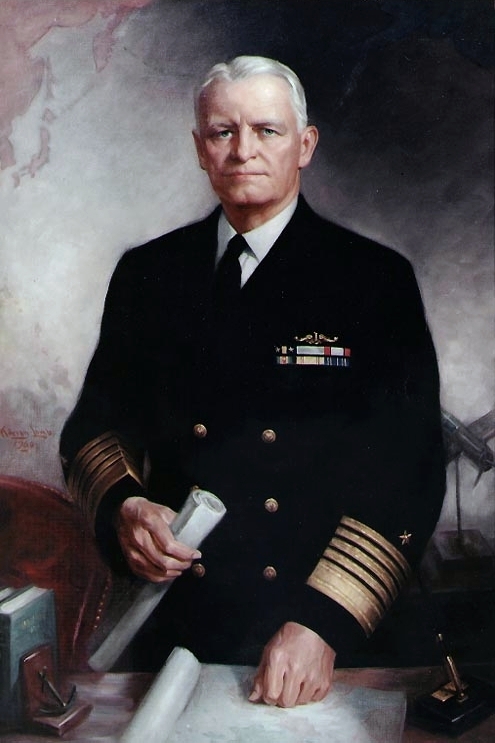
Chester William Nimitz was born in Fredericksburg, Texas, on 24 February 1885. He graduated from the United States Naval Academy in 1905 and went out to the Asiatic Station, where his first command was the gunboat Panay. In 1908, still an ensign, he ran the destroyer Decatur aground in Philippine waters, and a court-martial left him with a letter of reprimand. He shifted into submarines and commanded Plunger, Snapper, Narwhal, and Skipjack. In 1912 he received the Silver Lifesaving Medal after going into the water for a sailor. A diesel engine tore away the ring finger of his left hand while he was showing the machinery to visitors. The Navy sent him to study diesel works in Germany and Belgium, and he came home convinced that submarines should burn oil rather than gasoline. In 1913 he married Catherine Vance Freeman.
In the First World War he was executive officer and engineer of the tanker Maumee, the Navy's first large diesel-powered surface ship. Destroyers bound for European waters took fuel from her while both ships were underway. He finished the war as chief of staff to the commander of the Atlantic submarine force. After the armistice he commanded the cruiser Chicago, set up a Naval Reserve Officers Training Corps unit at the University of California, and attended the Naval War College. From 1933 to 1935 he commanded the heavy cruiser Augusta while she served as flagship of the Asiatic Fleet. Promoted to rear admiral in 1938, he led a cruiser division and then a battleship division. On 15 June 1939 he became Chief of the Bureau of Navigation, the office that managed the Navy's officers and enlisted men. He was still there when Japanese aircraft attacked Pearl Harbor on 7 December 1941.
President Franklin D. Roosevelt chose him for the Pacific Fleet ahead of many admirals senior to him. Admiral Husband E. Kimmel had already been removed, and Vice Admiral William S. Pye held the fleet in the interval. Nimitz reached Pearl Harbor on Christmas Day, 1941. On 31 December he took command and was promoted to admiral. The ceremony was held aboard the submarine Grayling (SS-209) at the submarine base, and he relieved Pye there. Her own captain remained in command of the boat. His flag was hoisted for the ceremony and hauled down again after he went ashore. Grayling returned to war patrols. By the next June she was on the patrol line west of Midway, and Nimitz was at Pearl Harbor, not in her. The submarine was lost with all hands in September 1943.
He directed the fleet from ashore, at Pearl Harbor and later on Guam. Coral Sea, Midway, the Guadalcanal fights, the Philippine Sea, Leyte Gulf, Iwo Jima, and Okinawa were all fought while he remained at headquarters. He did not go to sea for any of them. In the spring of 1942 he was also named commander in chief of the Pacific Ocean Areas, with Allied naval, ground, and air forces in the North, Central, and South Pacific under his authority, while General Douglas MacArthur held the Southwest Pacific. He kept the staff he found at Pearl Harbor so the work would not stop for a change of officers. Roscoe H. Hillenkoetter served as officer in charge of intelligence on that staff from September 1942 to March 1943. William M. Callaghan was a logistics officer for the fleet and then left to commission the new battleship Missouri (BB-63) as her first captain. Tom B. Hill was fleet gunnery and combat-readiness officer from October 1942 through August 1945. In October 1942, with Guadalcanal near its worst, Nimitz sent William Frederick Halsey, Jr. to relieve Vice Admiral Robert L. Ghormley in the South Pacific.
He made the commitments, and other admirals fought the battles. In May 1942 the Coral Sea action turned back a Japanese attempt to take Port Moresby by sea. In June, after radio intelligence pointed to Midway, he sent the carriers. Four Japanese carriers went down, and the United States lost Yorktown. From late 1943 the Central Pacific advance took Tarawa in the Gilberts, Kwajalein and Eniwetok in the Marshalls, and Saipan, Tinian, and Guam in the Marianas, each base supporting the next move. The Philippine Sea, in June 1944, broke Japanese carrier aviation as a serious threat. At Leyte Gulf that October, Halsey's Third Fleet covered the return to the Philippines. Nimitz was made fleet admiral in December 1944 and took the oath on the 19th. In January 1945 he moved his headquarters to Guam, and the landings on Iwo Jima and Okinawa were run from there.
On 2 September 1945 his flag was broken on the battleship Missouri (BB-63) in Tokyo Bay. Stuart S. Murray commanded the ship. Nimitz held no command of her himself. She had come into the bay as flagship of Halsey's Third Fleet, and Halsey's flag came down when the five-star flag went up. Nimitz had told Murray to see that the day's arrangements ran on time. Aboard her he signed the instrument of surrender for the United States, and General of the Army Douglas MacArthur signed for the Allied powers.
He hauled his flag down at Pearl Harbor on 26 November 1945. On 15 December he relieved Fleet Admiral Ernest J. King as Chief of Naval Operations, served the single two-year term he had promised, and left the office on 15 December 1947. Robert L. Dennison worked under him there on political-military affairs. For the defense of Grand Admiral Karl Dönitz, Nimitz stated in writing that American submarines in the Pacific had been ordered to wage unrestricted war on merchant shipping. In retirement he was a regent of the University of California. He died on 20 February 1966 at his quarters on Yerba Buena Island, in San Francisco Bay, and was buried in Golden Gate National Cemetery.