Ships
- USS Missouri (BB-63) Captain, 11 June 1944 – 14 May 1945
William M. Callaghan was born in Oakland, California, on 8 August 1897, the son of Charles William Callaghan and Rose Wheeler Callaghan. The family was Roman Catholic. He died at Bethesda Naval Hospital on 8 July 1991, after a stroke, and is buried at Arlington.
His older brother was Rear Admiral Daniel Judson Callaghan. Daniel was killed on the night of 12–13 November 1942 on San Francisco at Guadalcanal. The Medal of Honor was awarded after his death.
Both brothers went to Saint Ignatius College Preparatory in San Francisco and to the Naval Academy. William entered in 1915 and graduated with the accelerated class of 1919. He was commissioned ensign on 6 June 1918 and reported first to the battleship Wisconsin. That is not the later battleship Wisconsin (BB-64). In the last months of the First World War he transferred to destroyers in the Atlantic, serving in Stevens and then in Allen (DD-66) on convoy escort. That Stevens is not the later destroyer Stevens (DD-479).
In 1925 he earned a master of science in electrical engineering from Columbia. Later duty included assistant engineering officer of the light cruiser Concord, engineering billets ashore, and assistant engineer officer of Saratoga from May 1930 to May 1933. He was not her captain. He then taught marine engineering at the Naval Academy. He commanded the destroyer Reuben James (DD-245) from 15 June 1936 to 5 March 1938. She was sunk on 31 October 1941, after he had left her. From March 1938 he was executive officer of the transport Henderson.
From 1939 into August 1941 he worked in the Ships' Movements Section under the Chief of Naval Operations. In August and September 1941 he was a naval observer at the American Embassy in London, planning petroleum deliveries to Britain. From July 1942 to May 1944 he served on the staff of Admiral Chester W. Nimitz as assistant war plans officer for logistics and assistant logistics officer. The Legion of Merit covers that duty from 10 July 1942 to 1 May 1944.
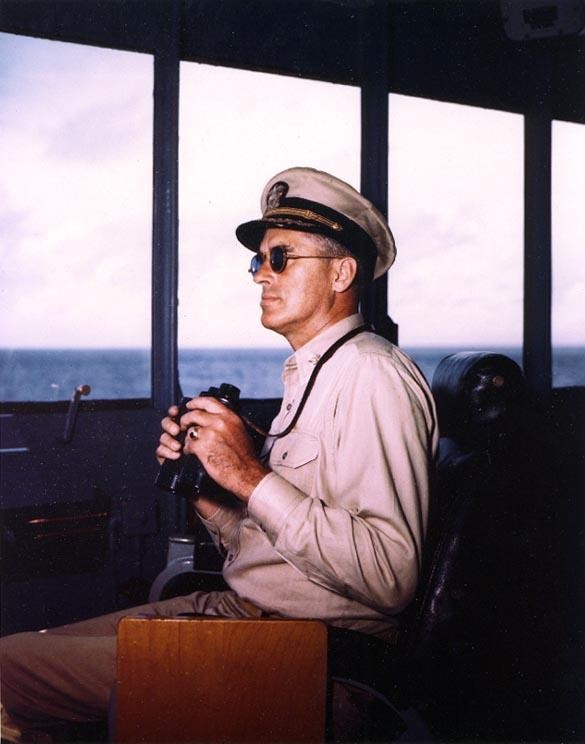
He assumed command of Missouri (BB-63) when she was commissioned on 11 June 1944. He was her first captain. In February 1945 she supported the carriers in the first mass strikes on the Japanese home islands and in the operations off Iwo Jima. On 24 March she took part in the initial bombardment of Okinawa. On 11 April 1945, off Kikaijima, an A6M Zero hit her starboard side. The bomb did not explode. No one in the crew was killed. The pilot was. Some of the men wanted the remains washed overboard. Callaghan ordered a burial at sea the next day, with a flag made up aboard, a chaplain, and a rifle volley. He described it as the recognition due a man who had shown courage. The list of her captains on this page ends his tour on 14 May 1945. The Navy history of the ship named for him says he had her until 15 May, when Captain Stuart S. Murray, a classmate, relieved him at Ulithi. He was promoted to temporary rear admiral two days later, on 17 May.
He returned briefly to the Pacific Fleet staff, then became Assistant Chief of Naval Operations for Transportation and Chief of the Naval Transportation Service. That service brought nearly 3.5 million servicemen home from the Pacific. In September 1949 he became the first commander of the Military Sea Transportation Service, later the Military Sealift Command, and held the command until December 1952. He was promoted to vice admiral on 11 April 1951. He commanded the Amphibious Force, Pacific Fleet, from December 1952 to March 1954, and Naval Forces Far East from March 1954 to November 1956. He finished as Commander Western Sea Frontier and retired on 1 March 1957.
He received the Order of the Rising Sun, the Order of the White Elephant, and the Order of Boyaca, and he was a Knight of Malta. After retirement he was a vice president of American Export Lines and chairman of the Maritime Transportation Research Board of the National Academy of Sciences. The cargo ship Admiral William M. Callaghan (T-AKR-1001) is named for him. The destroyer Callaghan (DD-792) is named for his brother. He was survived by his third wife and by his children, among them Rear Admiral William M. Callaghan, Jr.