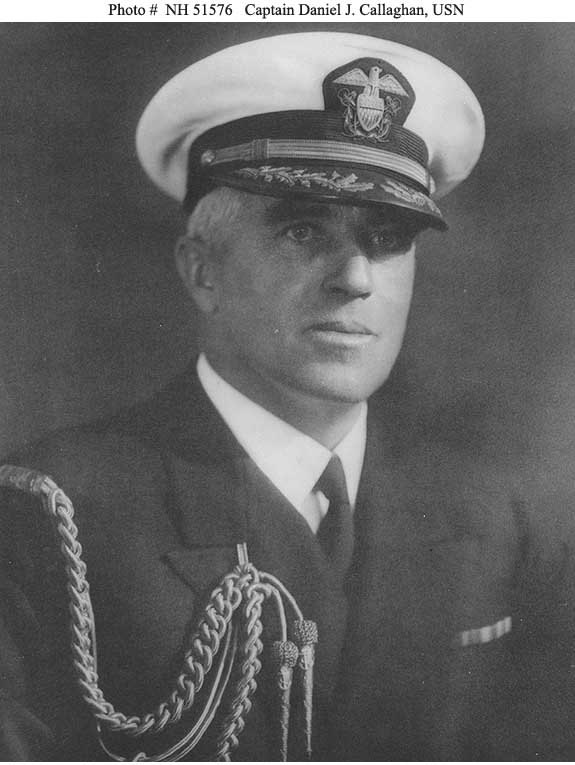
Ships
- USS San Francisco (CA-38) Captain, 27 May 1941 – 2 May 1942
- USS San Francisco (CA-38) Flag, not her captain, 13 November 1942 · Killed that night
Daniel Judson Callaghan was a United States Navy officer whose career ran from the eve of the First World War through the night fighting off Guadalcanal. He was born in San Francisco on 26 July 1890 and graduated from the Naval Academy in 1911. He is a different officer from William M. Callaghan, who later commanded Missouri.
After commissioning he served in the fleet that was still learning how a modern navy would fight. Early duty took him to battleships and to smaller ships, the ordinary path of a junior officer who was expected to learn gunnery, navigation, and the habits of a watch. By the time the United States entered the First World War he was a lieutenant, and the war years put him in destroyers and in convoy and patrol work rather than in a single famous action. The Navy kept him at sea and in staff billets through the 1920s, when the battle fleet trained hard and promotions came slowly.
In the 1930s he became known less as a ship driver than as a staff officer who could explain the fleet to civilians in high office. He served as naval aide to President Franklin D. Roosevelt, a post that put a relatively junior captain beside the commander in chief during the years when the Navy was arguing for more ships and for a Pacific strategy. That work did not make him a rear admiral. It did give him a reputation for plain speaking and for loyalty to the officers who would later send him back to sea.
He had San Francisco as her captain from 27 May 1941 to 2 May 1942. The heavy cruiser was already a veteran of the peacetime Pacific, and under Callaghan she went to war. After Pearl Harbor she operated with the forces trying to hold the line in the South Pacific, including the early carrier raids and the fighting around the Coral Sea. He was still a captain on that cruise. The ship’s later battle honors belong to the whole crew and to the officers who succeeded him. He left her in May 1942 for the staff of the South Pacific Force.
On that staff he worked under the officers directing the Guadalcanal campaign, among them Royal E. Ingersoll in the wider Pacific command structure and Charles Horatio McMorris, whose planning work shaped how the Navy fed and fought the island. Callaghan’s job was the unglamorous one of turning orders into ships, ammunition, and schedules while Japanese surface forces kept coming down the Slot at night. By the autumn of 1942 he had been promoted to rear admiral and given a task force of his own.
On the night of 12–13 November 1942 he was a rear admiral in command of the American column off Guadalcanal. His flag was back in San Francisco. Cassin Young was her captain. Callaghan was not. The column was a scratch force of cruisers and destroyers, sent to stop a Japanese bombardment group that was coming to shell Henderson Field. Norman Scott, who had fought a night action off Cape Esperance only weeks earlier, was in the same line, junior to Callaghan for the night. The two columns met almost head-on in the dark, at ranges so short that ships on both sides fired into friends as well as enemies.
The gunfire that killed him is not credited to one Japanese ship. He was killed on that bridge, standing with his staff while San Francisco was hit again and again in the melee that became known as the Naval Battle of Guadalcanal. Young was killed on the same ship in the same fight. The American column was badly hurt, and Scott died as well, but the Japanese bombardment of the airfield was broken up. The transports and the field survived the next day.
The Medal of Honor was awarded after his death. The citation rested on his decision to take an outgunned column into a night action at close range and on the fact that he stayed on the bridge until he was killed. A destroyer was later named for him. Officers who had shared earlier watches and staffs with him, including William Lewis Beck, Ralph Chandler Parker, Charles Moulding Yates, Henry Ehrman Thornhill, Herbert Emery Schonland, Albert Finley France, Jr., Harvey Edward Overesch, and John Esten Whelchel, remained part of the Navy that finished the war he did not see.