Ships
- USS San Francisco (CA-38) Captain, 9 November 1942 – 13 November 1942 · Killed in command
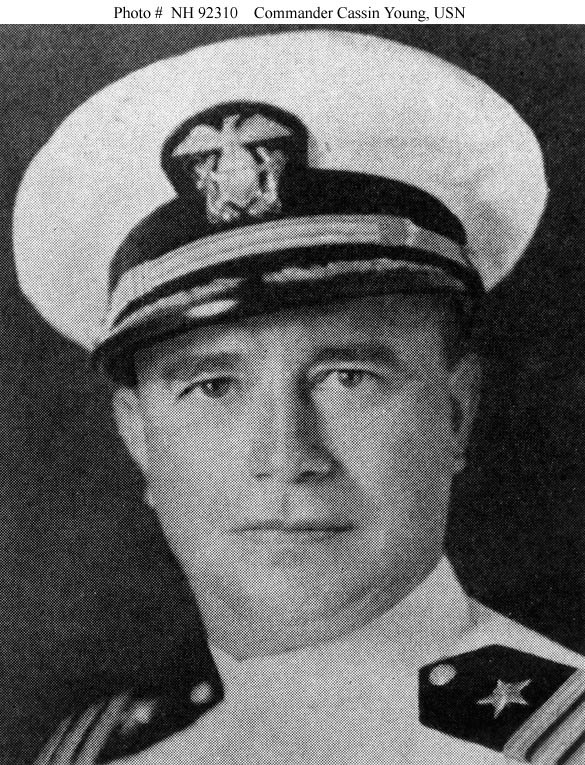
Captain Cassin Young was born in Washington, D.C., on 6 March 1894, the son of Casanave Howle Young and Anna Cassin Young. The Cassin side of his family had served in the Navy since the War of 1812. When he was about two, the household moved to Milwaukee, where his father kept a drugstore. His father died in 1905, and his mother brought Cassin and his younger brothers back to Washington. Wisconsin appointed him to the Naval Academy. He entered in 1912 and graduated in 1916.
His first sea duty was in the battleship Connecticut, where he served through the First World War and into 1919. That year he married Eleanor McFadden in Philadelphia and went into submarines. In the early 1920s he commanded the submarine R-23. Later in the decade he worked in naval communications, served on the staff of the Battle Fleet submarine command, and taught at the Naval Academy. From 1931 to 1933 he was a lieutenant commander in the battleship New York. He then commanded the destroyer Evans into 1935 and spent the next two years with the Eleventh Naval District.
Promoted to commander in 1937, he led Submarine Division Seven. From July 1939 he was executive officer of the submarine base at New London, Connecticut. In the autumn of 1941 he returned to sea as commanding officer of the repair ship Vestal. On the morning of 7 December 1941 she was moored alongside the battleship Arizona at Pearl Harbor. When Japanese aircraft attacked, Young reached the bridge and then took charge of a 3-inch antiaircraft gun. The blast of Arizona's forward magazine threw him into the water. He swam back through burning oil to Vestal, which bombs had left on fire, listing, and settling. He took her clear of the burning battleship and beached her, and the repair ship was saved. For his conduct that morning he received the Medal of Honor. Admiral Chester W. Nimitz presented it on 18 April 1942.
The Navy advanced him to captain in February 1942. On 9 November 1942 he became captain of the heavy cruiser San Francisco, relieving Charles Horatio McMorris. Rear Admiral Daniel Judson Callaghan had his flag in the ship. Young was her captain.
On 13 November 1942, in the night action off Guadalcanal, San Francisco met a Japanese force that included the battleship Hiei. The ships fought at very short range in the dark. Young was killed on her bridge while directing the cruiser. Callaghan was killed the same night. His flag had been in the ship, and Young had commanded her. San Francisco was hit by many heavy shells and badly damaged. She remained afloat.
Herbert Emery Schonland, the damage-control officer, took command when Young was killed and had her until 17 November 1942. Lieutenant Commander Bruce McCandless, the communications officer, conned her out of the fight. The captaincy did not pass to McCandless. Young was awarded the Navy Cross after his death for the way he fought San Francisco on the night of 12–13 November 1942, and he received the Purple Heart.
He was buried at sea. A memorial marker stands at Mount Pleasant, South Carolina. His wife, Eleanor, and their children survived him. The Navy named a destroyer for him. Cassin Young was launched on 12 September 1943, with his widow as sponsor, and commissioned on 31 December 1943.