Ships
- USS San Francisco (CA-38) Acting commanding officer at the conn, 13 November 1942 · Took the conn after the admiral, the captain and the bridge officers were killed or wounded
- USS Gregory (DD-802) Captain, 29 July 1944 – 9 October 1945
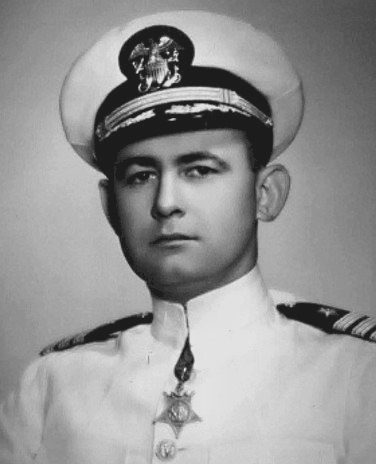
Bruce McCandless was the communications officer of the heavy cruiser San Francisco. On the night of 12–13 November 1942, off Savo Island, the admiral, the captain, the navigator, and the other officers on her bridges were killed or wounded. He took the conn and kept her in the fight. The Medal of Honor citation says that, with no flag officer or captain left to give orders, he "promptly assumed command of the ship." For the rest of that night he was her commanding officer in everything but rank and appointment.
He was born in Washington, D.C., on 12 August 1911. His father was Byron McCandless, a career naval officer who retired as a commodore. The family name had once been spelled McCanles. Bruce McCandless's great-grandfather was David Colbert McCanles, who was shot at Rock Creek Station, Nebraska, in the 1861 fight with Wild Bill Hickok. Afterward the family took the spelling McCandless and settled at Florence, Colorado. Bruce McCandless was appointed to the Naval Academy from Colorado.
He entered Annapolis as a midshipman in 1928 and graduated with the class of 1932. His classmates included Richard Best, the dive-bomber pilot of Midway, and Lloyd Mustin. He was commissioned an ensign in June 1932.
His early sea duty was in the heavy cruiser Indianapolis and the destroyer Case. He then took postgraduate instruction at Annapolis, finishing in September 1939. That month he reported to San Francisco, and in October 1939 he was promoted to lieutenant. He married Sue Worthington Bradley, the daughter of Captain Willis W. Bradley. They had two sons and two daughters.
He was still in San Francisco as her communications officer when Japanese aircraft struck Pearl Harbor on 7 December 1941. The cruiser was in the Navy Yard for overhaul and was not hit. Through 1942 she worked with the carriers and then with the cruiser forces fighting for Guadalcanal. He was promoted to lieutenant commander in June 1942. In October she was Rear Admiral Norman Scott's flagship at Cape Esperance.
On 12 November 1942, Rear Admiral Daniel J. Callaghan moved his flag into San Francisco. Captain Cassin Young had taken command of her three days earlier. That night Callaghan's column of cruisers and destroyers ran into a Japanese force built around the battleships Hiei and Kirishima between Guadalcanal and Savo Island. The fight was at very close range. Shells swept San Francisco's navigating and signal bridges. Callaghan was killed with most of his staff. Young was mortally wounded. The navigator and the others on the bridges were killed or wounded.
McCandless was wounded and knocked unconscious. The citation records what he found when he came to: no flag officer and no captain left on board, and the battle still going on. The ships behind San Francisco did not know that their admiral was dead. The citation says he "ordered her course and gunfire against an overwhelmingly powerful force" and "continued to engage the enemy and to lead our column of following vessels." The senior surviving officer, Lieutenant Commander Herbert E. Schonland, the first lieutenant and damage control officer, stayed below fighting fires and flooding. He judged that saving the ship was the more urgent work and left the conn to McCandless. Between them they brought the cruiser out of the action and back to port. San Francisco was not sunk.
Both men received the Medal of Honor. The citation for McCandless calls him communication officer of San Francisco in the battle off Savo Island, 12–13 November 1942. It ends: "Largely through his brilliant seamanship and great courage, the San Francisco was brought back to port, saved to fight again in the service of her country." Admiral Ernest J. King presented the medal aboard the cruiser at San Francisco on 12 December 1942. Earlier that month Admiral Chester W. Nimitz had visited the ship at Pearl Harbor and was photographed with Schonland and McCandless. McCandless was promoted to commander and stayed in the ship into 1944.
On 29 July 1944 he placed the new Fletcher-class destroyer Gregory (DD-802) in commission at Tacoma, Washington, as her first commanding officer. After shakedown on the West Coast she reached Pearl Harbor on 23 October and trained there into the new year. In January 1945 she sailed for Iwo Jima by way of Eniwetok and Saipan, and she was off the island on D-day, 19 February. For about a month she screened transports and fired in support of the troops ashore.
She left Saipan on 27 March for Okinawa and arrived on 1 April 1945. Her group made a demonstration landing on the southeast coast to draw attention away from the main landings in the west. She stayed on patrol and radar-picket duty. On the afternoon of 8 April Japanese aircraft came in out of the sun. Gregory's guns hit the attackers, but one suicide plane crashed into her port side amidships, just above the waterline, and opened the hull. McCandless directed the damage control, kept the ship able to fight off further attacks, and brought her back to port. He received the Silver Star for his command off Okinawa from 1 to 8 April 1945.
He gave up Gregory on 9 October 1945 and joined the staff of the naval operating base at Terminal Island, California. In November 1946 he went to Washington, to the Naval District Affairs Division in the Office of the Deputy Chief of Naval Operations. He retired on 1 September 1952 and was advanced to rear admiral on the retired list.
He died in Washington on 24 January 1968, at fifty-six, and was buried in the Naval Academy Cemetery at Annapolis. His father died the year before. His son Bruce McCandless II became a naval aviator and a NASA astronaut, and in 1984 made the first untethered spacewalk. In 1971 the frigate McCandless (FF-1084) was named for father and son, Commodore Byron McCandless and Rear Admiral Bruce McCandless.