Ships
- USS San Francisco (CA-38) Captain, 16 May 1942 – 8 November 1942
Charles Horatio McMorris was born in Wetumpka, Alabama, on 31 August 1890. He attended school there, and in 1908 his state appointed him to the Naval Academy. He graduated in June 1912 and was commissioned an ensign. His first ships were Delaware, the armored cruiser Montana, and New Hampshire. In 1914, during the Mexican campaign, he went ashore at Veracruz with the landing force from New Hampshire. That autumn he returned to Montana for torpedo instruction, and on 18 November 1914 he joined Maryland. The next year he assisted in the salvage of the submarine F-4 after she went down off Honolulu, and a letter of commendation followed his help in taking passengers off a ship grounded in a storm in the Gulf of California.
He moved into destroyers as the United States entered the First World War. In January 1917 he reported to Mare Island, where Shaw was building, and he joined her on commissioning that April. In June she sailed for Queenstown, Ireland, and he served in her with the destroyer force overseas until the end of July 1918. He then fitted out Meredith at Quincy, Massachusetts, and was her executive officer from her commissioning in January 1919 until June. On 13 June 1919 he received his first command, the destroyer Walke. A month later he went ashore to the recruiting station in Pittsburgh, and for the next two and a half years he worked in the Detail Section of the Bureau of Navigation in Washington. Promoted lieutenant commander in June 1922, he navigated Baltimore and, from September of that year, was executive officer of Burns until December 1924, when he joined Mine Squadron Two.
Between September 1925 and May 1927 he taught seamanship and flight tactics at the Naval Academy and was assistant editor of the Naval Institute Proceedings. He next commanded the destroyer Shirk off Nicaragua in the Second Nicaraguan Campaign, and in February 1930 he shifted to command of Elliot. In July 1930 he returned to Annapolis, this time in the Department of English and History, and for two years he edited the Proceedings. He was promoted commander in October 1931. After leaving the Academy in May 1933 he served as navigator of California, then went back to the Bureau of Navigation in July 1935. From July 1937 to May 1938 he took the senior course at the Naval War College. He afterward became operations officer on the staff of the Scouting Force, and from October 1939 to January 1941 held the same duty with the Hawaiian Detachment. Officers who served with him called him Soc, a shortening of Socrates. He was promoted captain in July 1939.
On 1 February 1941 he reported as war plans officer to the Commander in Chief of the Pacific Fleet. He was still in that post when the Japanese attacked Pearl Harbor, and he stayed on the fleet staff under the new commander. The Legion of Merit recognized his service from 7 December 1941 to 15 April 1942, when the early plans for the Pacific war were being made under heavy pressure.
He became captain of the heavy cruiser San Francisco on 16 May 1942 and kept her until 8 November 1942. She went into the fighting off Guadalcanal. On the night of 11–12 October, at Cape Esperance, she was the flagship of Rear Admiral Norman Scott. McMorris was her captain. Scott was not. Through that night action off Savo Island he fought the ship in the forward part of the American column and supported the task force commander in a confused gun battle. He received the Navy Cross for it, and he was entitled to wear the ribbon of the Presidential Unit Citation awarded to San Francisco for the same night.
Cassin Young took San Francisco on 9 November 1942. The night action of 13 November, and the deaths of Young and of Daniel Judson Callaghan, were not his. McMorris had already left the cruiser.
In December 1942, by then a rear admiral, he took command of a cruiser task force in the North Pacific. Early on 26 March 1943, south of the Komandorski Islands, his ships met a stronger Japanese force of cruisers and destroyers covering transports headed for the garrisons on Attu and Kiska. Salt Lake City and Richmond fought a running gunnery duel, and the American destroyers closed in for a torpedo attack. The Japanese retired toward the Kuriles, and the transports turned back short of the islands. Salt Lake City was badly damaged. McMorris was awarded the Distinguished Service Medal for the action.
In June 1943 he joined the staff of Admiral Chester W. Nimitz as chief of the joint staff and aide, and he remained there through the end of the war. He coordinated the staff work on the naval plans for the Gilberts, the Marshalls, the Marianas, the western Carolines, Iwo Jima, and Okinawa, and he assisted in the Hollandia and Morotai operations, the Philippines campaign, the attacks on Japan, and the naval side of the occupation. A Gold Star in lieu of a second Distinguished Service Medal followed. He served in the temporary rank of vice admiral from 23 September 1944 until July 1948, when he reverted to rear admiral.
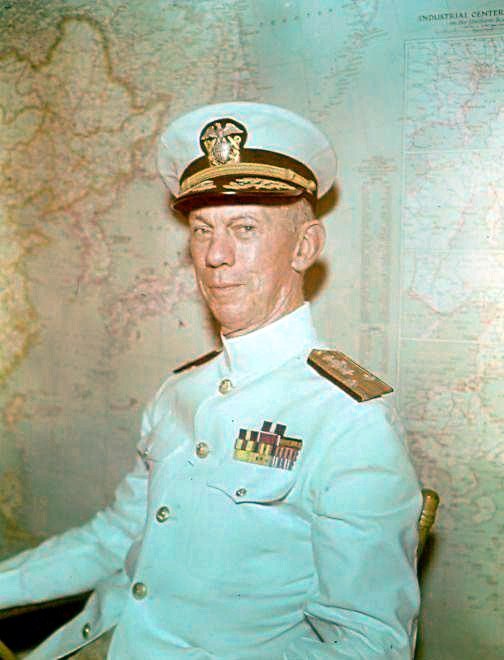
In February 1946 he became commander of the Fourth Fleet, and in September he went to the General Board of the Navy. He was president of the board from 10 December 1947 until August 1948, then reported at Pearl Harbor as commandant of the Fourteenth Naval District and commander of the Hawaiian Sea Frontier. On 1 June 1951 he added command of the Naval Base, Pearl Harbor. He retired on 1 September 1952 and was advanced to vice admiral on the retired list on the basis of his combat awards. He lived in Wetumpka with his wife, the former Elizabeth M. Case. On 11 February 1954 he died at Valparaiso, Chile, while visiting their son. The destroyer escort McMorris was later named for him.