Ships
- USS Pensacola (CA-24) Captain, 16 December 1939 – 21 January 1942
- USS San Francisco (CA-38) Flag, not her captain, 11 October 1942
- USS Atlanta (CL-51) Flag, not her captain, 13 November 1942 · Killed that night
Norman Scott was born in Indianapolis, Indiana, on 10 August 1889 and went to Shortridge High School there. An appointment from Indiana took him to the Naval Academy in 1907. He graduated in 1911, made his first cruise in the battleship Idaho, and was commissioned an ensign in March 1912. Destroyer duty followed. On 6 December 1917 he was executive officer of Jacob Jones when a German submarine sank her between Brest and Queenstown, and he was commended for his conduct in the sinking. He spent the rest of the First World War in the Navy Department and as naval aide to President Woodrow Wilson.
In 1919, holding the temporary rank of lieutenant commander, he had charge of a division of Eagle boats and commanded two of them. The early 1920s found him in destroyers, in the battleship New York, and on shore duty in Hawaii. From 1924 to 1930 he served on the staff of the Commander, Battle Fleet, and taught at the Naval Academy. He then commanded the destroyers MacLeish and Paul Jones, returned to the Navy Department, and completed the senior course at the Naval War College. After a tour as executive officer of the light cruiser Cincinnati, he served with the United States Naval Mission to Brazil from 1937 to 1939.
He came home a captain. On 16 December 1939 he relieved Andrew Daniel Denney in command of the heavy cruiser Pensacola. That was a captain's tour, and it lasted until 21 January 1942. The cruiser served in the Pacific. On 7 December 1941 she was at sea with a reinforcement convoy that had left Pearl Harbor for the Philippines. The convoy was diverted after the attack, and the troops and cargo were landed for the Allies in Australia. Scott left Pensacola on 21 January 1942.
The first months of 1942 were spent in the Office of the Chief of Naval Operations. In May he was made a rear admiral, the rank he held at his death. He went to the South Pacific and in early August commanded a gunfire-support group for the landings on Guadalcanal and Tulagi. At the Battle of Savo Island he was in the cruiser San Juan on the eastern approach to the sound, miles from the cruisers the Japanese caught and shattered.
In September he took Task Force 64, a mix of cruisers and destroyers, and drilled it in night gunnery and maneuver. On the night of 11–12 October 1942, off Cape Esperance, his flag was in San Francisco. Charles Horatio McMorris was her captain. Scott was not. The ship was not sunk. With her were Helena, Boise, Salt Lake City, and five destroyers. They met a Japanese column of heavy cruisers and destroyers coming down to shell the Marines on Guadalcanal. American guns fired first. The heavy cruiser Furutaka and the destroyer Fubuki were sunk, the Japanese admiral was killed, and the bombardment was given up. A turn in the dark left ships unsure which radar blips were their own, and American gunfire damaged Farenholt. Duncan was sunk in the crossfire. Cape Esperance was still the Navy's first surface victory of the Guadalcanal campaign.
On the night of 12–13 November 1942 he was second in command to Rear Admiral Daniel J. Callaghan in the opening night action off Guadalcanal. His flag was in the light cruiser Atlanta. He was not her captain. Captain Samuel Jenkins had the ship. The American column ran into a Japanese force built around battleships, and the formations tangled at short range. Atlanta was hit by a torpedo and by heavy gunfire and left crippled. Scott was killed aboard her that night, along with several officers of his staff. San Francisco also hit Atlanta while that ship was already crippled. The shot that killed him is not credited to one ship. Atlanta was scuttled that afternoon. Callaghan was killed the same night, his own flag flying in San Francisco. The Japanese plan to bombard Henderson Field was broken up.
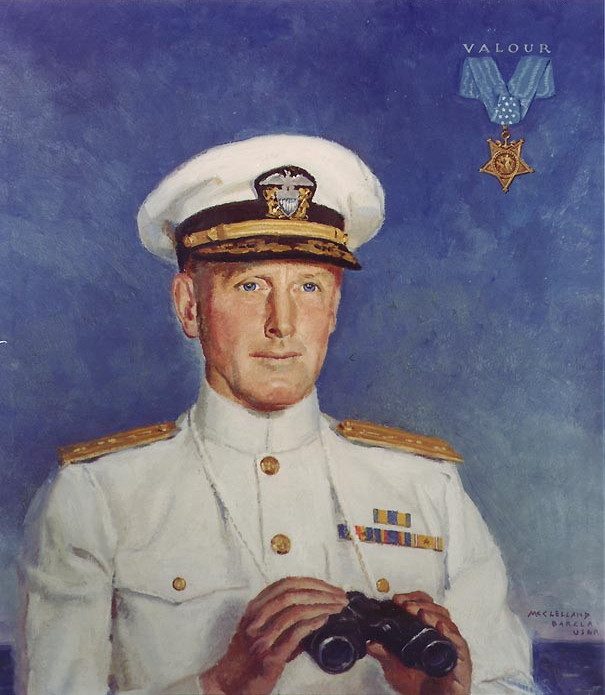
For the actions of 11–12 October and 12–13 November he received the Medal of Honor after his death, and the Purple Heart. On 9 December 1942 the President presented the medal to the family, and Midshipman Norman Scott, Jr., accepted it for his father. Scott was buried at sea off Guadalcanal. The Navy named the destroyer Norman Scott for him, and a later destroyer, Scott, carried the name as well.