Ships
- USS Pensacola (CA-24) Captain, 6 December 1937 – 16 December 1939
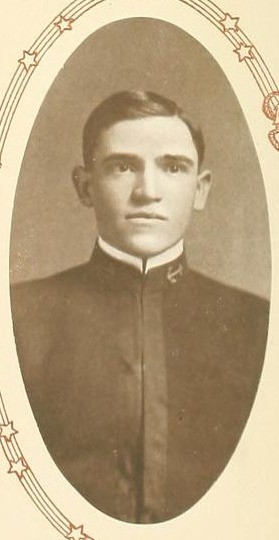
Andrew Daniel Denney (1884–1962) was a regular officer of the United States Navy, a Missourian from the Ozark town of Mountain Grove who graduated from the Naval Academy with the class of 1908 and served for thirty-five years until his retirement in November 1943. He was a gunnery specialist and a marksman: a member of the Academy rifle team that shot in the National Match at Camp Perry in 1907, named to the American team for the international rifle and pistol matches of 1921, gunnery officer of the battleship Arizona in the early 1920s, and fleet gunnery officer on the staff of the Commander, Scouting Fleet, at the end of that decade. He put the destroyer La Vallette into commission in December 1920, came back to Arizona as her executive officer in 1934–35, and from December 1937 to December 1939 commanded the heavy cruiser Pensacola, taking her from San Diego to her new base at Pearl Harbor in October 1939. In 1940 and 1941 he was captain of the yard at the Mare Island Navy Yard; he was retired on 1 November 1943 and appears in February 1944 at Northwestern University, as a retired captain, swearing in the members of the university's naval training units as they left for the fleet. He commanded no ship in the war itself. His name was often printed "Denny," including in the Navy's own ship history of La Vallette and its directory listings for Pensacola; he is a different man from Lieutenant Edward Francis Denney of the class of 1935, an Englishman by birth raised in Rochester, New York, who served in the Asiatic Fleet's destroyers and died in April 1942, and from the other Denneys who held commissions in the war years.
The Navy's registers give his birth date as 26 October 1884. His Naval Academy yearbook, the Lucky Bag of 1908, gives his home as Mountain Grove, Missouri, a small railroad and farming town in Wright County, on the high ground of the Ozarks east of Springfield. "He's from Missouri—that settles it," his classmate wrote, using the state's proverbial claim to be shown, and added that "Mountain Grove holds him in high esteem, as do we all."
About his family the record consulted is thin. A family compilation on Find a Grave lists an Andrew Daniel Denney, born about 1884, among the children of Benjamin F. Denney and Drucilla Caroline Hull Denney, who died in 1898, and names a younger brother, Richard William Denney, born in Wright County in 1890, who became a physician and died at Mountain Grove in 1974. If that compilation is right, his mother died when he was about thirteen. It has not been checked against census or vital records. A physician named Benjamin Franklin Denney, born at Mountain Grove in 1883, whose published biography names his parents as James M. and Minnie (Reeves) Denney, was evidently a kinsman or a neighbor of the same name rather than a brother; nothing found ties the two men together.
The register of 1947 gives 1904 as the year of his original entry into the service. He would have entered the Naval Academy that summer, at nineteen, in the class that graduated in 1908.
The Lucky Bag sketch of "Dan" Denney is short. It calls him a man with "a quiet, winning manner" who had become, "through this," "the hardest kind of a fusser," the Academy's word for a midshipman who sought out the company of young women. He roomed with a classmate called "Harmless Hughie," "who somehow tolerates his awful joking"; the epigraph above his name, from Molière, is "Not everyone is a wit that would be." He "took the management of the U.S.N.A. newspaper and periodical department, and has made a good thing of it." The sketch closes: "Time changeth our good friend not." In his first-class year he wore the stripe of a cadet ensign in the Eighth Company.
What the sketch lists under his name, "Rifle Team," is the thread that runs through the next twenty years of his career. The Academy's rifle team of 1907 beat the National Guard of the District of Columbia and the officers of the 71st New York for the Wells trophy, and the Navy Department then sent nineteen midshipmen to Camp Perry, Ohio, for the National Matches, after three weeks of practice at Annapolis in temperatures the yearbook puts at 95 to 115 degrees on the firing line. Denney was one of the twelve chosen for the National Team Match. The team stood tenth after the skirmish runs and finished sixth among forty-eight entries, "thus putting us in the money," the yearbook said, with a higher score than the winning team of the year before. One of his teammates, Willis A. Lee, won the National Individual Match and the National Pistol Match. Lee, who would command the American battleships off Guadalcanal in November 1942, served with Denney again in the Asiatic Fleet five years later.
The class of 1908 graduated in June 1908 and went to sea as passed midshipmen for the two years then required before commissioning. The Navy register of 1909 lists Midshipman Andrew D. Denney in the new armored cruiser North Carolina, under Captain William A. Marshall, in a wardroom that also held his classmates Philip Seymour and William D. Brereton. The register of 1910 lists him in the protected cruiser New Orleans, under Commander Roger Welles, and that of 1911 lists him there as an ensign, under Commander William G. Miller, in the Asiatic Fleet. By January 1913 he was one of the four officers of the gunboat Helena, under Commander George R. Marvell, in the Second Division of the Asiatic Fleet, and the fourth was Ensign Willis A. Lee. Helena was a shallow-draft gunboat built for work on the China coast and the Yangtze; the register does not say where she was lying that winter.
He came home to the battleship Rhode Island, where the register of January 1914 places him, and in September 1914 he was ordered to the Naval Academy for instruction duty. The registers and directories of 1915 through 1917 carry him at Annapolis as a lieutenant (junior grade) and then a lieutenant, his permanent lieutenant's commission dating from 29 August 1916. A list in the register of 1915 also shows him under instruction at the Naval Proving Ground at Indian Head, Maryland, the Navy's gun-testing range on the Potomac, which fits the specialty he would follow for the rest of his active career.
When the United States entered the First World War he was made a temporary lieutenant commander, with rank from 1 January 1918. The only trace of his war service found is a photograph in the Naval Historical Center's collection, taken about 1918 aboard the transport Northern Pacific, in which he stands among the ship's officers, all in life jackets, with canteens and binoculars; the caption names him as "Lieutenant Commander Andrew D. Denney, USN." Northern Pacific, a fast coastal passenger liner taken over for the war, ran between Hoboken and Brest with the Cruiser and Transport Force, carrying more than 22,000 troops and passengers to France in thirteen voyages. In September 1918 the influenza epidemic struck her on the way to Brest; cots were set up in the brig and the open corridors, and seven men died. The caption does not give his duty, and how long he was aboard is not known.
His permanent rank of lieutenant commander dated from 8 June 1920, according to compiled sources drawing on the registers. On 24 December 1920 he put the new destroyer La Vallette into commission at San Francisco, built by Bethlehem's yard there; the Navy's official ship history gives her first captain as "Lt. Comdr. A. D. Denny." It was a short command. Philip Seymour, his classmate from the North Carolina, relieved him on 15 February 1921.
That summer the Secretary of War named him to the team that was to represent the United States at the international rifle and pistol matches at Lyon, France, in August 1921. The Washington Evening Star of 3 July printed the roster: an Army team captain, a Navy coach, two naval officers, Lieutenant Commander Andrew D. Denney and Lieutenant (jg) W. A. Sprout, three Marines, and soldiers and civilians. The Americans won the team title in free rifle at Lyon, but Denney is not among the five men credited with that score, and whether he shot in any of the matches has not been established.
He spent the academic year 1922–23 back at the Naval Academy, as an instructor in the Department of Ordnance and Gunnery, and then went to the battleship Arizona as her gunnery officer. The Navy Directory lists him there in 1923, under Captain J. R. Y. Blakely, and in every issue through January 1926; in October 1925 his captain was H. P. Perrill. A battleship's gunnery officer answered for her main and secondary batteries, her fire control and her showing in the fleet's competitive practices, and he held the post for about three years.
He was promoted to commander on 26 August 1925 and went ashore to Washington, where the directories of 1927 and 1928 place him in the Division of Fleet Training of the Office of the Chief of Naval Operations, under Rear Admiral M. M. Taylor, the office that directed the fleet's gunnery and training exercises. In 1929 and 1930 he was at sea again, as aide and fleet gunnery officer on the staff of the Commander, Scouting Fleet, Vice Admiral W. C. Cole, in the flagship Wyoming. In 1930–31 he took the senior course at the Naval War College at Newport, whose completion the registers afterward noted beside his name, and in 1932–33 he was in the Bureau of Navigation in Washington, the Navy's personnel bureau, in the administration section of its Naval Reserve personnel division.
In 1934 he went back to Arizona, this time as executive officer, the second in command, responsible for the running of the ship and the work of her crew. The directories list him in that billet in April 1934, under Captain M. Milne, and in January 1935, under Captain G. M. Baum. From there, in 1936, he was sent to Los Angeles to take charge of the Navy recruiting station in the Klinker Building. He was promoted to captain while there, with rank from 1 July 1936.
In December 1937 he received the command that was the summit of his career. Pensacola, commissioned in 1930, was the first of the Navy's cruisers designed to the limits of the Washington Naval Treaty: 585 feet long, built for 32 knots, with ten 8-inch guns in four turrets and a ship's company of more than six hundred. Compiled command lists give his tenure as 6 December 1937 to 16 December 1939, between Captain George H. Bowdey and Captain Norman Scott. The Navy Directories of January 1938 and January 1939 list him as her commanding officer and print her wardroom: Commander O. M. Forster as executive officer in both years; Lieutenant Commanders E. G. Fullinwider and then R. E. Nelson as gunnery officer; a scouting squadron detachment, VCS-4, for her floatplanes; and, in 1939, a lieutenant named J. C. Landstreet, who would command the ship himself for a few months in 1943.
The record of his two years is the record of the peacetime Pacific Fleet. The official ship history says only that from her home port at San Diego, "fleet problems ranged to Hawaii," and that "combined fleet maneuvers returned her briefly to the Caribbean Sea" before she sailed on 5 October 1939 for a new base at Pearl Harbor, arriving on the 12th. The Caribbean maneuvers the history mentions without a date were almost certainly those of the fleet's concentration in the Atlantic in early 1939; the move to Pearl Harbor came five weeks after the war in Europe began, and he was in command when the cruiser went west. No account of his handling of the ship, no fitness report and no letter from those years has been found.
Norman Scott relieved him in December 1939. It was his last command at sea.
He came back from Hawaii to the Mare Island Navy Yard on San Pablo Bay, north of San Francisco, as captain of the yard. The register of 1940 and the directories of June 1940, November 1940 and April 1941 list him in that post. The captain of a navy yard ordinarily ran its waterfront: the berthing, docking and moving of ships, the tugs and yard craft, and the harbor. Mare Island in 1940 and 1941 was being expanded from a peacetime yard toward the great wartime establishment it became, and the ships coming to it for building, overhaul and repair passed through that office.
The Navy Directory, which places him office by office until April 1941, was not published after that month, and the wartime registers give rank and seniority but not duty. Where he was on 7 December 1941, when the Arizona, in which he had served twice, blew up at her mooring at Pearl Harbor, has not been found. Nor is it known what he did during most of the next two years.
The registers show that he was retired on 1 November 1943, six days after his fifty-ninth birthday, after thirty-nine years in the service counting his time at the Academy. He retired a captain. His retirement did not end his service. On 22 February 1944, at Cahn Auditorium in Evanston, Illinois, Northwestern University held a commencement convocation "for members of the naval training units leaving for active service," and the printed program lists "Andrew D. Denney, Captain, U.S.N., (ret.)" as administering the oath of office to the candidates for commissions. The program lists about a hundred and fifty young men receiving commissions that day as ensigns of the Naval Reserve, and one as a second lieutenant of the Marine Corps Reserve. It does not give his position, and no record has been found that states what his duty at Northwestern was, whether he had been recalled to active service, or how long he was there.
He had spent much of his career training men to shoot and running the ships they served in. The last glimpse of him in uniform is of a retired gunnery officer, too old for sea, giving the oath to young men who would go to sea in his place.
The registers carry him on the retired list as a captain through the 1950s; the last one found that lists him by name is that of 1960. No record has been found of his life after the war: where he lived, whether he married, or whether he had children. A compiled online memorial, drawing on the Social Security death index, gives his death as January 1962, at the age of seventy-seven, without a place. His burial place has not been confirmed.
What survives of him is a set of entries in the Navy's annual books, a photograph of officers in life jackets on a troop transport in 1918, a yearbook sketch of a quiet, joking, well-liked Missouri midshipman who could shoot, and his name, misspelled, at the head of the commissioning history of a destroyer scrapped in 1931 and at the head of the wardroom of a heavy cruiser that he took to Pearl Harbor two years before the war came there.