Ships
- USS Missouri (BB-63) Captain, 6 November 1945 – 31 May 1946
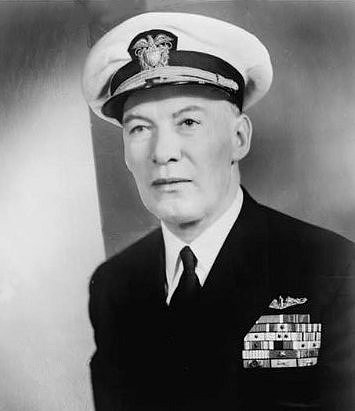
Roscoe Henry Hillenkoetter was born in St. Louis, Missouri, on 8 May 1897. He graduated from the United States Naval Academy in 1919 with the Class of 1920 and served with the Atlantic Fleet in the First World War. His later reputation rested on intelligence work as much as on sea command. In the mid-1930s the Navy began sending him abroad as an assistant naval attaché, the duty that ran through the rest of his career.
He held the French attaché post in 1933–1935 and again in 1938–1940, then returned in 1940–1941 while the Vichy government administered unoccupied France. From Paris and from Vichy he watched a continent already at war and learned the liaison and political reporting the Navy expected of an attaché. Those tours made him one of the service’s officers with recent, firsthand experience of Europe just as the United States was drawn into the fighting.
In December 1941 he was executive officer of the battleship West Virginia at Pearl Harbor. Japanese aircraft attacked on the morning of 7 December, and West Virginia was badly hit and settled in the harbor. Hillenkoetter was wounded and was the senior surviving officer of her crew. In September 1942 the Pacific Fleet placed him in charge of intelligence on the staff of Chester William Nimitz, work he carried until March 1943. Later in the war he commanded destroyers in the South Pacific.
Japan signed the surrender on board Missouri in Tokyo Bay on 2 September 1945, while Stuart S. Murray still had the ship. Hillenkoetter relieved him on 6 November 1945. At a short ceremony on the fantail, Murray, nominated for rear admiral and ordered to the office of the Chief of Naval Operations, read the orders and turned the battleship over. Hillenkoetter, then described as a veteran of twenty-five years in the Navy, told the officers and crew that he was glad to have Missouri and asked them to keep her efficient and a good ship to serve in. Afterward she received about two thousand parents and relatives of Navy, Marine Corps, and Coast Guard men killed in the war, and her chaplains held brief memorial services.
He remained captain of Missouri until 31 May 1946. The battleship spent that first postwar winter and spring as the Navy’s best-known capital ship, her name already fixed to the surrender. When he left at the end of May, Tom B. Hill followed him in command.
On 29 November 1946 he was promoted to rear admiral and returned to Paris for another tour as assistant naval attaché. In the spring of 1947 President Harry S. Truman called him home to lead the Central Intelligence Group. He was sworn in as Director of Central Intelligence on 1 May 1947. The National Security Act of that July created the Central Intelligence Agency in place of the group on 18 September 1947, and Hillenkoetter became the agency’s first director. He served until 7 October 1950, the third Director of Central Intelligence and the officer who carried the office from the postwar group into a permanent agency during the early Cold War.
He went back to the fleet in October 1950 as commander of Cruiser Division 1 in the Cruiser-Destroyer Force, Pacific Fleet, and held that command through August 1951, during the Korean War. From 1952 to 1956 he commanded the Third Naval District in New York. Promoted to vice admiral on 9 April 1956, he finished his career as Inspector General of the Navy from 1 August 1956 until his retirement on 1 May 1957. He died on 18 June 1982.