Ships
- USS Saratoga (CV-3) Captain from 6 July 1935 · Relieved on 9 June 1937
- USS New Jersey (BB-62) Flag, not her captain, October 1944
- USS Missouri (BB-63) Flag, not her captain, from mid-May 1945
- USS Iowa (BB-61) Flag, not her captain, 2 September 1945
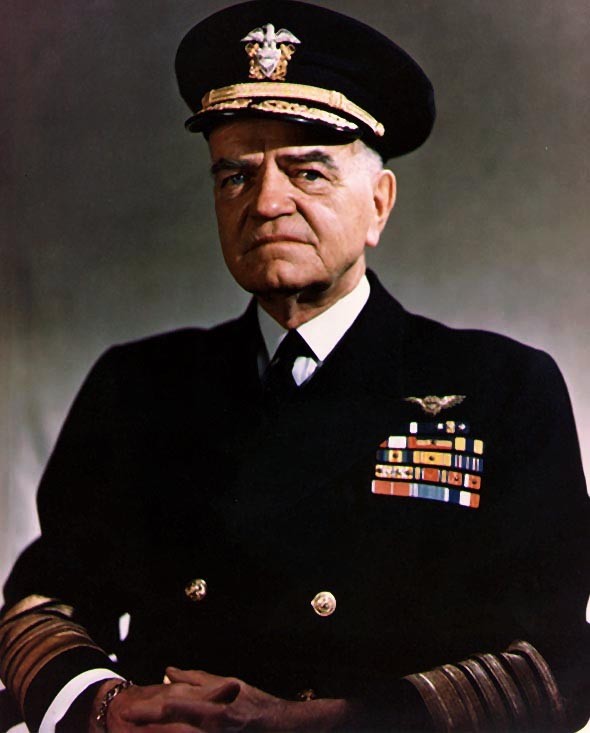
William Frederick Halsey, Jr., was born in Elizabeth, New Jersey, on 30 October 1882, the son of a Navy captain. He studied medicine for a year at the University of Virginia, then entered the Naval Academy and graduated in 1904, forty-third in a class of sixty-two. As a junior officer he made the cruise of the Great White Fleet and took part in the 1914 landing at Veracruz. In the First World War he commanded destroyers in the Atlantic, among them Shaw, escorting convoys and patrolling against submarines, and he received the Navy Cross.
After the war he served as naval attaché in Germany, as executive officer of the battleship Wyoming, and in destroyer command, and he completed the course at the Naval War College. In 1934 he reported to Pensacola for flight training, because an aviation qualification was required before he could command a carrier. He took the full pilot course and was designated a naval aviator on 15 May 1935, at the age of fifty-two. He became captain of Saratoga on 6 July 1935 and was relieved on 9 June 1937. For those two years the carrier and her air group were his ship to command.
He next commanded the naval air station at Pensacola. Promoted to rear admiral on 1 March 1938, he led carrier divisions with his flag in Yorktown and again in Saratoga. In 1940 he became a vice admiral and Commander, Aircraft, Battle Force, flying his flag in Enterprise. He was at sea in her, homeward bound from a flight-ferry run to Wake, when the Japanese attacked Pearl Harbor. In the first months of 1942 his carriers struck the Marshalls, the Gilberts, Wake, and Marcus. In April he took Enterprise to sea with Hornet and commanded the force that carried Army bombers into range of Tokyo.
A severe skin disease put him in the hospital before Midway. On his recommendation, Rear Admiral Raymond A. Spruance took that task force into the battle. On 18 October 1942 Halsey became Commander, South Pacific, with his headquarters at Noumea, and during that command the Navy promoted him to admiral. The job was to hold Guadalcanal and then push up the Solomons. On the nights of 13 and 15 November 1942, when the heavy surface actions were fought off the island, he was at Noumea. He ordered the ships to sortie. He remained ashore, out of the battle line. Guadalcanal held, and the South Pacific offensive continued under his direction into 1944.
In June 1944 he was given the Third Fleet. From the autumn of that year the fleet struck the Palaus, Formosa, and the Philippines. For the Leyte landings in October 1944 his flag flew in the battleship New Jersey. He was the fleet commander embarked in her, and he was not her captain. New Jersey stayed with the fast battleships east of the Philippines. Planes from his carriers attacked the Japanese force in the Sibuyan Sea, and New Jersey was not in that strike. He was not in Surigao Strait, where other battleships met the Japanese southern force, and he was not in the gunfight off Samar. He took the fast battleships north against the Japanese carriers.
In December 1944 the Third Fleet sailed into a typhoon east of the Philippines. The destroyers Hull, Monaghan, and Spence went down, and many men were lost. A court of inquiry found fault with his handling of the fleet in the storm. He kept command, led a raid into the South China Sea in January 1945, and then turned the ships over. He did not take the Third Fleet back until late May 1945. The battle for Okinawa was fought in that interval, under Admiral Spruance and the Fifth Fleet, and it was not Halsey's battle. In mid-May 1945 his flag was in Missouri. He was not her captain.
Late in May 1945 he resumed the Third Fleet, still flying his flag in Missouri, and through the summer the fleet hit the Japanese home islands by air attack and by gunfire. On 2 September 1945, in Tokyo Bay, he shifted his personal flag to Iowa so that Chester William Nimitz could hoist his flag in Missouri. Halsey was not the captain of either battleship. Command of Missouri rested with Stuart S. Murray. Halsey attended the surrender ceremony aboard Missouri as commander of the Third Fleet, and his flag flew that day in Iowa.
In December 1945 he was promoted to fleet admiral. Newspapers called him Bull. In the Navy he was Bill, and his standing order was to hit hard, hit fast, and hit often. His name rested on the early carrier raids, on the shore command that held Guadalcanal, and on the Third Fleet's sweep across the western Pacific, along with the arguments that followed Leyte Gulf and the typhoon. He died at Fishers Island, New York, on 16 August 1959, and was buried at Arlington National Cemetery.