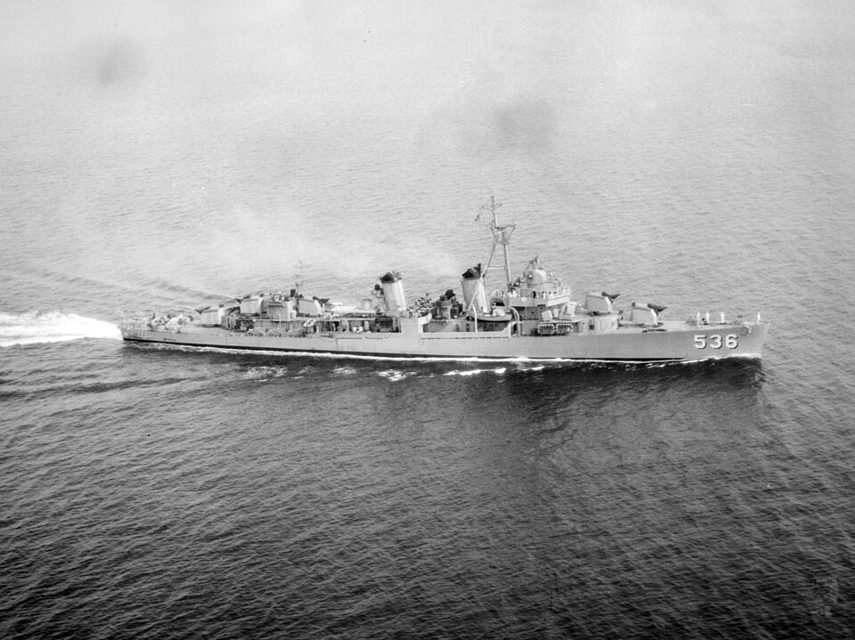
USS Owen (DD-536) was a Fletcher-class destroyer. She was launched on 21 March 1943 and commissioned on 20 September 1943, with R. W. Wood as captain from that day. In the Second World War she took the ships in her care out to their targets, remained with them while aircraft bombed in a dive, strafed, and launched torpedoes, and covered them as they drew off.
She left Pearl Harbor on 16 January 1944 for the Marshalls. From 29 January to 3 February she guarded the carriers of Task Group 58.2 during their work off Kwajalein, then fell back on Majuro. Sailing from that anchorage, the group struck Truk on 16 February, called briefly at Pearl Harbor, and was back at Majuro around the middle of March. On 22 March the carriers put to sea with battleships and cruisers in company and destroyers drawn in a circle about them. Owen held a station on the outside of that circle. Palau, Yap, Ulithi, and Woleai were struck from 29 March to 1 April. The ships returned to Majuro and then went on to New Guinea, where on 21 and 22 April they backed an Army assault with blows at Hollandia, Wakde, Sewar, and Sarmi. Truk, Satawan, and Ponape followed from 29 April to 1 May, and Marcus and Wake from 19 May to 23 May. The force then made ready for the Marianas.
On 6 June the carrier force left Majuro again. From 11 May through 17 May, ships and planes ranged from the Volcano and Bonin Islands down to the southern Marianas while troops went ashore on Saipan. On the 17th, after Owen had screened the carriers for strikes on Saipan, Tinian, Rota, and Guam, word came that a Japanese fleet was on the way from the Philippines. Screening went on through 18 May. Enemy dive bombers began the Battle of the Philippine Sea on 19 May. For the two days of that fight, which left Japan’s sea-borne air arm permanently broken, she stayed at her protective station around Bunker Hill.
Pagan Island was hit before a short upkeep at Eniwetok. In July the force attacked Iwo Jima and Chichi Jima, then Palau, Ulithi, and Yap. August brought further work among the Marianas and the Bonins. Raids in September reached Palau, Mindanao, Leyte, Luzon, and Samar in connection with the Palau campaign, and October opened with a sweep through the East China Sea and the South China Sea. On 20 October the force supported the landings on Leyte and Samar. Boiler trouble kept Owen from that China Seas sweep, and she rejoined in time for the Leyte landings. On 25 October, for a time with Task Group 34.5, she sailed to help Task Force 77 ships already in action against enemy forces trying to enter Leyte Gulf. A little past midnight, near the eastern entrance of San Bernardino Strait, fire was opened on the Japanese destroyer Nowaki. The gun duel ran through several exchanges until Owen and Miller closed in and struck the last blows. They were done in less than twenty minutes. Nowaki went down with her whole company, and with her the survivors of Chikuma who had been taken aboard the day before.
Raids on Philippine targets continued into November. On 25 November the force drew back to Ulithi, and on 11 December it sailed to cover the amphibious operation against Mindoro. Formosa was struck before the ships returned to Philippine waters for the landings in Lingayen Gulf. After the assault on Luzon, sorties into the South China Sea and the East China Sea grew heavier. Installations were blasted repeatedly from Saigon out to the Ryukyus, and the ships often ran north against Japan’s industrial heart. From 19 to 21 February 1945 the force covered the assault at Iwo Jima, then turned west to pound the Tokyo plain. Toward the middle of March a harder run of raids on the Ryukyus and Japan was well along, clearing the way for an invasion force.
On 19 March a Japanese dive bomber slipped through the screen and struck Franklin with a direct hit. When the rescue work was over, Owen was sent with other ships to take the damaged carrier back to Ulithi. She left Ulithi on 5 April for her last wartime operation. For the next fifty-three days she screened Task Group 58.2 while that group gave air cover to forces in the battle of Okinawa and sent raids against Kyushu. On 28 May she left those hard-fought waters, steamed south, and anchored in Leyte Gulf. On 20 June she set a course for home. She reached San Francisco, California, on 9 July and was still there when the war ended.
She was assigned to the 19th Fleet, the Pacific Reserve Fleet, decommissioned on 10 December 1946, and was laid up at San Diego. She remained in reserve until the Korean War. Recommissioned on 17 August 1951, she became flagship of Destroyer Division 282 and in November reported for duty with the Atlantic Fleet. Cold-weather operations in the North Atlantic early in 1952 were followed by an overhaul at Charleston Naval Shipyard and by training in the Caribbean. On 7 January 1953 the division sailed for the Far East, passed through the Panama Canal, and arrived at Sasebo, Japan, on 12 February. She joined the Seventh Fleet and went at once to operations off Korea. Her five months with the United Nations force were divided between the fast carriers of Task Group 77 and Task Force 95, the blockade and escort force. With the carriers she screened and served as plane guard, in the pattern of her earlier war. With Task Force 95 she patrolled from Wonsan to Chongjin and served as flagship for the defense and blockade units at Yong Do and at Wonsan. That duty included defense of friendly islands, patrol along the coast, shore bombardment to quiet enemy batteries and hinder their transport and communications, and the destruction of mines.
On 26 June she left Sasebo for Norfolk by way of the Suez Canal and finished a voyage around the world on 22 August. She remained on the Atlantic coast until January 1954. Three months in the Mediterranean followed, and she spent the rest of that year in the western Atlantic. In January 1955 she transferred to the Pacific Fleet and made port at Long Beach on 26 January. Her division was then redesignated Destroyer Division 192. From 1955 to 1958 she alternated training on the eastern side of the Pacific and shipyard overhauls with deployments to the western Pacific. In December 1957 she returned from her last Seventh Fleet deployment and reported for inactivation. Owen survived the war. She was sold for scrap on 27 November 1973.