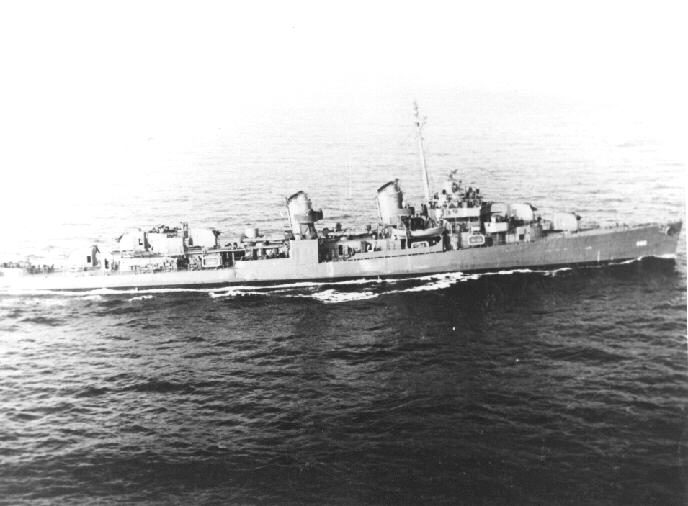
USS Picking (DD-685) was a Fletcher-class destroyer. She was launched on 1 June 1943 and commissioned on 21 September 1943. Raymond Starr Lamb was her captain from that day until 12 August 1944, when Benedict Joseph Semmes relieved him.
She worked up off Bermuda, passed through the Panama Canal, and reached Dutch Harbor, Alaska, on 28 December 1943 for duty with Destroyer Squadron 49 in the North Pacific Fleet. Her guns fired on Paramushiro in the Kuriles on 4 February 1944, on Matsuwa on 13 June, and on Paramushiro again on 26 June. In August she went to San Francisco for upkeep, then to Hawaii, entering Pearl Harbor on the 31st to join the 3rd Fleet.
Escort of attack transports brought her to Manus on 3 October. With the 7th Fleet she covered the southern landings at Leyte on 20 October. While she guarded unloaded transports bound for Hollandia, New Guinea, her gunners brought down one aircraft on 24 October. Word of the Battle off Samar sent her hurrying to help, and on 25 October she and Hale together shot down another plane. After the Battle for Leyte Gulf she took Mount Olympus and Auriga back to Manus, then returned to Leyte on 20 November to watch convoys carrying reinforcements.
On 9 January 1945 she gave antiaircraft cover over the Lingayen Gulf beachhead. She screened the landings at San Antonio on 29 January, and on 15 February she furnished gunfire and a screen as troops went ashore at Mariveles, doing the same at Corregidor the next day. After replenishment at Leyte she was off Kerama Retto in the Ryukyus on 26 March and covered the transports during that morning's landings. From 1 April she was on fire-support duty and shelled Japanese positions on Okinawa. She downed two aircraft on 6 April and another on 9 April, and on 17 April she pulled a Navy aviator from the water. On 18 May, off Naha, she took aboard survivors from the destroyer Longshaw. Fire-support duty ended on 7 June. She stood radar picket until 23 June, then sailed for Saipan. Charles Thomas Mauro Aug was her captain in 1945, through her decommissioning on 20 December.
She was back in San Francisco as the war closed. On 20 December 1945 she left commission and entered the Pacific Reserve Fleet at San Diego. Five battle stars marked her World War II service.
The Korean War returned her to sea. She recommissioned on 26 January 1951, operated from Newport, Rhode Island, and reached Yokosuka, Japan, on 4 May 1953. Off Korea she worked with Task Forces 77 and 95, bombarding the shore while with 95, and she saved a naval aviator. With that duty finished she left Sasebo on 5 August, passed the Suez Canal, and arrived at Boston on 2 October. Korean service brought one battle star.
Stateside operations filled 1954. On 5 January 1955 she sailed for European and Mediterranean duty. Working from Derry in Northern Ireland, her crew studied British methods of convoy escort, then she served with the 6th Fleet and returned to Newport on 26 May. Shifted to the Pacific Fleet, she reached Long Beach, California, on 15 April 1956. She left on 5 June for a 7th Fleet tour that included a Taiwan patrol and was home on 18 November. Another Far East cruise ran from 13 August until 24 January 1958. From 8 October 1958 to 27 March 1959 she deployed with an antisubmarine hunter-killer group led by the carrier Yorktown, and during that tour she carried emergency supplies to Koniya, a Japanese town damaged by fire. That fall she joined Canadian forces in antisubmarine exercises off the west coast. Further western Pacific deployments ran from January to June 1960 and from August 1961 to February 1962. In October 1962, during the Cuban Missile Crisis, she escorted the carrier Ranger. East Coast operations and training filled 1963.
On 13 March 1964 she deployed with the 7th Fleet and, after the Gulf of Tonkin incident, escorted ships off Vietnam before returning to Long Beach on 2 October. She sailed again on 10 July 1965 and reached Dixie Station off Vietnam on 11 September. Through September and November she shelled enemy positions in South Vietnam, then came home on 16 December. Training and local operations occupied 1966. She departed on 27 December and bombarded military, naval, and supply targets in North and South Vietnam, sinking several logistical craft in coastal waters off North Vietnam. Antisubmarine and gunnery training off the west coast filled 1967. In February 1968 she headed west and arrived at Yankee Station on 25 April. Gunfire support off South Vietnam and a return to Yankee Station followed, and she reached Long Beach on 17 August. Pacific Fleet duty continued through 1969. She decommissioned at Long Beach on 6 September 1969 and entered the Reserve Fleet. Her name left the Navy list on 1 March 1975, and on 27 February 1997 the hull was sunk as a target.