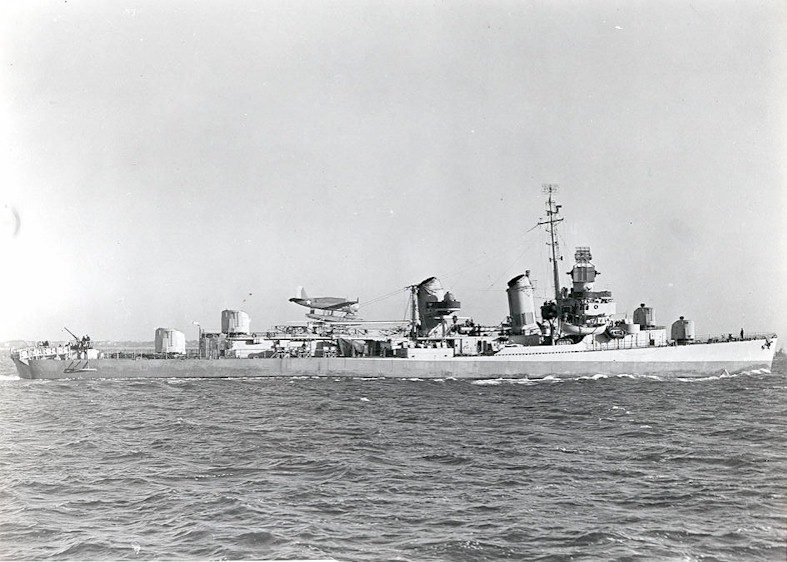
USS Pringle (DD-477) was a Fletcher-class destroyer. She was launched on 2 May 1942 and commissioned on 15 September 1942, with Harold O. Larson in command from that day. Of six ships once planned for the experiment, she was one of three Fletchers fitted with a catapult and a floatplane.
The catapult and its crane stood immediately behind the second funnel. That gear occupied the after torpedo-tube position, the third 5-inch gun, and the upper level of the after deckhouse, the usual place on most of the class for a twin 40 mm anti-aircraft mount. The twin 40 mm instead stood on the fantail, ahead of the depth-charge racks, a spot sister ships more often gave to 20 mm guns. The aircraft was to scout ahead of whatever flotilla she joined: it would leave on the catapult, alight in the water alongside, and come aboard again on the crane. Among the five destroyers that in time carried this catapult, Pringle was the first to use it on operations. Design faults in the derrick kept the Kingfisher from being recovered. Stevens and Halford, finished in 1943, were given a revised derrick, and Stevens was first among those five both to send the plane off and to get it back. Later, each of them was altered to a conventional Fletcher layout.
Once her shakedown was over, she met convoy ON 154 in the mid-Atlantic on 1 January 1943 and escorted the portion bound for Halifax. On that duty she became the first American destroyer to fly an airplane from a catapult, sending the floatplane out to look for submarines. Hauling the aircraft back aboard, in the weather then running and on a hull of her size, was a hard job. After Halifax she went into Charleston Naval Shipyard for a short overhaul, and the catapult came off so she matched an ordinary Fletcher. On 6 February she sailed for the Pacific, escorting the British carrier HMS Victorious onward from the Norfolk Navy Yard.
She reached the waters off Guadalcanal on 30 May and began patrol work in the Solomons. On the night of 17–18 July, in company with Waller and Saufley, she went after a trio of Japanese destroyers near Vanga Point, Kolombangara. Several of her torpedoes hit, and she brought down one Japanese aircraft. As the fighting in the Solomons ran on into August, she screened the leading ships of the force assaulting Vella Lavella, shepherded LSTs through Gizo Strait, and on the 24th covered a mine plant off Kolombangara within reach of Japanese guns. During the night of 3–4 September she and Dyson hunted barges on the run from Gambi Head on Choiseul toward Kolombangara and sank three. On 11 November, ten days after the first troops had landed at Empress Augusta Bay on Bougainville, she brought Task Group 31.7 into the bay, destroyed one enemy plane, and damaged a second. A voyage to Sydney late in January 1944 broke an otherwise steady stay in the Solomons. Early in March she worked the southwest Bougainville coast by daylight, shelling enemy positions and barges left on the beach.
In the Marianas she spent a long stretch firing at shore targets, screening other ships, and hunting submarines. At Saipan and at Tinian her guns supported the landings. She then went to San Francisco for a refit while the crew rested. With the Mare Island Naval Shipyard overhaul behind her, she put to sea for Pearl Harbor on 19 October. On 10 November she left Pearl Harbor for the Philippines and the landing operation then approaching. Between 27 and 28 November her guns worked over enemy positions along the shore by Ormoc Bay on Leyte, and during that spell she brought down a Japanese airplane. On 27 November, Pringle, Saufley, Waller, and Renshaw together destroyed the Imperial Japanese Army transport submarine Maru-Yu No. 2. The next day, 28 November, those destroyers sank I-46.
From 27 through 30 December, on escort with a supply echelon bound for Mindoro, she met the heaviest air attack of her service. Other vessels in the formation were lost. Her gunners destroyed two aircraft. On the 30th a kamikaze struck the after deckhouse. Eleven men were killed and twenty wounded. The hit wiped out one 40 mm mount and damaged two 5-inch mounts. Repairs done, she returned to duty in February, guarded transports for the assault at Iwo Jima on the 17th, and then fired in support of the Marines ashore. She was back at Ulithi on 4 March, getting ready for Okinawa.
Serving in Destroyer Division 90, she screened the waters where the transports lay, covered minesweepers, and delivered support fire. Radar picket duty came on 15 April. On 16 April 1945 two kamikazes fell to her guns before a third hit the bridge and ripped along the superstructure deck behind the base of the forward stack. Either one bomb of 1,000 pounds or two of 500 pounds passed down through the main deck and the superstructure deck and detonated. The blast bent the keel and tore the ship apart at the forward fireroom. Within six minutes she was gone, watched under by 258 survivors. Sixty-nine men were killed. Ten battle stars marked her World War II service.