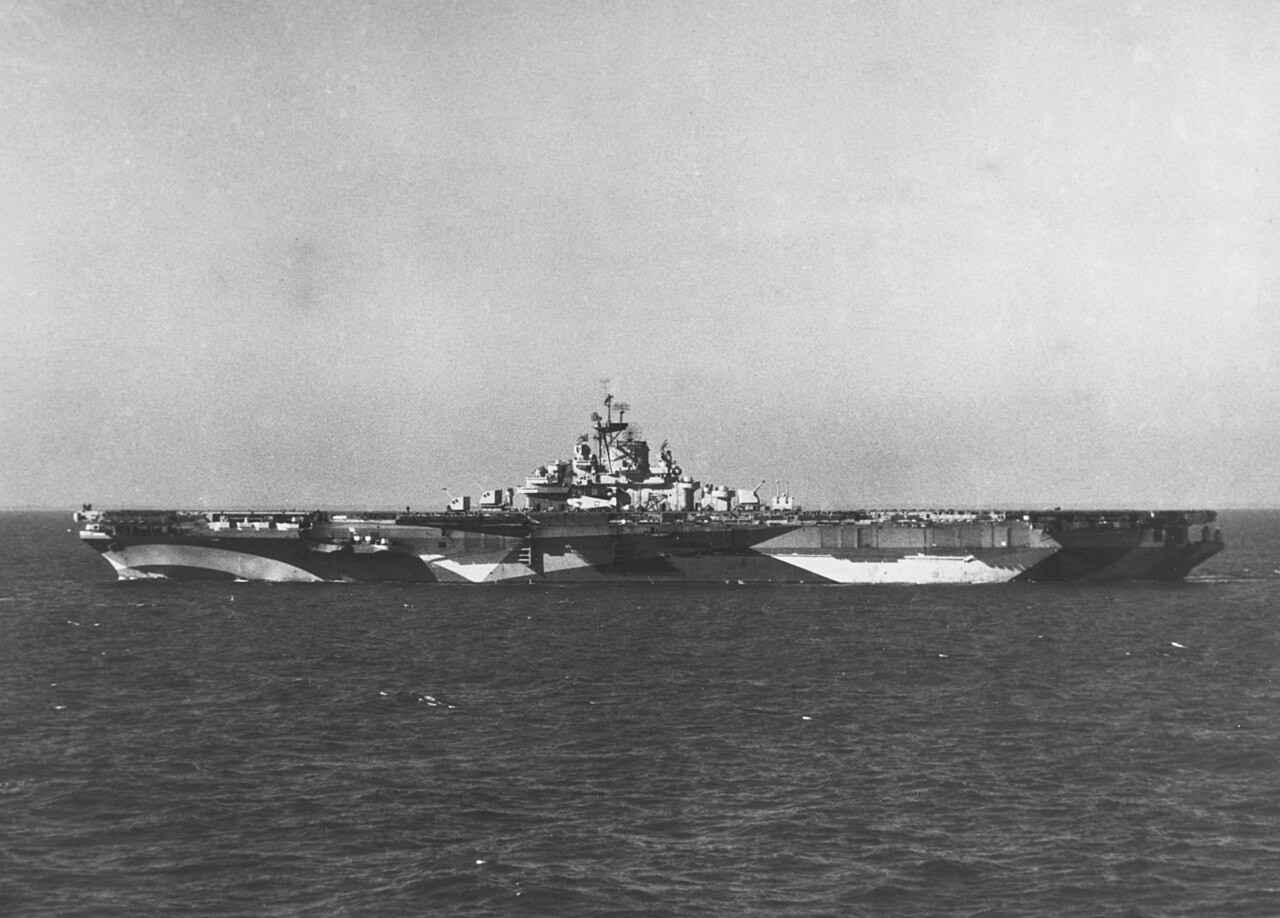
Building and namesake
Randolph was the second Navy ship of the name. She honored Peyton Randolph of Virginia, president of the First Continental Congress. She was laid down in Shipway 10 at Newport News Shipbuilding and Dry Dock Company on 10 May 1943, launched on 28 June 1944, sponsored by Rose Gillette, wife of Senator Guy M. Gillette of Iowa, and commissioned on 9 October 1944. She was one of the "long-hull" Essex-class carriers.
Into battle
She left San Francisco on 20 January 1945 and sortied from Ulithi with Task Force 58 on 10 February. On 16–17 February she struck Tokyo's airfields and the Tachikawa engine plant, the first carrier raids on Tokyo since Doolittle. On 20 February she flew three sweeps over Iwo Jima for the invading Marines and two over Haha Jima, and she kept up strikes and nearly continuous fighter patrols for four more days.
The Ulithi attack
On the night of 11 March 1945, while she lay at anchor at Ulithi, a twin-engine P1Y1 "Frances" bomber of the Japanese long-range Operation Tan No. 2 crashed into her starboard side aft, just below the flight deck. Twenty-seven men died. Four were missing, and five died later in the hospital ship Relief. Another 105 were wounded. She could still launch and recover aircraft, so the repair crews concentrated on her stern, replacing hangar-deck steel, elevator framing and flight-deck supports that the fires had warped or destroyed. Working around the clock, they finished on 1 April, the day the Okinawa landings began.
Okinawa and Japan
From 2 April her planes supported the troops on Okinawa and swept Kyūshū airfields. In May she hit the Ryukyus, the Kikai naval base, and Kyūshū. With Carrier Air Group 16 replacing Air Group 12, she launched eight raids on Tokyo-area airfields on 10 July. On 14 July her planes struck the Tsugaru Strait, sinking two of the vital Honshū–Hokkaidō train ferries and damaging three. On 24 July, in the Inland Sea sweep off Shikoku, the battleship-carrier Hyūga was heavily damaged. Her last strike hit Kisarazu airfield on the morning of the 15 August surrender. She earned three battle stars.
Postwar
She trained reservists and midshipmen, cruised to the Mediterranean in 1946 and northern Europe in 1947, and was decommissioned into reserve at Philadelphia on 25 February 1948. She was modernized, reclassified CVA-15 on 1 October 1952, and recommissioned on 1 July 1953. She then served in the Atlantic, Mediterranean and Caribbean and later became an antisubmarine carrier (CVS-15). In July 1961 she recovered astronaut Virgil "Gus" Grissom after his suborbital flight. In February 1962 she was primary recovery ship for John Glenn's flight, the first American orbital mission. On 27 October 1962, during the Cuban Missile Crisis, she and eleven destroyers cornered the Soviet submarine B-59 and dropped practice depth charges to force it up. B-59 carried a nuclear torpedo. Her captain, Valentin Savitsky, reportedly prepared to fire it, believing war had begun, but Second Captain Vasily Arkhipov persuaded him to surface instead. Randolph was decommissioned at Boston on 13 February 1969 and sold for scrap in 1975.
Sources
Wikipedia, "USS Randolph (CV-15)" (citing DANFS; Savranskaya on B-59).
NHHC/DANFS, "Randolph II."
Flag: "First raids on Tokyo since Doolittle" and "Tan No. 2" both come from the general record. The extract truncates the operation name. Check before publishing.