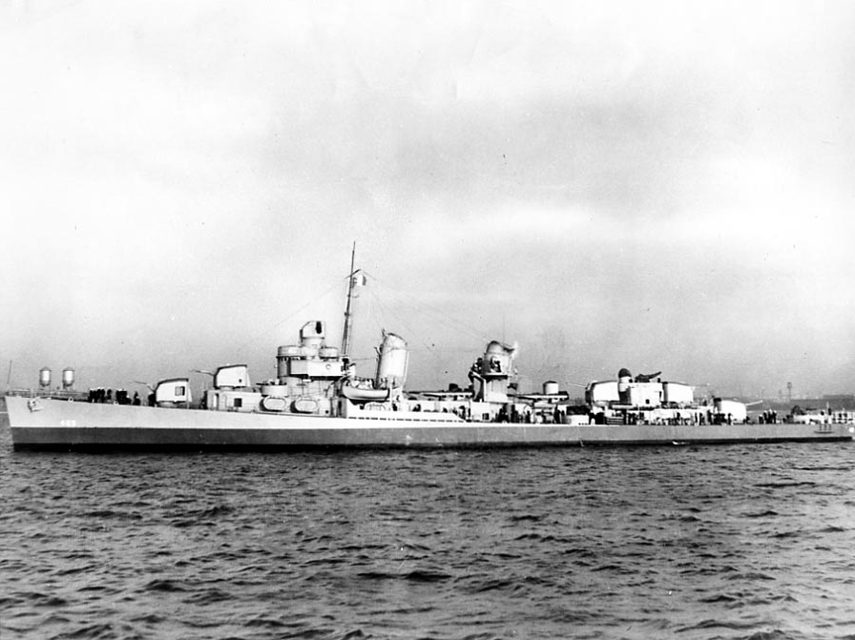
USS Saufley (DD-465) was a Fletcher-class destroyer. She was launched on 19 July 1942 and commissioned on 29 August 1942, the day Captain Bert Franklin Brown took command. He remained in command until 6 December 1943. After working up off the northern New England coast, she ran escorts along the seaboard and made ready for the South Pacific. She left Norfolk on 9 November, reached Nouméa, New Caledonia, on 2 December, and three days later entered the Guadalcanal campaign.
Her early duty was shepherding reinforcements from Espiritu Santo to Lunga Point. She soon swept for enemy shipping in the waters north and west of Guadalcanal and shelled positions on the island. During the Japanese withdrawal from Guadalcanal in late January and early February 1943 she operated with Task Force 11. On 19 February she sailed to join ships staging for Operation Cleanslate, the occupation of the Russell Islands. She carried troops, towed landing craft to the beaches, and bombarded the shore as the troops landed on Pavuvu and Banika on 21 February. Planes flying from those islands could cover the later move against Rendova.
In March she returned to escort and antisubmarine work among the southern Solomons, New Caledonia, and the New Hebrides. A short upkeep period at Sydney was followed by a return to Nouméa and more escort duty through the end of June. On 30 June, as Allied forces closed on Rendova, she shelled Japanese installations ashore. July and August brought assault operations against New Georgia and escort runs to the New Hebrides and Vella Lavella. On 31 August near misses from shore batteries in the Slot left her lightly damaged, and no one aboard was hurt.
At 10:11 on 15 September, bound for Espiritu Santo with Montgomery and two merchant ships, she sighted a torpedo wake. Montgomery’s sound gear was out of action, so Saufley searched back along the wake and, over the next three and a half hours, made five depth-charge attacks. At 14:43 the Japanese submarine Ro-101 surfaced. Saufley’s five-inch guns and machine guns fired on the conning tower. A PBY flying boat dropped two depth charges: one fell clear, and the second struck the submarine, which disappeared at 14:46. Her crew then heard a heavy underwater blast. By 17:35 a slick of diesel oil covered about one square nautical mile, centered near 10°57′S, 163°56′E. Through the rest of September and well into October she patrolled at night against barges between Kolombangara and Choiseul and sank four. On the night of 1 October Japanese bombs damaged her, killing two men and wounding eleven.
Captain Dale Eugene Cochran relieved Brown on 6 December 1943. Through November and December 1943 and January 1944, Saufley escorted reinforcements for Bougainville. In February she joined the assault on the Green Islands, which severed the Japanese supply line between Rabaul and Buka and gave the Allies another airfield near Rabaul. Antisubmarine patrols gave way to call-fire during the occupation of Emirau Island. That landing closed the ring around Rabaul and kept her engaged into April. Back in the Emirau–Mussau area on the morning of 7 April, the ship gained contact on a submerged submarine. Forty-five minutes and eighteen depth charges later, two explosions were heard below, and within hours oil covered the area. A postwar reading of Japanese records identified the boat as the Type J1 submarine I-2.
Escort duty to the Admiralties followed. She returned to Purvis Bay on 18 April and exercised with Task Force 38 into May. On 4 May she sailed for Pearl Harbor, arriving on 12 May, and on 1 June she headed west in Task Group 51.18, the reserve for Operation Forager, the seizure of the Marianas. On 16 June, the day after the landings, she and the other escorts brought their charges into the transport unloading area west of Saipan, and she was then shifted to call fire. For the next month she provided call fire, screening, and shore bombardment around Saipan and Tinian. On 20 July she moved south for the invasion of Guam and furnished call fire for the assault troops. She was back at Tinian on 23 July and supported the landings there on 24 July. Over the following week she gave gunfire support and served as a radar picket. She stayed in the Marianas until 12 August, then sailed for California and reached San Francisco with Destroyer Squadron 22 at the end of the month. Overhaul lasted into October.
On 26 October she steamed west again and arrived at Ulithi Atoll on 17 November. She went on to Leyte Gulf, then into the Camotes Sea to search for a reported submarine. Shortly after she entered the area on 28 November, the Japanese Type C2 submarine I-46 was found on the surface off Pilar Point, Ponson Island. In a gun action with Renshaw, Waller, and Pringle, the submarine was reported sunk forty-five minutes later. A separate report holds that I-46 may instead have been sunk by Gridley and Helm on 28 October 1944. On 29 November a kamikaze attack killed one of Saufley’s men and did heavy damage to the hull.
Repairs in the Admiralties followed. On 2 January 1945 she met the Lingayen attack force. The formation entered the Sulu Sea on 7 January, and at dusk on the 8th she shot down a Japanese aircraft that attacked the ships. On the morning of 9 January the force stood into Lingayen Gulf, and she screened the assault waves as they landed. On the morning of 10 January she claimed a Val. Captain Francis William Silk took command on 12 February 1945, relieving Cochran. Saufley survived the war. On 20 February 1968 she was sunk as a target.