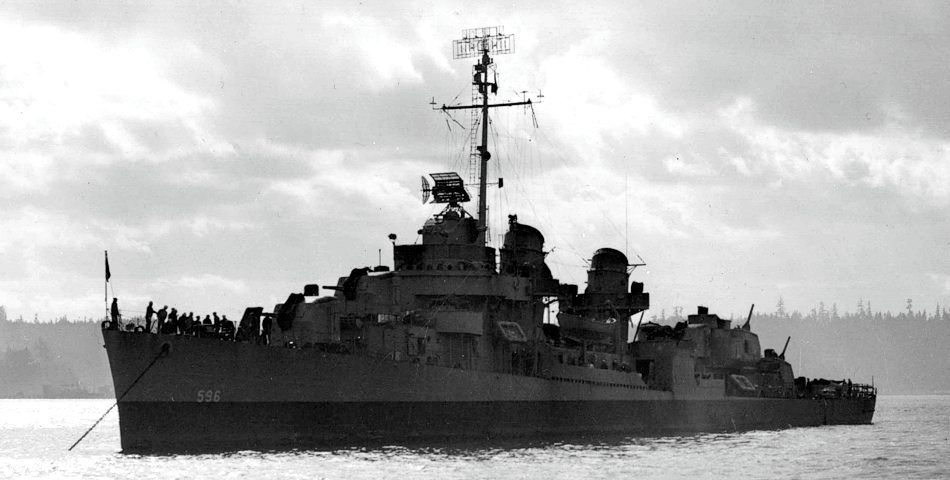
USS Shields (DD-596) was a Fletcher-class destroyer of the United States Navy. She was launched on 25 September 1944 and commissioned on 8 February 1945. George Bernard Madden was her first captain and served until 12 June 1945.
Shakedown lasted from 7 March to 18 April 1945 and included nine days screening the battleship Iowa. On 6 May she left Puget Sound. After several days of work near Pearl Harbor she sailed for Eniwetok Atoll with convoy PD-413-T. From 24 May to 15 August 1945 her wartime employment was convoy escort and area patrol among Eniwetok, Ulithi, Leyte, Okinawa, and Borneo. George Thornhill McDaniel took command on 12 June 1945. On 26 June her guns bombarded Japanese shore positions at Miri, Borneo, in aid of Australian troops fighting ashore.
She lay in Buckner Bay, Okinawa, on 15 August 1945 when the Commander in Chief, Pacific Ocean Areas, ordered offensive action against Japan to stop. A short passage took her to Leyte and Subic Bay and then back to Okinawa. She next joined Task Group 78.1 and escorted ships of Transport Squadron 17 as they carried occupation troops to Jinsen, Korea. The landing met no resistance. On 12 September she left Jinsen with Task Unit 71.5.1 for the waters off northern China. Through most of the rest of 1945 she stayed in the Gulf of Po Hai, joined naval demonstrations along that coast, and watched the unsettled port of Chefoo. Calls on that gulf included Chefoo and Chinwangto, Weihaiwei and Taku, and also Dairen and Port Arthur. Marcy Mathias DuPre became captain on 22 October 1945. She closed the cruise by escorting the carriers Antietam and Boxer to the outer limit of the Seventh Fleet area, then patrolled from Shanghai with the Yangtze River Patrol Force. On 19 February 1946 she reached San Pedro Bay in California, having paused at Eniwetok and at Pearl Harbor. She remained on the west coast until she was decommissioned and placed in reserve on 14 June 1946.
Laid up, she kept an in-service role in the reserve program. At the start of the Korean War she returned to active duty and was recommissioned on 15 July 1950. She arrived in the Far East in September 1951 on the first of three Korean tours, a cruise that ran into February 1952. Off the Korean coast near the bombline and Kojo she gave gunfire support to the First ROK Corps and to the First Marine Division, joined the assault on Kojo, and fired both harassing rounds and interdiction rounds. Her second tour began on 1 November 1952. Again she worked near the bombline, this time backing the Eighth Army as well as the First ROK Corps. Later she drilled in antisubmarine work off Japan and off Okinawa, and she finished the deployment by training Chinese Nationalist naval forces at Taiwan. After stops at Hong Kong and in Japan she was back in San Diego on 1 June 1953. For Korean service she received the Korean Presidential Unit Citation and three battle stars.
Six months on the west coast followed, and she then left for a third Far East cruise. Off Korea on 11 February 1954 she operated with Task Force 77 until 21 February, when she was sent on to the Philippines. During March and April she worked out of Subic Bay and patrolled the Indochina coast with Carrier Task Group 70.2. On 7 May she headed for Yokosuka, pausing at Hong Kong for a diplomatic call. After a week of tender upkeep at Yokosuka she sailed with Task Force 77 for battle exercises and returned to San Diego on 18 July 1954. From that date through 30 November 1963 she made seven deployments to the western Pacific. Between them she carried on ordinary destroyer duty from San Diego. In those years she took part when San Francisco commemorated the return of Theodore Roosevelt's Great White Fleet, and in August 1960 she earned the Battle Efficiency E for overall combat readiness.
On 30 November 1963 she left active fleet service and became a Naval Reserve training ship in Reserve Destroyer Squadron 27. Her full-time crew was cut by more than half. For the next eight years she worked with the Development and Training Command so reservists would keep their combat skills. A survey in March 1972 found that modernizing her would cost more than it was worth and that, left as she was, she had only slight further value to the Navy. She was decommissioned on 1 July 1972 and sold to Brazil. As the Brazilian destroyer Maranhão she served until she was scrapped in 1990.