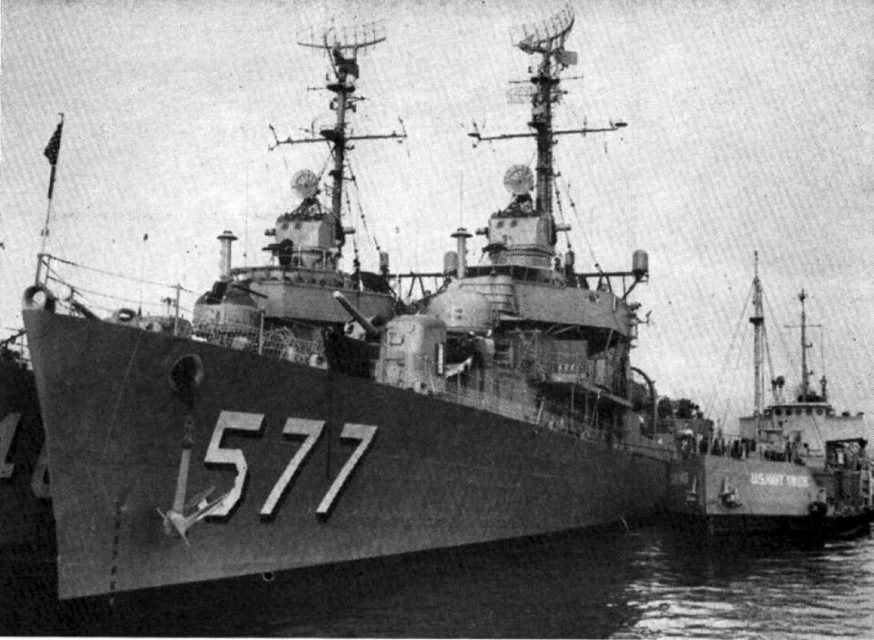
USS Sproston (DD-577) was a Fletcher-class destroyer of the United States Navy. She was launched on 31 August 1942 and commissioned on 19 May 1943. Fred Russell Stickney served as captain until 14 October 1943, when Michael Joseph Luosey relieved him. Her shakedown took her to Cuban waters. On 4 November 1943 she crossed the isthmus at Panama, made a short call at San Francisco, and on 15 November left for Pearl Harbor. Eleven days after that departure she set out for the Aleutians, and on 1 December she entered Kuluk Bay at Adak. She joined Destroyer Squadron 49, then serving in Task Force 94, and for two months the crew practiced gunnery and ran exercises.
On 1 February 1944 she sortied from Massacre Bay in Task Force 94, ordered to bombard targets in the Kurils. On 4 February her guns fired on Kurabu Point, in the Kurabu-Saki sector of Paramushiro. About a month later the force went north by way of the Sea of Okhotsk for another blow at those islands. Very heavy seas and bad visibility forced the ships to abandon the strike. Through the three months after that she searched Aleutian waters for submarines and kept patrol. On 10 June she was at sea for the Kurils once more and took part in shelling Matsuwa Island before daylight. On 26 June she fired on the airfield at Kurabu Zaki, toward Paramushiro's southern end. Leaving Sweeper Cove at Adak on 8 August, she spent two weeks in San Francisco, then shaped a course for the South Pacific, with calls at Pearl Harbor, Eniwetok, and Manus.
October found her in Task Unit 79.11.2, whose main duty was guarding transports of Task Group 79.2 as they operated off Dulag, on Leyte, in the opening move to free the Philippines. On 25 October, Hale (DD-642) and the transport Pickens (APA-190) adding their fire, Sproston brought down the first enemy airplane of her career. On 18 November, inside San Pedro Bay, the gunners destroyed two Zekes belonging to a raid of five aircraft. From late December 1944 into early January 1945 she patrolled the Lingayen region of central Luzon, and on 8 January yet another Japanese aircraft fell to her battery. She then shifted from Lingayen toward Zambales to support troops going ashore. She came into Subic Bay at 12:48 on 29 January and was believed the first American warship to enter after Japanese forces had occupied the bay. Work in the Philippines went on until 18 February, the day she was given escort duty. Robert John Esslinger had taken command on 6 February. A week at Guam kept her in Apra Harbor between 25 February and 1 March. She then left for Milne Bay and was again in Leyte Gulf by 13 March.
On 21 March she put to sea for Kerama Retto and for Okinawa Gunto in the Ryukyus. Relieving Heywood L. Edwards (DD-663) on 26 March, she began a stretch of picket work and patrols. That same evening a Jill was hit by her guns and drew away in flames. On 2 April call fire from the ship, directed at Makiminato Saki, destroyed two enemy pillboxes and a warehouse. On 4 April a bomb exploded fifty yards to port, a near miss that damaged the sonar and the Mk 1A computer serving the main battery. The crew suffered no casualties. Sonar was soon working again, while the main guns could be fought only under local control. Guam received her for repair of that computer, and she regained her station before two weeks were out. On 12 May, off Hagushi Beach, she fired sixteen rounds at an enemy plane, which caught fire and fell. On 28 May, in company with Wadsworth (DD-516), she accounted for two aircraft within the hour. Bradford (DD-545) lent her guns the next day, and Sproston splashed a further plane. On 6 June she rescued a flier from Gilbert Islands (CVE-107) after the escort carrier aircraft he had been flying was shot down.
On 28 June, steaming by herself toward overhaul in American waters, she took a signal from Antares (AKS-3) on the run between Saipan and Eniwetok. Antares was under attack by a submarine and asked for aid. Sproston arrived, made solid sonar contact at one thousand yards, and at five hundred yards saw a periscope travel from the starboard hand across to port. Her ram attempt missed. The contact was classed as a fleet submarine. A full depth-charge pattern went over the side, and a large slick of oil appeared later. Six added attacks showed nothing decisive. With the depth charges gone, a lookout caught a torpedo wake bearing sixty degrees off the bow on the port side. The destroyer turned sharply left, and the torpedo ran along the port side and cleared the ship. A periscope on the port quarter was then recognized as a kaiten, a suicide submarine. I-36, a Japanese fleet boat, had released it so the parent submarine could slip away. Two kaitens were put out from I-36, piloted by Ensign Kuge Minoru and FPO1C Yanagiya Hidemasa. The main battery opened as soon as the periscope was identified. A single salvo connected, set off a heavy secondary explosion, and sank the kaiten. LSM-197, LSM-196, and LC7-555 came up to cover the scene by radar through the night. Next morning the escorts Levy (DE-162), Roberts (DE-749), and Parks (DE-165) joined. After the area had been searched with care, every ship was sent on to the task it already held.
On 14 July 1945 Sproston made San Francisco, where a yard overhaul began and her crew started fitting her to leave active duty. Robert John Esslinger remained captain until 2 November 1945, when Robert Duane Karl relieved him. Around mid-December she changed base to San Diego. On 18 January 1946 her commission ended.
Communist troops had entered South Korea by the time Sproston returned to commissioned service on 15 September 1950, now numbered DDE-577. Training started with the Fleet Training Group at San Diego. In the early months of 1951 she left that port for Eniwetok and an atomic bomb test. July saw the test finished, after which Pearl Harbor became her home port. She then followed the usual pattern of Pacific Fleet destroyer life, with fleet, type, and single-ship exercises. A shipyard overhaul in the early part of 1952, and refresher work afterward, led to a departure on 2 June for the western Pacific. On 15 June she was placed in Task Force 77, the Seventh Fleet's striking force, and operated on Korea's eastern shore around Hungnam and Simpo. Across the half year that followed she joined the Taiwan Patrol in the spells when Task Force 77 did not have her.
On 5 December 1952 she was back at Pearl Harbor and settled into a steady operating schedule in Destroyer Squadron 25. During the decade that followed she completed nine cruises out to the Far East, serving with the Seventh Fleet. Most of those trips included time on the Taiwan Patrol, along with amphibious practice and other type training. Sproston survived the war. On 15 September 1971 she was sold as scrap.