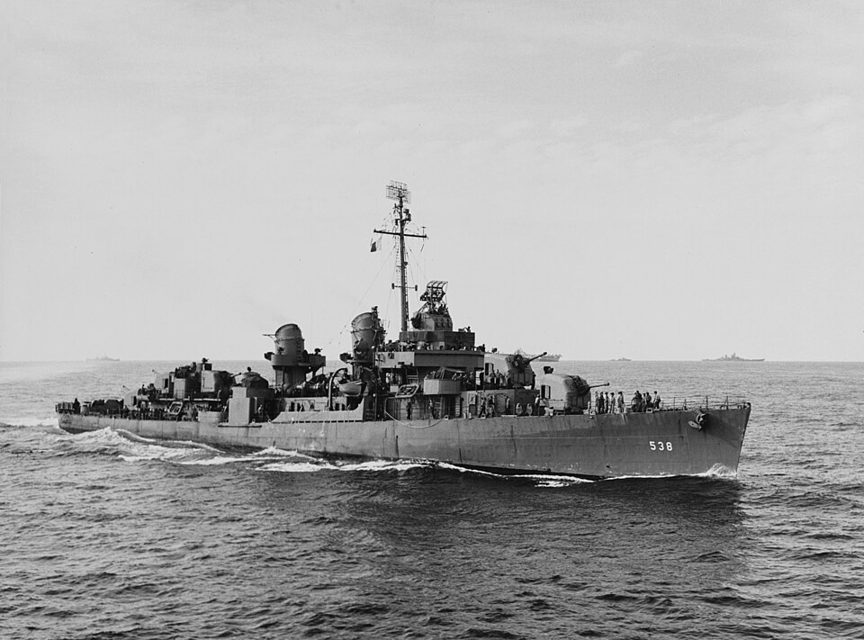
USS Stephen Potter (DD-538) was a Fletcher-class destroyer. Bethlehem Steel at San Francisco laid her keel on 27 October 1942. She was launched on 28 April 1943. Her sponsors were Sally and Marian Potter, nieces of Ensign Potter. The Navy commissioned her on 21 October 1943, and Captain Charles Helmick Crichton was her commanding officer from that day. She worked up off San Diego, was back in San Francisco on 8 December, sailed for Hawaii late in the month, and made Pearl Harbor on 31 December 1943.
She joined the Fast Carrier Task Force, numbered Task Force 58 or Task Force 38 according to whether the carriers were with Fifth Fleet or Third Fleet. The force put to sea on 16 January 1944 to strike the Marshall Islands. Those attacks opened on 29 January, ahead of the amphibious landing that began on 31 January. In February she stood in the carrier screen for the first blow at Truk, on the 17th and 18th. On the 17th an aircraft torpedo damaged Intrepid, and Stephen Potter saw the carrier back to the Marshalls. She left on 27 February, called at Pearl Harbor, and reached the West Coast on 13 March. Five days later she started the return passage to Majuro and rejoined the fast carriers.
On 21 and 22 April she screened the carriers while their planes supported the assault on Hollandia, New Guinea. Near the end of the month those ships went back to bomb Truk. On 30 April, south of the atoll, Stephen Potter was in company with Monterey and MacDonough when MacDonough gained a radar contact on a submarine. The boat submerged and the pip vanished. MacDonough held the target on sonar and delivered two depth-charge attacks. Stephen Potter came up and made an attack of her own, while an airplane from Monterey joined in. Deep explosions followed, and oil and debris rose as the submarine Ro-45 went down. On 1 May the destroyer took part in the shelling of Ponape, in the Carolines. After fuel and ammunition at Majuro, the force struck Marcus Island on 19 and 20 May. Captain Leonidas Walthall Pancoast relieved Crichton on 21 May. Wake Island was bombed on 23 May, and the ships then put in at Eniwetok to refit for the Marianas campaign.
Task Group 58.2 sailed on 6 June and, a week later, opened attacks on Saipan. On 17 June the task force moved into the Philippine Sea to head off a strong Japanese fleet that threatened the American effort to take Saipan. The Battle of the Philippine Sea, often called the Marianas Turkey Shoot, began on 19 June and lasted two days. In the course of it Stephen Potter picked up seven pilots who had come down. After five days of upkeep at Eniwetok, the ships hit targets in the Bonins, the Palaus, and the Carolines through July, then returned to the Marshalls to replenish. On 30 July she joined Task Group 58.4, which from 31 July to 8 August covered American troops fighting on Guam.
She steamed from Eniwetok on 30 August, met Task Group 38.2 on 3 September, and screened the fast carriers while their aircraft struck the Philippines from 9 to 25 September. The blows reached Mindanao, Luzon, Cebu, Leyte, Angaur, and Manila Bay. The group stayed at Ulithi from 1 to 6 October, then sailed again. Stephen Potter screened the carriers of Admiral Gerald F. Bogan for a strike on Okinawa on 10 October and for strikes on Formosa on 12, 13, and 14 October. On 13 October a torpedo hit Canberra under the armor belt and left her without power. Wichita took the cruiser in tow, and Stephen Potter was one of the escorts. The next day a torpedo struck Houston in the engine room. Boston took Houston in tow, and that pair joined the Canberra ships, now Task Unit 30.3.1, as they withdrew. On 15 October Munsee took the Canberra tow from Wichita. On 16 October Pawnee replaced Boston, and Houston was torpedoed a second time. Men who could be spared were taken off, and 83 of them came aboard Stephen Potter. On 20 October she left the damaged ships and rejoined Task Group 38.2, then bound for the Philippines to support the Allied landing on Leyte, which opened that day. Aircraft struck Luzon on 22 October, and the carriers turned toward Manus the next day.
On 1 November she went on to Ulithi by way of Saipan, met the fast carriers, and escorted them to the Philippines. From 11 to 25 November planes struck the Visayas, Manila, and Luzon, and the force then drew off. After a short rest at Ulithi, the group sailed on 11 December for waters east of Luzon to support the landing at Mindoro. Beginning on 14 December the carriers hit Luzon on three days in a row and, after fueling, were back at Ulithi on 24 December. Captain George Read Muse relieved Pancoast on 28 December 1944. On 30 December Stephen Potter got underway to join Task Group 38.2, headed for a point from which to attack Formosa. Strikes fell on Formosa and Okinawa across two days and, after the force moved southeast, on Luzon on 6 and 7 January 1945.
On 9 January she passed into the South China Sea with the carriers. Their aircraft struck Saigon and Camranh Bay in Indochina on 12 January and Formosa on 15 January, then Hainan and Hong Kong on 16 January. American planes photographed Okinawa from the air, and the ships retired to Ulithi. She sortied with Task Group 58.2 on 10 February and shared in carrier strikes on the Tokyo area on 16 and 17 February. From 19 through 22 February the carriers hit Iwo Jima in support of the landing there. Two days later they shaped course for Japan and, on 25 February, struck targets around Tokyo Bay, returning to Ulithi on 1 March. The group was at sea again on 14 March. Four days later it attacked airfields on Kyushu and shipping at Kobe and Kure, and the strikes continued on 19 March. Stephen Potter picked up a downed pilot on 18 March and another on 19 March. Japanese aircraft attacked the task group on both days, and the attacks kept up as the ships withdrew. Franklin was hit on 19 March, and Enterprise was hit the next day. Stephen Potter survived the war. Muse remained in command until 21 September 1945. She was sold for scrap on 27 November 1973.