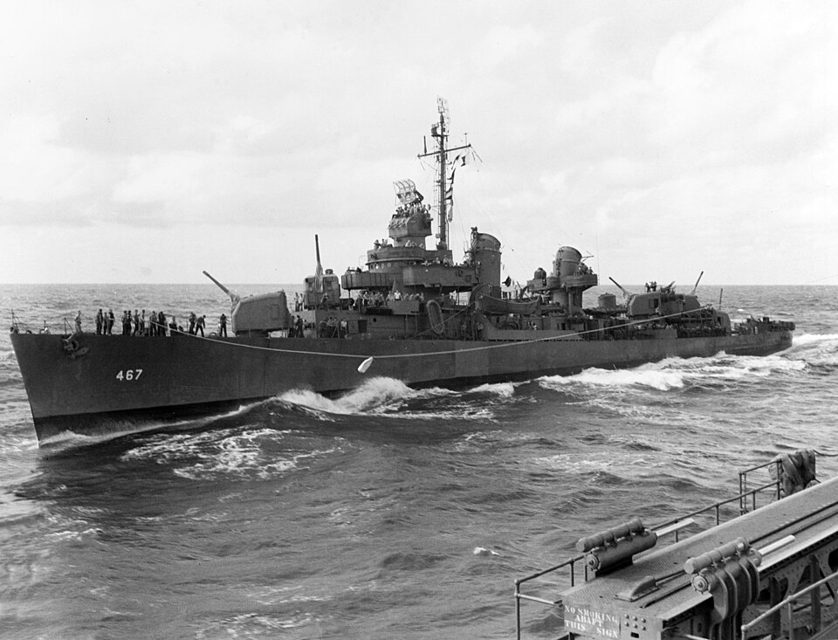
USS Strong (DD-467) was a Fletcher-class destroyer of the United States Navy. Her hull was laid down at Bath Iron Works in Bath, Maine, on 30 April 1941. She entered the water on 17 May 1942 with Mrs. Hobart Olson as sponsor, and she entered commission on 7 August 1942. Joseph H. Wellings was her captain from that date.
After she finished shaking down and working up, Strong left on 15 October in a convoy headed for San Juan, Puerto Rico. Norfolk saw her again on the 27th, and two days afterward she sailed for New York. On 13 November she went out in convoy UGS-2 toward North African ports, made Casablanca on 29 November, and came back to New York with convoy GUF-2. She spent 11 to 26 December in yard hands, then shifted to Norfolk.
On 27 December 1942 she sailed for the Pacific, passed through the Panama Canal, took on fuel at Bora Bora in the Society Islands, and on 27 January 1943 entered Nouméa. A northwest convoy kept her busy for two days until she was relieved and sent back. On 1 February she and Cony escorted a convoy to Espiritu Santo in the New Hebrides. From there she sailed on 5 February toward the Solomon Islands and kept watch off Guadalcanal through the 13th. She then joined Task Force 67, made up of four cruisers and the destroyers that screened them. Through most of the next month the ships stayed on patrol among the Solomon islands and in the water nearby.
On 14 March Strong, Nicholas, Radford, and Taylor left the force to bombard shore works on Kolombangara. On 16 March their guns were turned on the Vila Stanmore Plantation. They afterward returned to patrol. In the morning of 5 April Strong gained a surface radar contact at 9,350 yards, about 8,550 meters. The searchlight showed a target judged to be the Japanese submarine Ro-34. Strong and O'Bannon fired and claimed three hits with 5-inch shells. The boat sank by the stern. Two depth-charge patterns went over the side, and debris rose at 10°05′S 162°08′E.
In company with Task Force 18, Strong went along with three destroyers fitted as minelayers into Blackett Strait, the passage between Kolombangara and Arundel Island. Mines were laid there before dawn on 7 May. Next morning four Japanese destroyers rounded Kolombangara and steamed into the field. One sank on the spot. Two others, already hurt, were destroyed later by aircraft. The last of the four, though hard hit, slipped clear. Over the night of 12–13 May the task force, Strong with it, shelled Kolombangara, then began escort work and patrol off Guadalcanal. On the afternoon of 16 June, while she was about midway from Guadalcanal to Tulagi, some fifteen Japanese dive bombers attacked the American ships. Strong stood nearest as the planes came down in a shallow dive, and her gunners claimed three of them.
On the morning of 5 July American forces went ashore at Rice Anchorage. Strong, serving with Task Force 18, was to support that landing with gunfire against Vila-Stanmore, Enogai, and Bairoko. Nicholas and Strong pushed into Bairoko Harbor to search in front of the main body, and from 0030 to 0040 they shelled the harbor. A torpedo struck her port side nine minutes after that fire ended. Niizuki, a Japanese destroyer, had launched the spread from 11 nautical miles out, about 20 kilometers or 13 miles. That hit is believed to stand as the longest torpedo kill ever made.
Chevalier put her bow into Strong on purpose so nets and lines could be passed to the crippled ship, and 241 men were rescued. Japanese gunners ashore at Enogai saw them, threw star shells over the pair, and opened with high explosive. O'Bannon took the shore guns under counter-battery fire. Those guns were hitting Strong and Chevalier, and both ships were forced to draw off. Strong began settling fast, with a list of 40 to 60 degrees to starboard. She broke apart as the hull went down, and charges from her depth-charge racks detonated. Forty-six of the crew were killed. On 15 July 1943 the Navy struck her from its list.
In mid-February 2019 the research ship Petrel found the wreck in 300 meters of water, close to 980 feet. Strong is thoroughly broken up. The forward part, heavily damaged, lies on its port side within a compact field of debris that also holds what remains of the rest of her. In that scatter sit a wheelhouse in fairly sound condition, her torpedo tubes, the propellers together with their shafts, the 5-inch guns, the boilers, and at least one funnel that is still intact. She received two battle stars for her service in World War II.