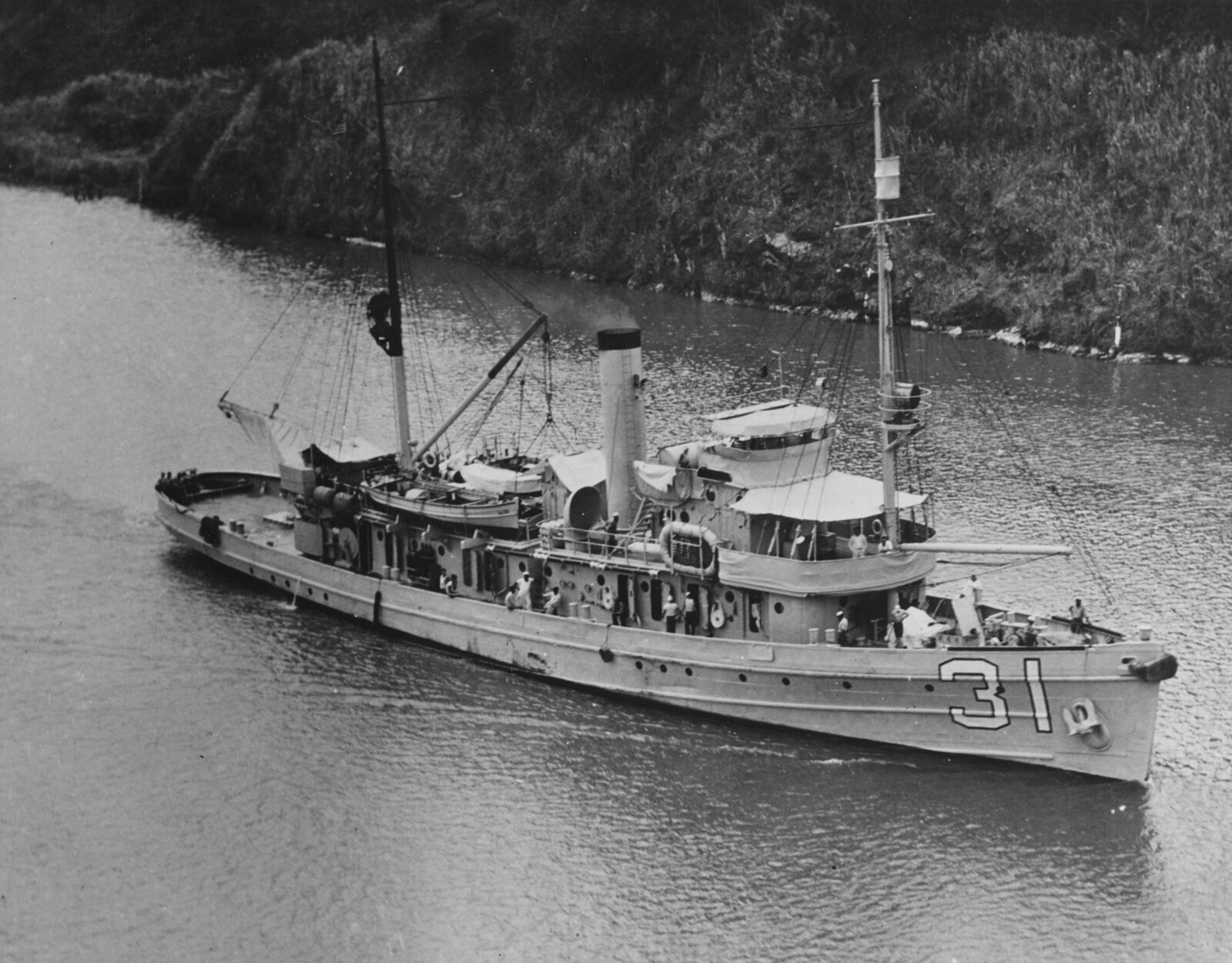
Tern, Mine Sweeper No. 31, was a Lapwing-class minesweeper, the second Navy ship of the name. DANFS gives her 950 tons, a length of 187 feet 10 inches, a beam of 35 feet 6 inches, a draft of 9 feet 9 inches, 14 knots, and an armament of one 1-pounder and two machine guns. The Gas Engine and Power Company and the C. L. Seabury Company at Morris Heights, New York, laid her down on 7 September 1918. She was launched on 22 March 1919, sponsored by Mrs. Bruce Scrimgeour, and commissioned on 17 May 1919 with Lieutenant Nels Drake in command. She was designated AM-31 on 17 July 1920.
She was assigned to the Pacific Fleet and joined Train Squadron 2, Fleet Base Force, at Pearl Harbor on 1 October 1919. The squadron supported the Battle Force for nine years. In July 1927 Tern and the squadron moved to San Diego. Six years later the base shifted to San Pedro. She stayed with Train Squadron 2, Base Force, and went with it to Pearl Harbor on 19 June 1941, when the squadron was assigned to Hawaii again. Lieutenant Walton Barclay Pendleton, Naval Academy class of 1921, had her from June 1939.
On 7 December 1941 she was not in the Coal Dock nest. Pendleton's report of 15 December, AM31/A9(242), says she was alongside the north end of Ten-Ten Dock, undergoing upkeep by Argonne. All machinery was dead. She was taking steam, water, and electricity from the dock. The upkeep was to have been finished at the close of working hours on 9 December. DANFS prints Argonne as AP-4. The Navy's list of ships present that morning carries Argonne as AG-31. She was notified of the attack at 0753 and made preparations to get underway. At 0805 she opened fire with .30 caliber Lewis machine guns. The 3-inch guns could not bear. The ship was heading east, and Argonne blanked them. The report says the plane she was firing at was seen to go down by the Officers' Club. It does not say Tern shot the plane down. She shifted fire. At 0815 the yard cut off lights, air, and steam. The men worked with flashlights. She got underway from dead firerooms in one hour and forty minutes. Boatswain J. A. Hein, USN, had the deck and took her from the dock into the stream. At 0943 she left the dock to pick up survivors and received 47. At 1050 she went to fight the fire on Arizona, then was shifted to West Virginia by orders from Maryland. Commander Hamilton, acting on orders from Maryland, put Tern's commanding officer in charge of the firefighting on West Virginia. At 1430 on Monday, 8 December, the fire on West Virginia was out and Tern went alongside Arizona. At 1235 on Tuesday, 9 December, the fire on Arizona was out. She went alongside Ramapo for fuel, filled to 95 percent, and by order of the Commander, Base Force, tied up alongside Nevada. At 1228 on Wednesday, 10 December, she left Nevada for the Coal Docks. Nevada did not need her. At 2040 she went from the Coal Dock to California. At 2110 she was released and returned to the Coal Docks with Turkey alongside. Turkey's steering gear had jammed and she could not proceed alone. Tern's own losses, damage, and casualties were none. Pendleton commended Ensign H. J. Perry, USNR, who had been in the Navy only a short time, and he named Hein and a list of enlisted men. NavSource's later commanding officer is Lieutenant Herbert James Perry, Jr., USN, from 1 April 1943. The report and the commanding-officer list do not say that the ensign and the lieutenant were the same man.
On 9 January 1942 she began towing a fuel-oil barge to Johnston Island, delivered it on the 13th, and returned to Pearl Harbor. On 9 February she left for the Society Islands, arrived at Bora Bora on the 18th, and served there as station ship. On 1 March the Base Force was renamed the Service Force, Pacific. On 1 June she was redesignated AT-142, an ocean tug. She stayed at Bora Bora until 2 January 1943, when Advent (AM-83) relieved her. She reached Pearl Harbor on 27 January and five weeks later left for San Pedro and an overhaul. She was back at Pearl Harbor on 23 May and joined the Service Squadron of the 3d Fleet in Hawaiian waters. For the next year she recovered training torpedoes, towed targets, and assisted other ships. On 15 May 1944 she was redesignated ATO-142. On 9 July she joined a convoy for the Marshalls, reached Eniwetok on the 28th, and for five months towed craft to Majuro, Tarawa, Ulithi, and Guam. On 4 January 1945 her base shifted to Ulithi. On 26 May she left for Leyte, arrived at San Pedro Bay on 1 June, and was assigned as a target-towing ship with Submarine Training, Pacific Fleet, at Guam. She reached Apra Harbor on 20 June and worked with submarines until 1 September, when Cormorant (ATO-133) relieved her. The next week she started home by Eniwetok and Pearl Harbor. She reached San Francisco in mid-October and prepared for inactivation. She was decommissioned on 23 November 1945 and struck on 5 December 1945. She received one battle star.
A note on sources. The career follows the DANFS entry for Tern II. The morning and the three days after it follow Pendleton's report of 15 December 1941, signed W. B. Pendleton, from the Modern Military Branch at the National Archives in College Park. DANFS says the plane was seen to crash near the Officers' Club. The report says it was seen to go down by the Officers' Club, and that is the sentence used here. DANFS does not mention the tow of Turkey on the night of 10 December, the dead machinery, or the 3-inch guns blanked by Argonne. Commanding officers are NavSource's list. Pendleton's Navy Cross is on that list without a year.