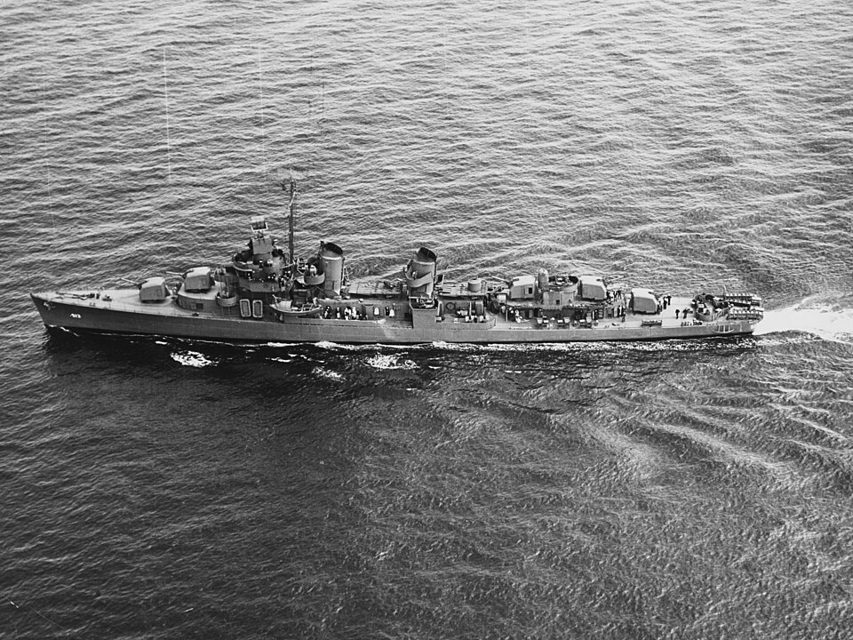
USS Terry (DD-513) was a Fletcher-class destroyer, the second United States Navy ship named for Commander Edward A. Terry (1839–1882). Bath Iron Works began her at Bath, Maine, on 8 June 1942. She was launched on 22 November 1942 with Mrs. Charles Nagel Jr. as sponsor, and she was commissioned at Boston on 26 January 1943. Captain George Richardson Phelan took command that day and held it into 1944.
February was spent fitting out at Boston. She ran her shakedown off Guantanamo Bay, then returned to Boston so the yard could finish what the cruise had shown still needed work. On 2 April she moved from Boston to Norfolk. Two days later she sailed north in a convoy screen for Naval Station Argentia, Newfoundland, arriving on 8 April and leaving the next morning. She fueled at Portland, Maine, on the 11th, and on the 12th she began hunting submarines off the northeastern coast.
On 18 April she met a German U-boat. A sound contact brought a depth-charge pattern, and she waited. Sonar then showed a torpedo coming straight at the bow. She turned away, and the torpedo ran past the stern. Oil and debris rose in her wake. Brownson (DD-518) joined the hunt for the damaged boat, and the trail went cold. On 20 April she spent a few hours in Narragansett Bay for fuel and stores, then went back to sea. She later picked up the crew of an Army bomber that had come down, and she landed them at New York on 23 April.
After one more short patrol and another call at New York, she left the United States on 1 May escorting Task Force 67 toward North Africa. A pause at Bermuda followed, and she then went on alone, reaching Casablanca on 12 May for a week of repairs and battle practice. On 19 May she sailed for home beside the battleship Texas (BB-35). The Boston Navy Yard received her on 31 May and put her in dock. She was afloat again on 9 June and sailed the same day, touching Casco Bay in Maine and Norfolk on her way to the British West Indies. Trinidad took her on 20 June. Nine days there mixed submarine patrol with gunnery drills. She cleared Trinidad on 29 June for the Philadelphia Navy Yard, but on 3 July, nearly at that yard, she was sent to Norfolk and arrived the same day.
On 6 July she sailed with the carrier Yorktown (CV-10) and the destroyers Dashiell (DD-659) and McKee (DD-575). They reached the Panama Canal on 10 July. On the 12th, Terry, Yorktown, McKee, and Sigsbee (DD-502) left for Hawaii and entered Pearl Harbor on 24 July. She exercised in Hawaiian waters until mid-August. On 19 August she sailed from Pearl Harbor toward the South Pacific with Fullam (DD-474) and Guest (DD-472), called at Suva in the Fiji Islands, and on 5 September entered Havannah Harbor at Efate in the New Hebrides. A visit to Nouméa, New Caledonia, followed. She was back at Efate only briefly, and late in September she took up duty in the Solomon Islands.
She joined the Solomon Islands campaign late, in mid-September 1943, for its last five months and its final two amphibious landings, and that tour ran into April 1944. Most days she screened supply convoys or broke up barge traffic that might carry Japanese troops off islands the Allies had already bypassed. Now and then she left for New Caledonia, escorting other ships or going in for upkeep. Her first fight there came early in October. On the 2nd she was sent into the Slot, the channel between Choiseul and Kolombangara, with Foote (DD-511), Converse (DD-509), and Jenkins (DD-447), to catch barges hauling men away from Kolombangara. The four destroyers waited until the boats were well clear of the island. Targets appeared at 9:14 p.m. The ships made a wide turn to starboard and opened fire five minutes later. Terry got off a single salvo before her fire-direction radar failed. She checked fire, the radarmen restored the picture in about three minutes, and the guns resumed almost at once. The boats shot back, but the destroyers pounded them until the contacts left the radar screen.
More barges then appeared, this time with a destroyer of the Wakatake class. Terry and the others fired a salvo and launched a torpedo spread. The Japanese answered with gunfire, then the torpedoes made them stop shooting and turn toward the American line. The U.S. ships, which had paused their own guns to launch, opened again with five-inch batteries. Return fire grew weaker as the Japanese took heavy punishment. Terry reported that her first salvo straddled, and flashes along the enemy destroyer, at first taken for that ship's own guns, were read as hits. The guns of Destroyer Division 8 seemed to dominate the action from the start. When it ended she shaped a course for Gizo Strait, then went back to escort and patrol through the rest of October. By early November she was north again, escorting George Clymer (APA-27), Hunter Liggett (APA-14), and President Jackson (APA-18) toward Empress Augusta Bay for the Bougainville landing. On 1 November, the day before troops went ashore at Cape Torokina, she and Fullam met an air attack. Guns in the small convoy brought down two aircraft and drove off the rest. The landing began early the next morning. Terry opened fire at 5:45 a.m. and supported the assault all day. On 3 November she left and steamed south to Florida Island, off Guadalcanal. For the next three months she returned to escort duty.
In 1944 Captain John Marshall Lee relieved Phelan and served until 28 November 1944. Captain William Brigham Moore commanded from that date until 20 September 1945, when Captain Irving Doremus Dewey took over. Terry survived the war. On 26 July 1974 the United States transferred her to Peru for spare parts.