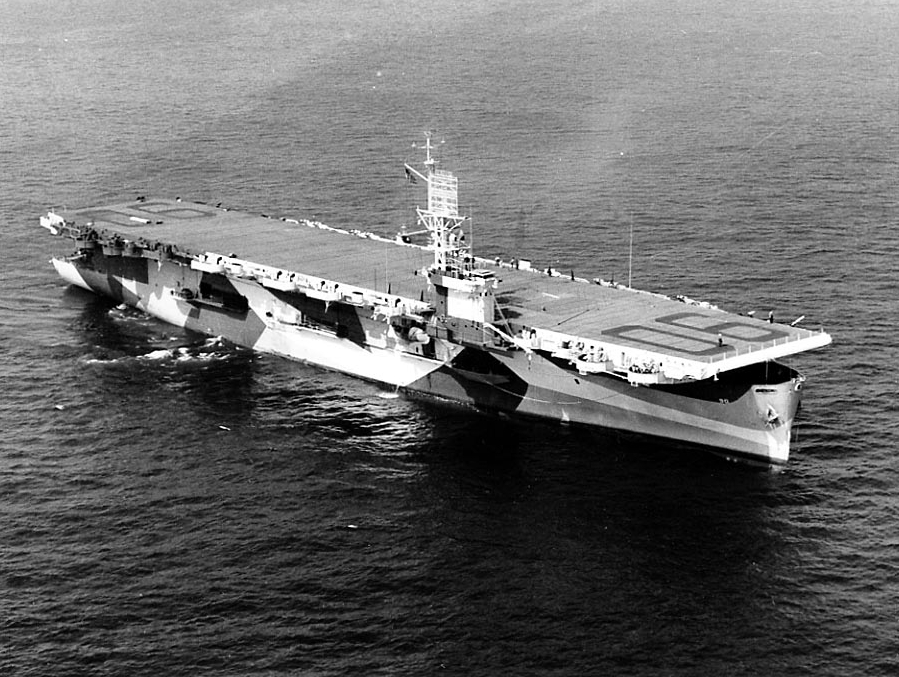
Thetis Bay is a bay at the south end of Tebenkof Bay, on the west coast of Kuiu Island, in the Alexander Archipelago of Alaska. Kaiser Shipbuilding at Vancouver, Washington, laid the escort carrier down on 22 December 1943 as Maritime Commission hull 1127. Mrs. Ricco Botta sponsored the launch on 16 March 1944. Captain Donald Edmund Wilcox commissioned her on 21 April 1944.
She shook down at San Diego. On 2 June she moved to San Pedro and loaded planes and passengers. She sailed on 5 June, called at Pearl Harbor on 11 June, and went on by way of Makin and Majuro to Kwajalein. There she took aboard the Army's 50th Engineer Battalion and put the battalion ashore at Pearl Harbor on 5 July. Two days later she left for Alameda with 41 aircraft that needed repair. She arrived on 13 July, landed the aircraft, and went to Terminal Island for three weeks in the yard.
From 11 August to 13 September she carried spare parts, replacement aircraft, and men to Hawaii and the Marshalls. From September 1944 she made five round trips from California ports to bases that ran from Pearl Harbor out to Finschhafen, New Guinea. One account carries those trips through mid-April 1946. Captain Benjamin Eugene Moore, Jr. relieved Wilcox on 21 January 1945.
On 12 June 1945 she came into Pearl Harbor from San Diego with a load of aircraft. The planes were made ready in 72 hours, and she sailed for Guam. She entered Apra Harbor on 25 June and joined Task Group 30.8 as a replenishment carrier. On 12 July she met Task Force 38 and passed across 40 planes. She was back at Guam on 22 July, loaded until the 24th, and was with the fast carriers again on 31 July. She loaded once more at Guam and from 14 August was alongside the task force with aircraft. One account has her back at Apra Harbor on 8 September, on the way home. She reached Alameda on 7 September.
She then carried veterans home until January 1946, and the yard began laying her up. Captain Allen Smith, Jr. had her from 19 October 1945. Commander Gordon Ernest Bolser had her from 10 February 1946. She went out of commission, in reserve, at Bremerton on 7 August 1946. She received one battle star.
In May 1955 a tow took her to the San Francisco Naval Shipyard for conversion into the Navy's first assault helicopter carrier. On 1 July 1955 she became CVHA-1. Captain Thomas W. South, II, recommissioned her on 20 July 1956. The conversion was finished on 1 September. She reached her new home port, Long Beach, on 20 September. Helicopter teams from Marine Corps Test Unit No. 1, at Camp Pendleton, showed how to land and take off. She trained in amphibious landings off the California coast, left for the Far East on 10 July 1957, and was back at Long Beach on 11 December 1957. On 28 May 1959 she was redesignated LPH-6.
In August 1959, while she was with the Seventh Fleet, floods on Taiwan left thousands without homes. On 12 August she was ordered from Hong Kong to Taiwan with 21 large troop-carrying helicopters. By noon on 20 August those helicopters had put ashore 1,600,540 pounds of supplies and had carried 850 passengers.
In May 1960 her helicopters set 1,300 troops and 33 tons of cargo ashore at Camp Pendleton in a practice night assault, the first large-scale night landing of ground forces by carrier-based helicopters. In the spring of 1961 she went to the western Pacific. After she returned to Long Beach the Navy moved her to the Atlantic Fleet, and she arrived at Norfolk, her new home port, in early December 1961.
In October 1962, during the Cuban missile crisis, she went to the quarantine area with a Marine landing team and a helicopter squadron embarked. In September 1963 she anchored off Port-au-Prince after Hurricane Flora and sent Marine helicopters in with medical aid and food. She left Norfolk on 5 January 1964 for Philadelphia and arrived the next day. She was decommissioned and struck on 1 March 1964. In December 1964 Peck Iron & Metal Co., Inc., of Portsmouth, Virginia, bought the hulk for scrap.