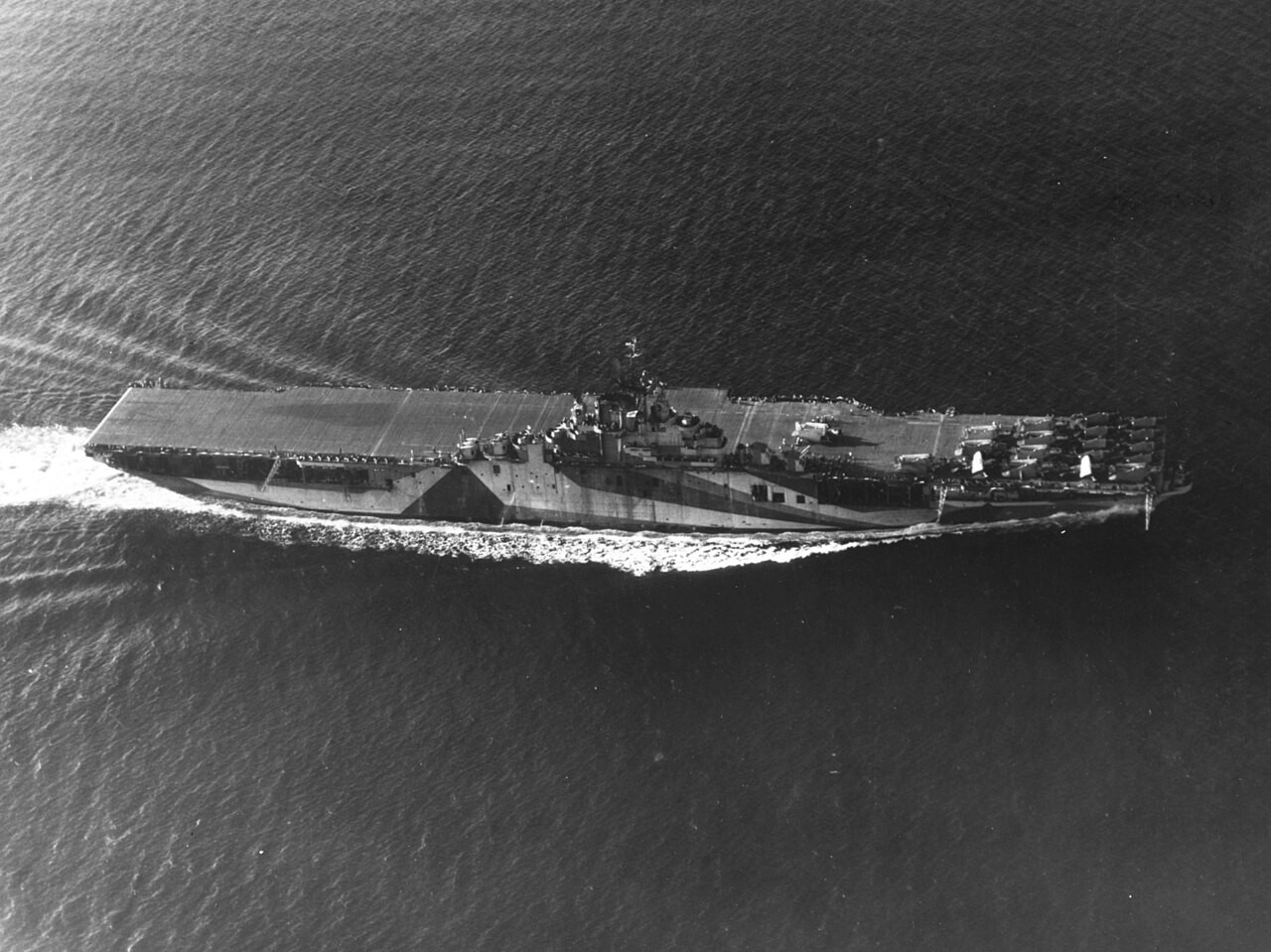
Building
She was laid down as Hancock at Newport News on 1 February 1943 and renamed Ticonderoga on 1 May 1943. She was the fourth Navy ship named for Ethan Allen's capture of Fort Ticonderoga in 1775. She was launched on 7 February 1944, sponsored by Miss Stephanie Sarah Pell, and commissioned at Norfolk Navy Yard on 8 May 1944, Captain Dixie Kiefer in command. She was one of the "long-hull" Essex-class carriers. Her bow was 16 feet longer to carry antiaircraft guns, and the later ships of the design were often called the Ticonderoga class.
Into the Pacific
She took Air Group 80 aboard, worked up off Trinidad, and crossed to the Pacific. She sortied from Ulithi with Task Force 38 on 2 November 1944 and flew her first strike on 5 November, hitting shipping and airfields on Luzon in support of the Leyte campaign. In January 1945 she went with the fast carriers through the Luzon Strait into the South China Sea, where her fighters helped down four snoopers on 11 January.
The kamikazes of 21 January 1945
On 21 January, after strikes on Formosa, the Pescadores and Sakishima Gunto, a kamikaze came out of the clouds just after noon. It crashed through her flight deck beside the No. 2 5-inch mount, and its bomb exploded above the hangar deck, setting parked planes on fire. Captain Kiefer turned the ship to keep the wind from fanning the flames. He had magazines flooded and corrected a 10-degree starboard list. Then he deliberately flooded compartments to port, giving her a 10-degree list the other way, which slid the burning wreckage overboard. Her gunners shot down three more attackers, but a fourth hit her starboard side near the island. It set more planes on fire and killed or wounded about another hundred men. Kiefer was among the wounded. The fires were under control soon after 14:00. She reached Ulithi on 24 January and transferred her wounded to the hospital ship Samaritan. She was repaired at Puget Sound between 15 February and 20 April, and Captain William Sinton took command.
The last campaign
Back with the fleet, she struck Kyushu's airfields on 2–3 June to blunt the kamikaze attacks on Okinawa. She came through her second typhoon in six months, swept Kyushu again on 8 June, and hit Minami Daitō and Kita Daitō. In July, damage to a reduction gear sent her to Guam for repairs. She then joined the final strikes on Japan and entered Tokyo Bay after the surrender. In Operation Magic Carpet she carried homeward-bound servicemen across the Pacific. She earned five battle stars in World War II. In late 1946 she lay in reserve at Bremerton, with Lieutenant Commander William J. Pendola briefly in command, and on 9 January 1947 she was decommissioned into the Bremerton Group of the Pacific Reserve Fleet.
Later life
She was modernized and recommissioned in the 1950s as an attack carrier (CVA-14), too late for Korea. She was heavily engaged in Vietnam. In August 1964, during the Gulf of Tonkin incident, she sent F-8E Crusaders to help the destroyer Maddox. She made five consecutive combat deployments and earned twelve battle stars, three Navy Unit Commendations and a Meritorious Unit Commendation. Converted to an antisubmarine carrier (CVS-14) in 1969–70, she recovered the Apollo 16 astronauts in April 1972, Apollo 17 in December 1972 and the Skylab 2 crew on 22 June 1973. She was decommissioned in 1973 and sold for scrap in 1975.
Sources
Wikipedia, "USS Ticonderoga (CV-14)" (based on DANFS).
NHHC/DANFS, "Ticonderoga IV."
NavSource, CV-14 commanding officers.