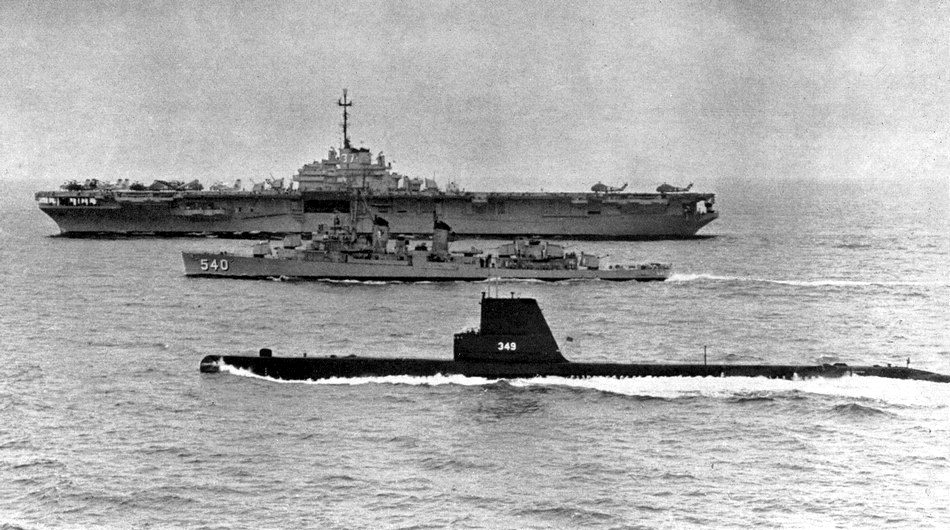
USS Twining (DD-540) was a Fletcher-class destroyer of the United States Navy, named in honor of Nathan C. Twining, a rear admiral who lived from 1869 to 1924. In the San Francisco yard of Bethlehem Steel, her keel was laid on 20 November 1942. She went into the water on 11 July 1943, Mrs. S.B.D. Wood serving as sponsor, and the Navy commissioned her on 1 December 1943. Ellis Kerr Wakefield was commanding officer from that day.
On 21 December she left San Francisco on shakedown and was in San Diego when Christmas Day closed the cruise. Drills out of that harbor followed. She returned to San Francisco, took passengers and freight aboard, and sailed on 11 February 1944, entering Pearl Harbor on 17 February. Three months of work there trained the crew in shelling ashore, in covering men at a landing, and in the amphibious tasks of Operation Forager.
On 31 May Twining left the Hawaiian Islands alongside Fire Support Group 1 of the Saipan invasion forces. She made Kwajalein on 8 June, filled her bunkers, and patrolled for submarines seaward of the harbor mouth. On the 10th she screened the task group clear of the lagoon and shaped a course for the Marianas. Dawn on the 14th found her off Saipan. Along the eastern side she covered the cruiser Montpelier, took a short part in the shelling before the assault, and late in the afternoon fought a running action with a battery on the coast. Leading Stockham and Montpelier, she closed until 3,000 yards lay between her and the beach, and the combined fire put the hostile guns out of action. After dark she screened ships that kept a harassing fire on Garapan, along the western shore.
The next day was D-Day. Twining stayed with the screen and sent shells onto chosen points as Marines landed to the west. Japanese aircraft appeared around dusk and remained outside the reach of her battery. Most of the 16th went to tracking a sound contact, and that contact never became a target. At dusk she added her guns to the shelling of Magicienne Bay. Overnight those guns struck a Japanese store of ammunition near the field at Aslito.
Early on 17 June she fell in with Destroyer Division 106 and stood out to meet the battleships under Vice Admiral Willis A. Lee, a fleet action expected. The thrust into the Marianas had pulled the Japanese Combined Fleet north, bent on throwing the landing back. The 18th brought a few sightings of snoopers and little else. At dawn on the 19th a single aircraft of unknown identity closed the formation, drew fire from Twining and from ships nearby, circled, and left. Quiet held until 10:08, when Alabama reported a large number of planes inbound from the west. From a picket station ten miles to the west of the formation, Twining saw the first wave at 10:49. Combat air patrol broke the attack up, downing many of the Japanese planes and spoiling the approach of the rest. Fighting aircraft for the first time, she destroyed two that penetrated and shared credit for one more. Twice, bombs were dropped at her, and she came through unhurt. Her part in the Battle of the Philippine Sea closed after twenty-six minutes. The hours that remained passed with carrier pilots still taking down intruders, and with no fresh attack forming close to the destroyer.
On the 20th she moved west, looking for the Japanese fleet. Late in the day the carriers sent off a strike, and night arrived with many of those planes still out. Twining switched on a searchlight as a homing beacon and took men from aircraft forced down in the dark. At dark on the 21st the chase was given up. The force reversed course and steamed east, searching again for airmen from the strike that the previous night had caught. On the 23rd she fueled at sea and set out for the Marianas as screen for the oiler Cahaba. Off Saipan on the 25th she bombarded near Mutcho Point. For the rest of June she stayed off the island, shelling the beach, putting harassing and illuminating fire ashore after dark, guarding transports, and meeting enemy planes.
As evening settled on 28 June in Magicienne Bay, the crew watched a sharp duel between Marine positions on the south side and Japanese troops on the north. Later, enemy planes scattered bombs over the water to seaward. From the ship, men saw shore guns hit a plane overhead and watched it plunge burning, about four miles out. Near midnight on 30 June, patrolling off Nafutan Point, Twining turned away two planes bent on Aslito airfield. July kept her off Saipan for screening, fighter direction, and fire support, with occasional trips to Tinian to bombard. Through the night that bridged 6 and 7 July, off the northern tip, Japanese pilots used her as a landmark for the runway at Marpi Point and as a ship to bomb. Nine planes came in, and one bomb was released. Flares lit the water while her guns drove all nine off, and the strip Japan still held saw no landing from that raid. She remained on picket duty afterward and at times fired into groups of enemy troops on the island.
On 24 July she formed a screen for Montpelier and New Orleans while those cruisers shelled positions the Japanese held on Tinian. The next day her own batteries covered American troops moving along the western shore. Support of the Tinian invasion lasted through the end of July, Twining holding a station between Tinian and Saipan and firing at intervals. On 27 January 1945 Frank Voris List relieved Wakefield. List's command ran to 8 September 1945, when Albert Francis Hollingsworth took the ship. Twining survived the war. On 16 August 1971 she was sold to Taiwan.