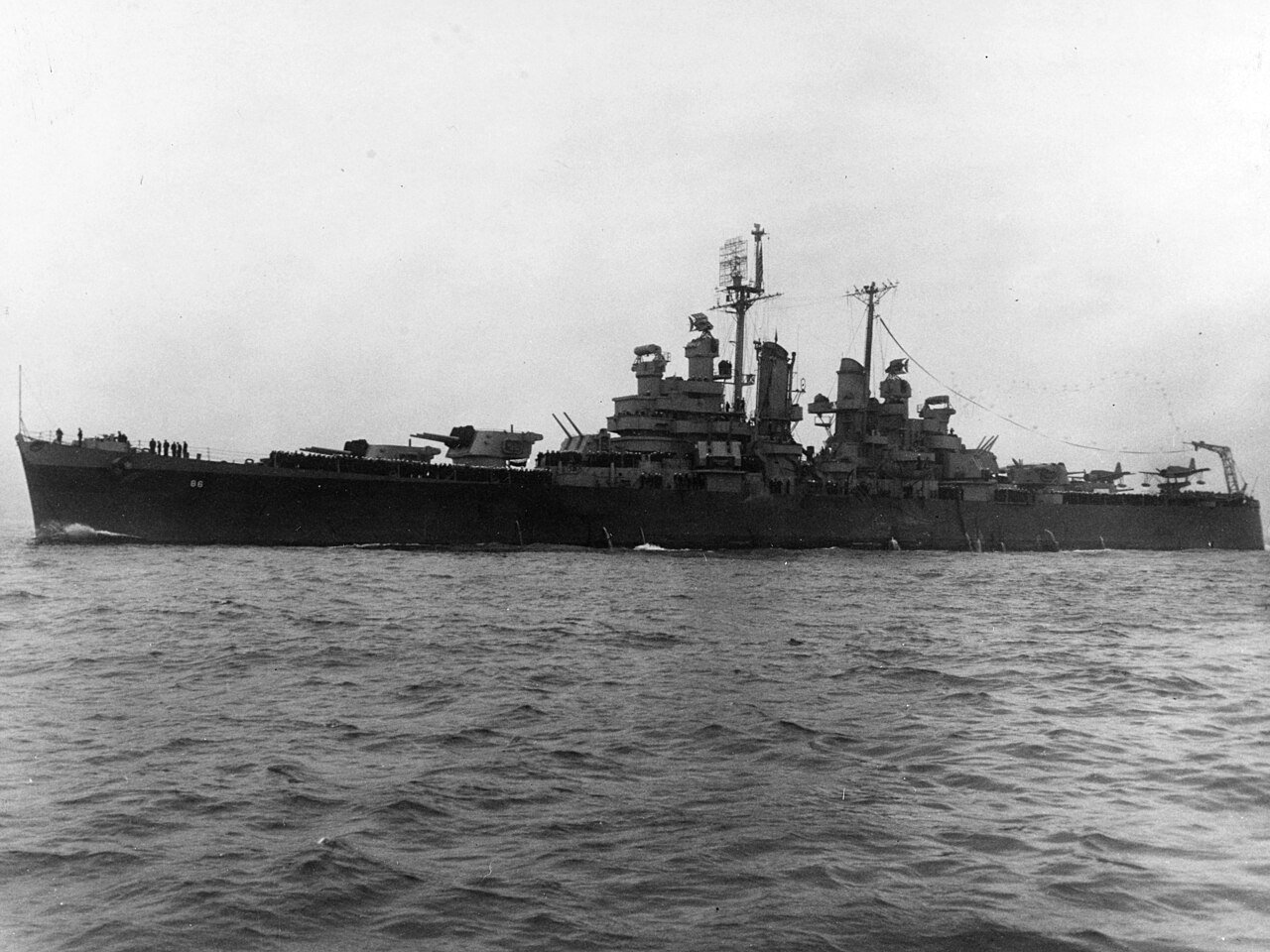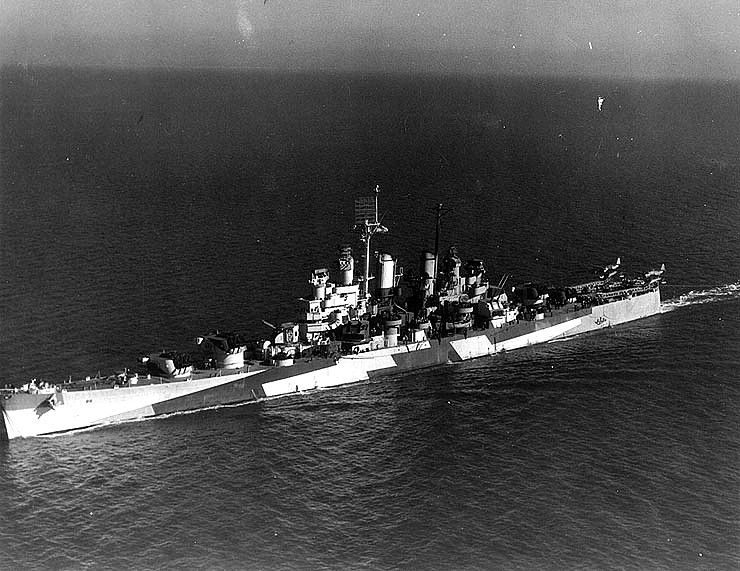
Vicksburg (CL-86) was a Cleveland-class light cruiser, the third Navy ship of the name, for the city in Mississippi. The name Vicksburg had also been assigned to a light cruiser on 28 December 1940. That ship became Houston (CL-81) on 12 October 1942, after the heavy cruiser Houston (CA-30) was lost in the Battle of the Sunda Strait on 1 March 1942. Cheyenne (CL-86) was laid down on 26 October 1942 at Newport News, Virginia, by the Newport News Shipbuilding and Drydock Company, and was renamed Vicksburg exactly one month later. She was launched on 14 December 1943, sponsored by Miss Muriel Hamilton, daughter of Mayor J. C. Hamilton of Vicksburg. She commissioned at the Norfolk Navy Yard on 12 June 1944, Captain William Cecil Vose in command. The DANFS line for the hull gives 10,000 tons, a length of 610 feet 1 inch, a beam of 66 feet 4 inches, a draft of 25 feet, 33 knots, a complement of 992, twelve 6-inch guns, twelve 5-inch guns, twenty-eight 40-millimeter guns, and ten 20-millimeter guns.
She fitted out at Norfolk into July and began her shakedown in Chesapeake Bay. On 7 August she sailed for the British West Indies. Out of Trinidad she finished the shakedown in the Gulf of Paria between 12 and 30 August, fired a shore bombardment off Culebra on 1 September, and the next day headed for Hampton Roads with Broome (DD-216) and Simpson (DD-221). On 9 September she practiced radar spotting at YAG-13 and at a battle raft, and on 10 September she fired at a drone off Cape May. A post-shakedown overhaul at the Boston Navy Yard ran from 11 to 24 September. She ran standardization trials off Rockland, Maine, and took part in radiation-laboratory tests near Deer Island in Boston harbor. From 5 October to 15 December she worked in Narragansett Bay, Block Island Sound, and Long Island Sound as a precommissioning training ship for crews of large warships. She was back at the Norfolk Navy Yard on 17 December and ran post-repair trials in the Chesapeake on the last two days of 1944.
She left Hampton Roads on New Year's Day 1945 and met Rodman (DD-456) and Emmons (DD-457) at the entrance of the bay. Together they were Task Group 21.12. Four days later she reached Cristóbal, transited the Panama Canal that afternoon, and moored at Balboa, where the group was dissolved. She sailed for the Hawaiian Islands on 6 January and reached Pearl Harbor on 17 January. Through the end of the month she exercised off Oahu, tracking aircraft, firing at drones, directing fighters, calibrating radar, and firing long- and short-range practices.
She left Pearl Harbor at 0800 on 5 February and reached Saipan on 13 February, where she fueled from Enoree (AO-69). This was her baptism of fire, Operation Detachment, the landing of the 4th and 5th Marine Divisions on Iwo Jima. She left Saipan the next day and joined Task Group 52.19. On 15 February she became part of Task Unit 54.9.2, movement group Baker, with Nevada (BB-36), Idaho (BB-42), Chester (CA-27), Pensacola (CA-24), and the screen. The force split. Vicksburg took station with Chester and Pensacola at 0651. At 0709 she catapulted a Vought OS2U-3 Kingfisher of Cruiser Scouting Squadron 14 and opened fire. The 6-inch battery worked from 12,000 yards against the northern end of the island. Squalls hid the target from the spotter. The first phase ended at 0808 and the plane was recovered. The second phase began at 0947 under broken cloud. By afternoon the fire was on target. Lieutenant J. B. Nabors, Jr., went up at 1249. At 1414 he reported Japanese antiaircraft fire, and a Mitsubishi A6M5 Zeke attacked his Kingfisher. A Kingfisher from Pensacola, of Cruiser Scouting Squadron 5, shot the fighter down. The third phase ended half an hour later. The fourth opened at 1618 from 10,000 yards, and the firing stopped at 1727. The fire-support ships retired for the night at 14 knots. Vicksburg stayed off Iwo Jima into March, still on gunfire support, and headed for Ulithi on 5 March.
She sailed again on 14 March in Task Group 58.1, with the Fifth Fleet's fast carriers, to strike Japanese air power before the invasion of Okinawa. On 18 March, about 100 miles east of Kyushu, a Mitsubishi G4M1 Betty dropped a torpedo. Vicksburg turned hard. The torpedo passed some 35 yards ahead of the bow and ran down the port side. Within twenty minutes another plane dropped flares and left under antiaircraft fire. Already at general quarters, she opened with her 40-millimeter battery on a plane that came through the formation already burning from other ships' fire, and the plane splashed. At 0600 a Yokosuka P1Y Frances dived on a carrier and was knocked into the water, probably by that carrier's own guns. Less than two hours later a Yokosuka D4Y1 Judy passed over Vicksburg. The cruiser scored three hits, and 5-inch fire, probably from Harrison (DD-573) or Miami (CL-89), finished the bomber. The next morning, at 0715, a plane dived on Wasp (CV-18) and scored one bomb hit. Vicksburg fired. A proximity burst took off a wing and the plane spun in. In the course of those strikes she destroyed eight Japanese planes. One of her Kingfishers picked a Marine aviator out of the water off the home islands.
Detached from Task Group 58.1, she shifted to a station off Okinawa for shore bombardment and close support. In one stretch of six hours she fired nearly 2,300 rounds of 6-inch and 5-inch for an Army advance up the southern part of the island. Some of the targets lay only a few hundred yards ahead of the troops. The guns worked on Japanese gun positions, caves, and strong points. She left the Ryukyus late in the campaign, supported a minesweeping operation in the China Sea until 24 June, and then sailed for the Philippines. She remained in Philippine waters through the capitulation on 15 August 1945.
Five days later she left San Pedro Bay, Leyte, in Task Unit 30.3.7 with Lowry (DD-770), Moale (DD-693), and Rowe (DD-564). Lowry sighted a drifting mine and exploded it. On 24 August Vicksburg joined Task Group 38.2, part of Vice Admiral John S. McCain's force. The group covered the approaches to Tokyo Bay before and during the formal surrender on 2 September. She entered the bay on 5 September. Rear Admiral I. J. Wiltse, Commander, Cruiser Division 10, shifted his flag to her. On 20 September she left with a Third Fleet group under Rear Admiral John F. Shafroth, anchored in Buckner Bay on 23 September, and took aboard 2,200 passengers. She reached Pearl Harbor on 4 October. Five days later she led the Third Fleet out for the United States. The fleet passed in review in San Francisco Bay on 15 October. She stayed until 26 October, shifted to Monterey Bay for Navy Day on 27 October, reached Long Beach on 31 October, went to Portland, Oregon, on 6 November for Armistice Day, and was back at Long Beach on 16 November.
On 17 January 1946 she entered the Terminal Island Naval Shipyard, in San Francisco Bay, for overhaul and modernization. On 20 May she became flagship for Vice Admiral Frederick C. Sherman, Commander, Third Fleet, who shifted his flag from Iowa (BB-61). Two days later she moved to San Diego and moored at the Naval Air Station. She remained there into September, when Vice Admiral A. E. Montgomery temporarily broke his flag in her. Captain Lawrence C. Grannis had relieved Vose on 27 July 1945. His tour runs into 1946, with no day given for the relief. Commander Frank Ingersoll Winant Jr. had her from 1946, again with no day given for the start, until 21 February 1947. No commanding officer is named from that date until she was decommissioned at San Francisco on 30 June 1947. She stayed in reserve until she was stricken on 1 October 1962. On 25 August 1964 she was sold to the National Metal and Steep Corp. of Terminal Island, California, and scrapped. She received two battle stars for World War II service. She was not sunk.
A note on sources. The narrative follows the Naval History and Heritage Command Dictionary of American Naval Fighting Ships entry for Vicksburg III (CL-86), updated by Mark L. Evans on 30 June 2015. The HyperWar copy of that entry was not available. The fetch of the usual HyperWar address returned no page. Digitized copies are what were used. NavSource, not DANFS, gives the order date of 9 September 1940 and dates the renaming 26 November 1942. DANFS says the renaming came exactly one month after the keel of 26 October 1942. NavSource gives 32.5 knots and a crew of 1,255 against the DANFS line of 33 knots and 992. The DANFS figures are the ones used above. The sale date, 25 August 1964, is in both. DANFS names the buyer as the National Metal and Steep Corp. NavSource names NASSCO. The DANFS name is the one used above. A NavSource caption of the launching prints Govenor, Farlay, and Hamiliton. Those forms are not used. The sponsor and the mayor are DANFS: Miss Muriel Hamilton, daughter of Mayor J. C. Hamilton. DANFS states that she destroyed eight Japanese planes while supporting the pre-invasion strikes. The same entry's account of 18 and 19 March names particular aircraft, some of them shared with other ships, and does not show the arithmetic of the eight. No casualty figure is given, and none was added. Commanding officers and the dates that have days are NavSource's list. DANFS names only Vose, at the commissioning. Uboat.net matches his dates, 12 June 1944 to 27 July 1945. The older Houston (CA-30) is a different ship from Houston (CL-81) and is not this cruiser.