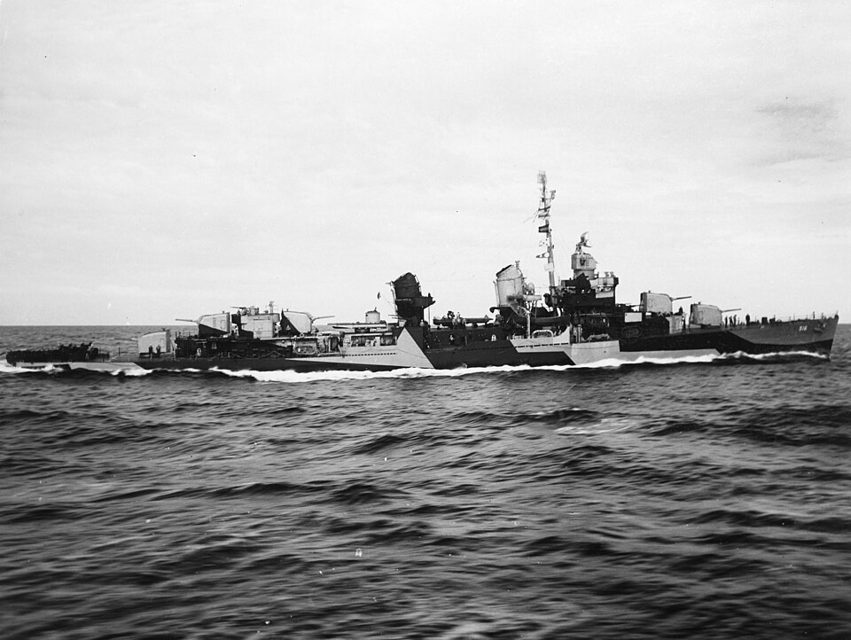
USS Wadsworth (DD-516) was a Fletcher-class destroyer. Bath Iron Works laid her keel at Bath, Maine, on 18 August 1942, and she entered the water on 10 January 1943. Rebecca Wadsworth Peacher sponsored the ship. Peacher’s great-great-grandfather was Commodore Alexander S. Wadsworth. On 16 March 1943 the Boston Navy Yard commissioned her, and John F. Walker took command that same day.
She left Boston on 5 April, drilled in Casco Bay until the 15th, and then headed for Cuban waters. Shakedown training was based at Guantánamo Bay. She afterward steamed north so the Boston yard could finish repairs and ready her for deployment. On 23 May she sailed to screen the carriers Princeton and Yorktown while they trained from Port of Spain, Trinidad. She touched at Norfolk on 17 June and was in Boston again the next day. After escorting the carrier Bunker Hill to Hampton Roads, she screened Cowpens and guarded aircraft while that carrier’s air group trained off the Virginia Capes.
Boston saw her off once more on 20 July, bound to join a task group built around Lexington, Princeton, and Belleau Wood. The ships met off the Delaware breakwater, set a southerly course for the Panama Canal, and reached Pearl Harbor on 9 August. Ten days in the Hawaiian operating area followed. She then screened the carrier Prince William toward Canton Island, called at Espiritu Santo in the New Hebrides, and reported to Rear Admiral Aubrey W. Fitch, who commanded South Pacific aircraft.
On the last day of August 1943 she cleared Espiritu Santo to hunt the Japanese submarine later identified as I-20. That boat had torpedoed and damaged the tanker W. S. Rheem roughly ten miles north of Bougainville Strait. The first area she searched stayed quiet. Teamed with amphibious patrol planes, she then worked the sea to the south of Espiritu Santo and the waters west of Malakula. On 1 September an underwater sound contact brought seven depth-charge patterns and a claim of damage that was left unconfirmed. I-20 never reached home, and from 10 October 1943 she is carried as missing.
Wadsworth entered Havannah Harbor on Efate on 6 September and exercised with a force formed around the carrier Saratoga. On 17 September she sailed in company with the minelaying destroyer Tracy. Over the days that followed they escorted supply ships to Kukum Beach on Guadalcanal, and on 30 September she returned to Efate with empty cargo ships. She took a screening station near the battleship South Dakota and escorted her west to meet a cruiser-and-battleship striking force under Rear Admiral Willis A. Lee. Patrol off Meli Bay then covered convoys as they entered Havannah Harbor.
She next joined other ships of Destroyer Division 45 in the screen of Task Group 31.5, a dozen troop transports headed for the Solomons and the opening landings in Empress Augusta Bay at Cape Torokina, Bougainville. The expedition arrived off the beach in the early darkness of 1 November, and Wadsworth led the minesweepers into the bay. At 05:47 her five-inch guns opened and destroyed enemy barges along the shore. For nearly two hours she shelled targets inland of the beaches. With the sister ship Sigourney she then patrolled to protect the transports while troops went ashore.
Six enemy planes plunged out of the sun at the two destroyers. The first of six bombs burst 25 yards to starboard. Two more exploded within 500 yards, one on either beam. A near miss twenty feet from the port side sprayed the after part of the ship with fragments, killing two of her sailors and wounding nine. Each destroyer destroyed two of the attackers. On the night of 1 November she left the unloading area and patrolled off Koli Point, Guadalcanal. Early a week later she was back at Bougainville with the second echelon of troop transports. From a fighter-director station off the transport area she helped repel a noon air attack, and her guns claimed a dive bomber and a torpedo plane. She was clear of Cape Torokina before midnight.
Patrol off Guadalcanal continued until 10 November, when she moved to Purvis Bay on Florida Island, then soon returned along the Bougainville coast with a troop convoy. Off Cape Torokina near midnight on 12 November, she repelled two torpedo attacks before dawn with radar-directed five-inch fire. She kept on in support of the occupation, escorting troop and supply convoys from Kukum Beach to Empress Augusta Bay and, from time to time, bombarding the shore. Three days after Christmas 1943, with air spotting, she shelled Japanese trenches and gun positions on both the south and north sides of the Reini River mouth. After her last screening and escort trips for that work, she left the Solomons on 8 January 1944 with a merchantman for Pago Pago in American Samoa, and she returned to Espiritu Santo escorting replenishment shipping. She survived the war and was placed in reserve. On 6 October 1959 she was loaned to West Germany and renamed Zerstörer 3. She remained in the West German navy until 1980, when she passed to the Hellenic Navy and was renamed Nearchos. Nearchos stayed active until 1991 and was sold for scrap.