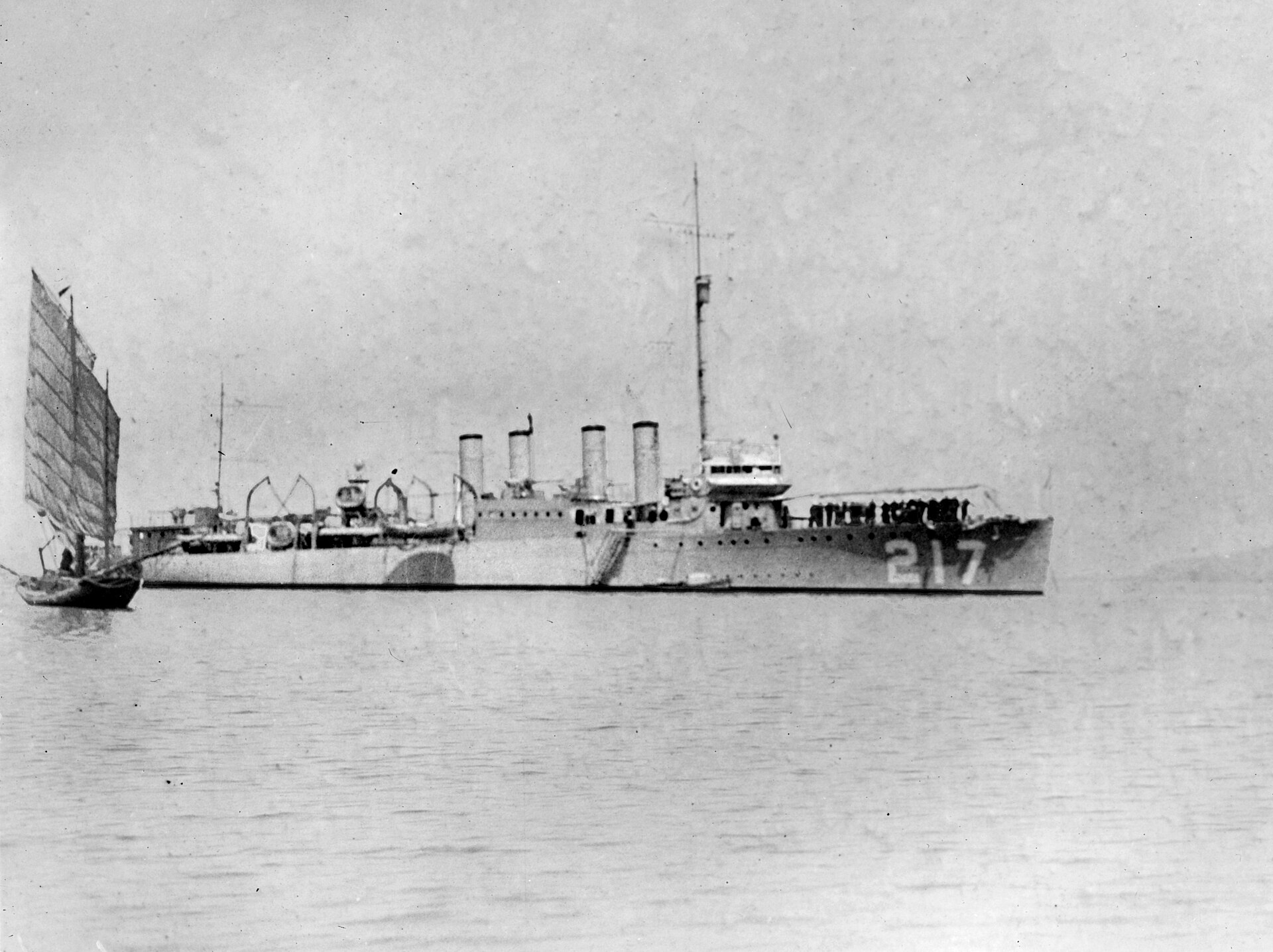
Whipple was a Clemson-class destroyer, DD-217, named for Commodore Abraham Whipple of the Revolutionary War. An earlier destroyer had carried the name. William Cramp and Sons laid her down at Philadelphia on 12 June 1919, launched her on 6 November 1919, and commissioned her on 23 April 1920. She spent her peacetime years with the Asiatic Fleet, and she was the flagship of Destroyer Division 57.
On 14 April 1936, bound from Manila toward Shanghai, she rammed Smith Thompson amidships. No one was killed. Smith Thompson was towed back to the Philippines and was not worth repair. She was sunk off Subic Bay on 25 July 1936. Whipple's own bow was bent around until it faced aft. She was given the undamaged bow from Smith Thompson and went back to sea.
Lieutenant Commander Eugene S. Karpe had her from March 1941. The day in March is not known. On 9 February 1942 she was with the Allied striking force under Rear Admiral Karel Doorman, in company with Pillsbury, Edsall, Alden, Stewart, John D. Edwards, Barker, and Bulmer. That evening Edsall and Alden were detached toward Tjilatjap. On 12 February, leaving Prigi Bay, she and the light cruiser De Ruyter collided. The accounts do not agree on which ship hit the other.
On 27 February, south of Java, Japanese bombers disabled the seaplane tender Langley. Langley was abandoned. Whipple and Edsall took the survivors off, and the abandoned tender was sunk so she would not be taken. That sinking is not credited to one ship. Off Christmas Island on 1 March the two destroyers put the Langley men aboard the oiler Pecos. Whipple was sent on toward the Cocos Islands. Edsall was sent back toward Java.
That afternoon Japanese aircraft sank Pecos. Karpe took Whipple back after dark. She began picking men out of the water about 1915. The number she got aboard is given as 232 and as 220. A submarine contact made her drop depth charges, and accounts say those charges killed men still in the water. The contact was later tied to the submarine RO-33, which reported firing one torpedo and missing. The senior officers with her, among them the captains of Pecos and Langley, agreed she could not stay. She left about 2200. The men still in the water were not recovered. She reached Fremantle on 4 March.
She worked with Australian and New Zealand ships along the Australian coast. About 4 May 1942 she was sent toward Port Vila. Commander Vincent James Meola relieved Karpe on 29 June 1942. She later went to the Atlantic on convoy duty. On 30 June 1945 she was reclassified AG-117. She was decommissioned on 9 November 1945, struck on 5 December 1945, and sold on 30 September 1947 to the Northern Metals Company of Philadelphia and broken up.