Building
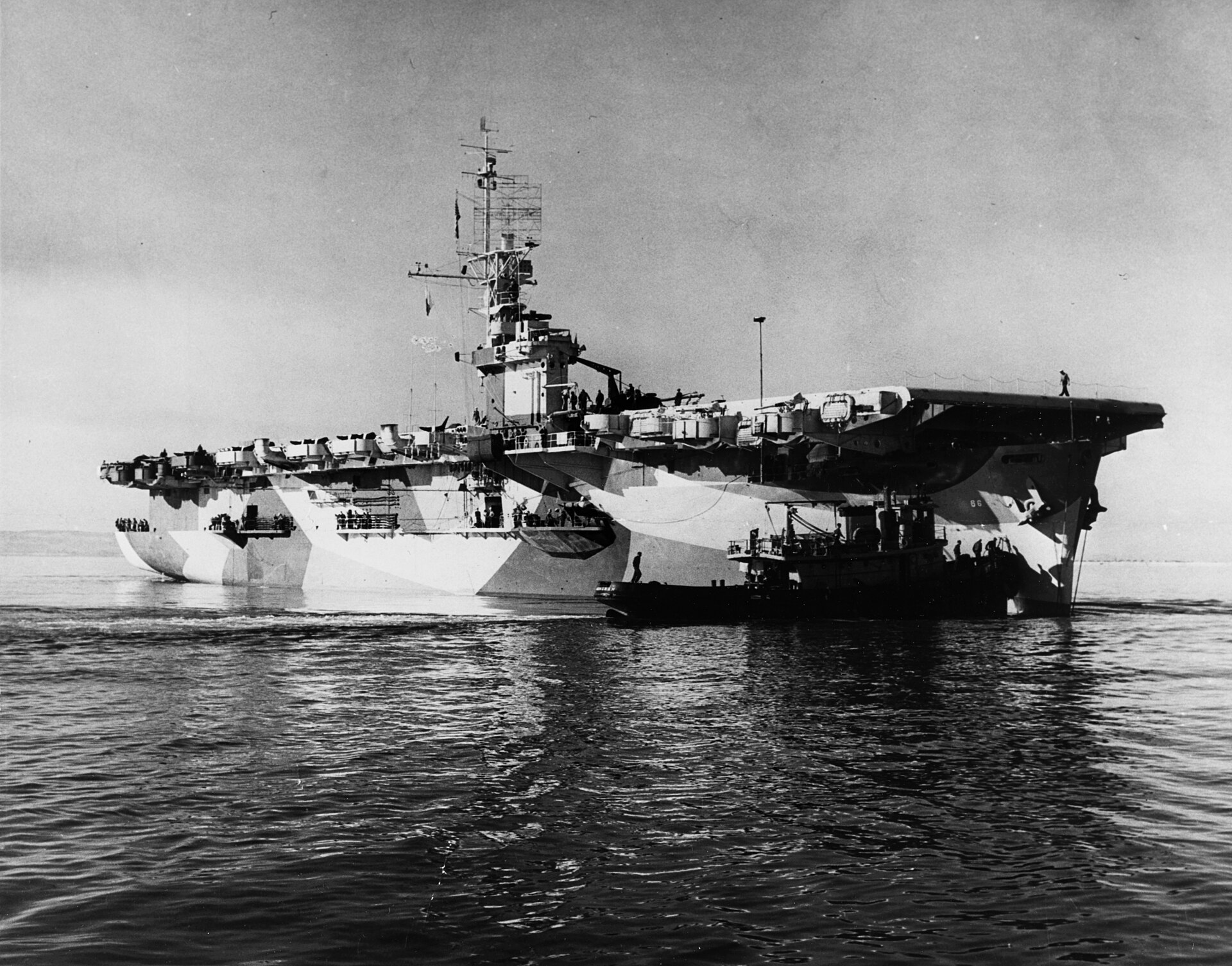
The Casablanca-class escort carrier White Plains was laid down by Kaiser at Vancouver, Washington, on 11 February 1943 as Elbour Bay (ACV-66), Maritime Commission hull 1103. On 3 April 1943 she was renamed for the 1776 Battle of White Plains, and she was redesignated CVE-66 on 15 July. She was launched on 27 September 1943, sponsored by Mrs. Marc A. Mitscher, and delivered and commissioned at Astoria, Oregon, on 15 November 1943, Captain Oscar A. Weller in command.
Ferry duty and the Marianas
After shakedown she ferried aircraft to Tarawa, arriving on 11 January 1944. In April she embarked her own Composite Squadron 4 (VC-4), with 16 Wildcats and 12 Avengers. She reached Pearl Harbor on 1 May and at the end of the month sailed from Eniwetok with the Marianas invasion force. Her planes flew antisubmarine and combat air patrols, strafed beaches, spotted naval gunfire, and helped beat off at least three heavy air attacks. On 17 June her gunners made their first certain kill, and her Avengers torpedoed a transport off Rota. After a week at Eniwetok in July she came back with 28 aircraft to support the Tinian assault.
The Battle off Samar
After repairs at Manus she sailed for Leyte with Taffy 3. At 06:59 on 25 October 1944 Yamato opened fire from about 34,500 yards, and White Plains was the target of her first four salvos. A close straddle landed at 07:04. Its blast under the keel acted like a mine: it damaged her hull and starboard machinery and tripped most of her electrical circuit breakers. Her crew restored power within three minutes, and by overspeeding her port engine she kept her place in formation. The black smoke from the sudden loss of boiler air convinced Yamato and Nagato that they had scored a direct hit, and both shifted fire elsewhere. For two and a half hours Kurita chased Taffy 3 south. Its planes kept attacking, even making dummy runs after their ordnance was gone. Johnston, Hoel, Samuel B. Roberts and Gambier Bay were sunk. Her 5-inch gun crew claimed six hits on the cruiser Chōkai. The old belief that one of these set off Chōkai's torpedoes was disproved in 2019, when RV Petrel found the wreck with its torpedoes intact.
At 10:50 the Zeros of the first kamikaze unit attacked. White Plains's gunners hit one, and it turned away and crashed St. Lo, which sank. Kitkun Bay and Kalinin Bay were also hit.
1945 and fate
After repairs she left San Diego on 19 January 1945 and spent the rest of the war on escort and ferry duty. Her closest approach to the fighting was in April 1945, when she came within 100 miles of Okinawa to fly off two Marine Corsair squadrons to the island's airfields. The war's end found her bound for the West Coast. In Magic Carpet she carried more than 800 men home from Buckner Bay, and made further trips by way of Pearl Harbor and Guam, reaching Seattle on 14 December 1945. She went around to Boston on 17 February 1946 and was decommissioned on 10 July 1946. She was redesignated CVU-66 on 12 June 1955, struck on 1 July 1958, and sold on 29 July 1958 to Hyman Michaels Company of Chicago for scrap. She received the Presidential Unit Citation with Taffy 3, along with battle stars for her World War II service.
Sources
Wikipedia, "USS White Plains (CVE-66)" (citing DANFS; Hornfischer; Haguro action report; RV Petrel 2019 survey).
NHHC/DANFS, "White Plains I."