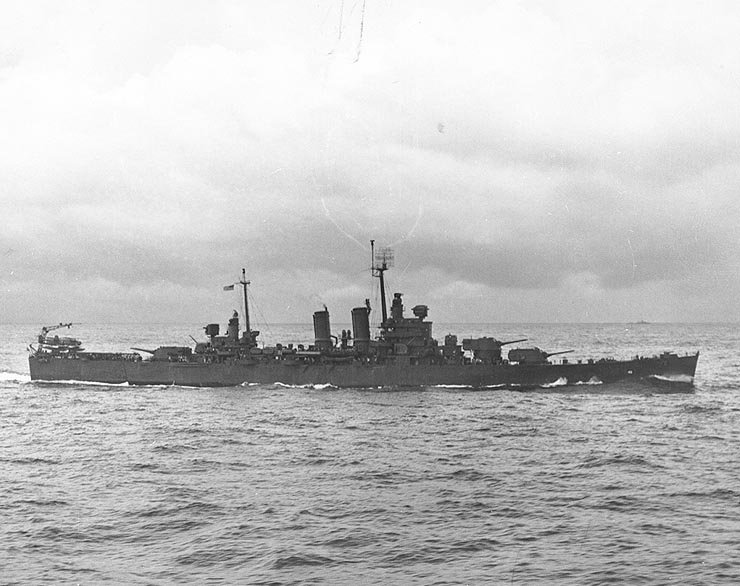
A one-of-a-kind cruiser
Wichita was named for the Kansas city and was the last heavy cruiser built under the 1929 Cruiser Act and the London Treaty's limit of 18 American heavy cruisers. She was planned as a New Orleans-class ship, but she was built instead on an improved, better-armored hull derived from the Brooklyn-class light cruisers, carrying nine 8-inch guns in three triple turrets. She was a unique ship and became the pattern for the wartime Baltimore class. The Philadelphia Navy Yard laid her down on 28 October 1935 and launched her on 16 November 1937. She came out so close to the 10,000-ton limit that she was completed with only six of her eight planned 5-inch guns. She was commissioned on 16 February 1939 as CA-45.
Pre-war and the Atlantic
Her first voyage took her to Houston, Texas, where on 20 April 1939 she took part in the dedication of the San Jacinto Battle Monument, and she then shook down in the Virgin Islands, Cuba and the Bahamas. She served on Neutrality Patrol, sailed for Guantánamo on 7 January 1941, and reached Reykjavík with Wasp and Mississippi on 6 August 1941. With Task Group 7.5 she patrolled Icelandic waters, and on 7 December 1941 she was at anchor in Hvalfjörður. She rode out a hurricane-force storm there on 15 January 1942. From the spring of 1942 she worked with the British Home Fleet as part of Task Force 99 with Washington and Tuscaloosa, covering the Murmansk convoys PQ 16 and QP 12. At the end of June she joined Tuscaloosa at Seyðisfjörður for the cover of PQ 17. When the convoy was ordered to scatter, the Germans sank 21 of its 34 isolated merchantmen.
Casablanca
In Operation Torch on 8 November 1942, she and Tuscaloosa engaged the El Hank batteries and the submarine pens while Massachusetts fought Jean Bart. Later the cruisers also fired on Jean Bart. At 11:28 a 194 mm shell from El Hank pierced her deck and exploded below, wounding fourteen men. In the afternoon she and Tuscaloosa closed the harbor to engage the French cruisers Primauguet and Gloire until El Hank's fire drove them off after 15:00. She left on 12 November and was repaired at New York.
The Pacific
She joined Rear Admiral Robert C. Giffen's cruiser force in the South Pacific. On the night of 29 January 1943, off Rennell Island, Giffen had his ships disposed against submarines when Japanese torpedo bombers attacked. Chicago was torpedoed and sunk. Wichita, at the head of the starboard column, was hit by a torpedo that failed to explode. In April she sailed for Adak with Giffen's flag. She shelled Kiska on 6 July and again with the battleships New Mexico, Idaho and Mississippi on 22 July.
With the fast carriers she screened Operation Hailstone against Truk in February 1944 (on the night of 16 February Intrepid was torpedoed), the Hollandia strikes of 13–22 April, and the second Truk raid of 29 April, during which she shelled Satawan. In the Battle of the Philippine Sea on 19 June her gunners helped down two torpedo planes. After the Okinawa strike of 10 October, Japanese bombers badly damaged Canberra on the 13th. Wichita took her in tow until the tug Munsee relieved her on 15 October, and then screened Canberra and the twice-torpedoed Houston to safety by 21 October.
Leyte Gulf
On 25 October 1944, off Cape Engaño, she was detached in Vice Admiral Willis A. Lee's Task Force 34 and then with a cruiser group sent to finish off Ozawa's cripples. With three other cruisers she sank the light carrier Chiyoda and the destroyer Hatsuzuki. She fired 148 armor-piercing rounds at Chiyoda and 173 at Hatsuzuki, about 22 percent of her supply. She gave gunfire support at Leyte on 28 October.
Okinawa, Japan and fate
After repairs that ended on 8 February 1945 she returned to the Pacific and was heavily engaged off Okinawa, giving gunfire support to the troops ashore. After the surrender she arrived at Nagasaki with Task Group 55 on 11 September 1945. Her crew inspected Japanese ships and harbor installations at Sasebo, where she rode out a severe typhoon on 9–11 October. She then carried veterans home in Magic Carpet. She was decommissioned on 3 February 1947, laid up at Philadelphia, struck in 1959, and sold for scrap in August 1959.
Sources
Wikipedia, "USS Wichita (CA-45)" (citing Friedman, U.S. Cruisers; Rohwer, Chronology of the War at Sea; O'Hara; DANFS).
NHHC/DANFS, "Wichita."