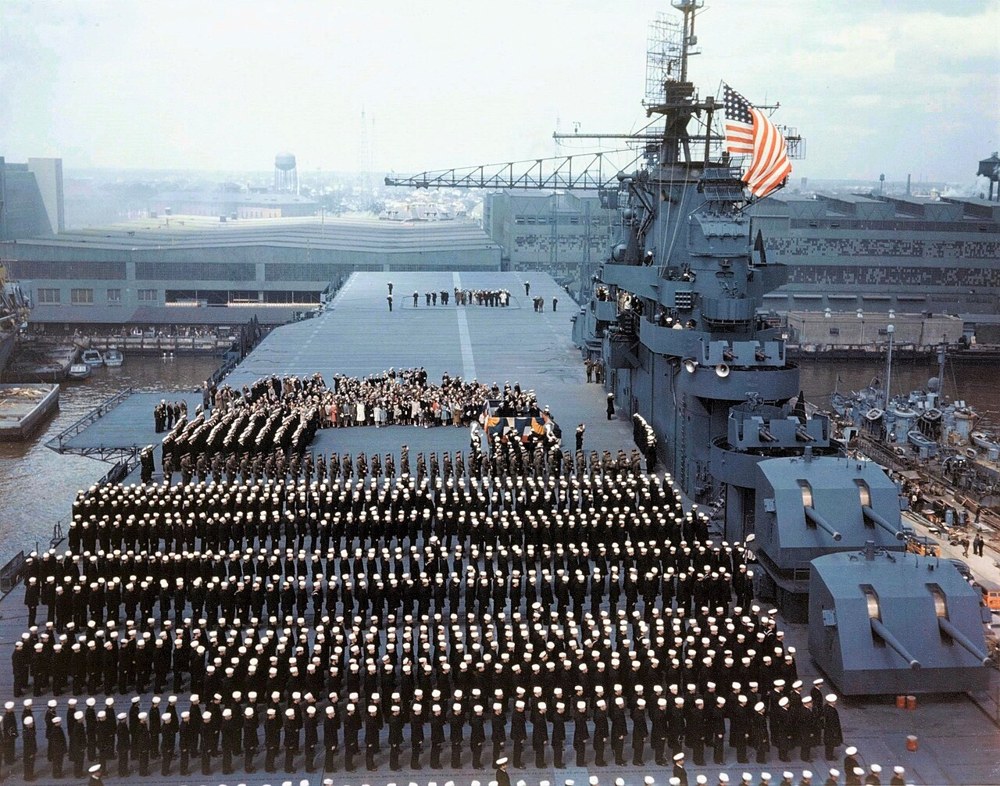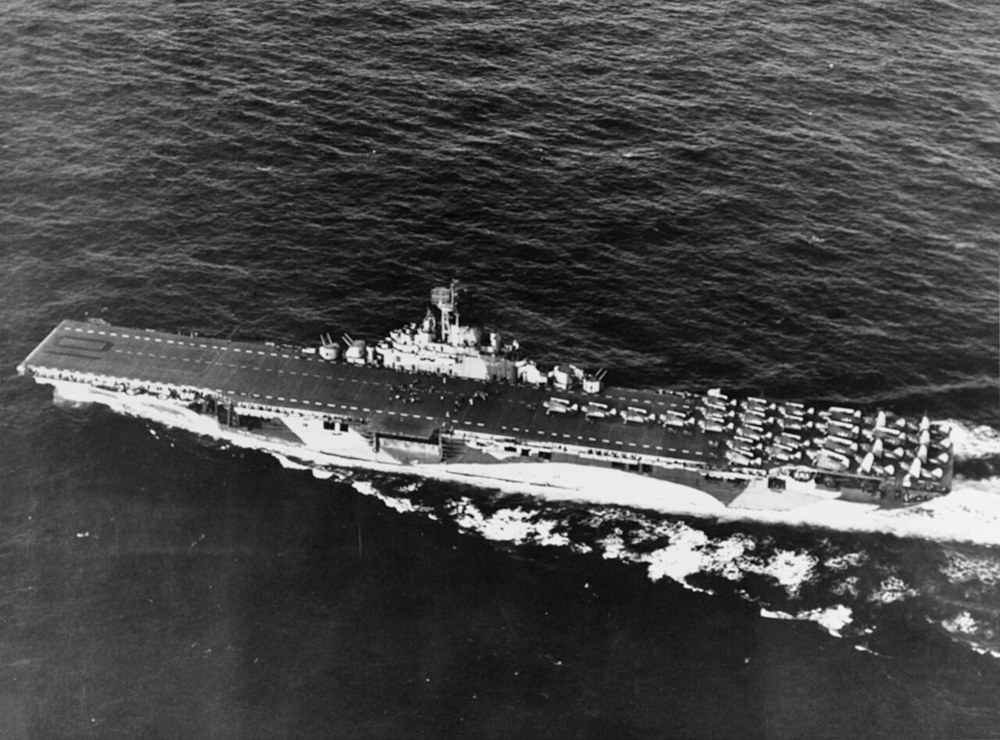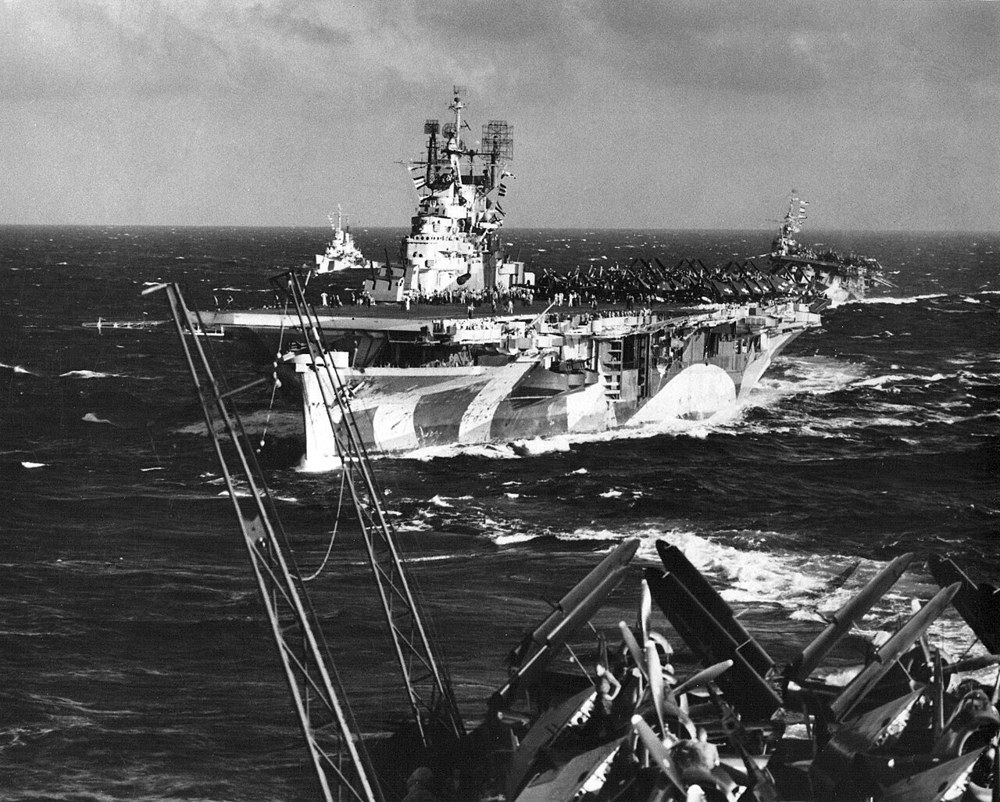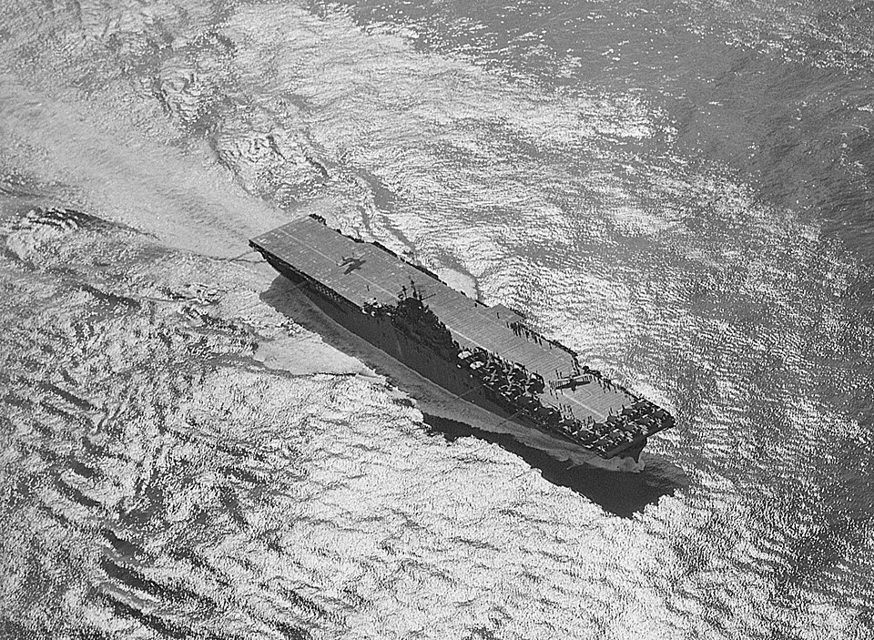
This is Yorktown, CV-10, an Essex-class carrier, not the Yorktown (CV-5) lost at Midway. She was laid down at Newport News on 1 December 1941 as Bon Homme Richard, six days before Pearl Harbor, and renamed Yorktown on 26 September 1942 to commemorate the carrier lost at Midway. She was launched on 21 January 1943, sponsored by Eleanor Roosevelt, and commissioned at the Norfolk Navy Yard on 15 April 1943, Captain Joseph J. Clark in command. She is the carrier of the 1944 Navy film The Fighting Lady, and she earned the Presidential Unit Citation.
She reached Pearl Harbor on 24 July 1943. Her first combat was a one-day strike on Marcus Island on 31 August, followed by two days of raids on Wake Island on 5 and 6 October. On 19 November she launched raids on Jaluit and Mili during the Gilberts operation, and on 20 November some of her planes supported the troops on Makin. On 4 December she made passing raids on Wotje and Kwajalein.
On 16 January 1944 she left Pearl Harbor for Operation Flintlock. With Task Group 58.1 and her sister carriers Lexington (CV-16) and Cowpens she began striking Taroa on Maloelap on 29 January, shifted to Kwajalein on 30 January, and supported the troops who went ashore on 31 January until the first days of February. She then struck Truk on 16 and 17 February, Saipan on 22 February, Palau on 30 and 31 March and Woleai on 1 April, supported the Hollandia landings from 21 to 23 April and raided Truk again on 29 and 30 April.
In the Marianas she struck the Guam airfields from 11 June and the Bonins on 16 June. In the Battle of the Philippine Sea on 19 June her aircraft claimed 37 enemy planes destroyed. On 20 June she launched a 40-plane strike that found Admiral Ozawa's force at about 1840 and scored hits on Zuikaku, which did not sink. The record shows no confirmed sinking to the credit of her air group. She struck Iwo Jima on 24 June and the Palaus and Yap in July, then went to Puget Sound for a two-month overhaul. She was back at Ulithi on 3 November and her aircraft struck the Philippines in support of Leyte. In December 1944 she steamed through the center of the typhoon that sank Spence, Hull and Monaghan and took part in rescue operations for their survivors. In January 1945 she raided Formosa, Indochina, Hong Kong and Canton in the South China Sea sweep.
On 16 and 17 February 1945 she struck the Tokyo area, and from 20 to 23 February her aircraft supported the Marines on Iwo Jima. On 18 March, off Kyushu, she was attacked within minutes of beginning operations. Two twin-engine bombers were shot down. That afternoon a D4Y 'Judy' dive bomber put a bomb on her signal bridge. It passed through the first deck and exploded near the hull, punching two large holes in her side, killing five men and wounding 26. She stayed fully operational. She struck Okinawa from 23 March and, from 1 April, supported the troops ashore for almost six weeks. On 7 April, when the Japanese task force built around the battleship Yamato was found, her aircraft joined the strike. Air Group 9 aviators claimed several torpedo hits on Yamato before she exploded and sank, and bomb hits sank the cruiser Yahagi.
She joined the final raids on the Japanese home islands in July and August 1945, struck Tokyo for the last time on 13 August, flew air cover over the occupation forces from 25 August, and after the surrender on 2 September dropped supplies to Allied prisoners of war. She entered Tokyo Bay on 16 September, left on 1 October, and reached San Francisco on 20 October. She was decommissioned on 9 January 1947, rebuilt to the SCB-27A design at Puget Sound and placed in full commission as an attack carrier on 20 February 1953. She was decommissioned again on 27 June 1970 and struck on 1 June 1973. She was donated to the Patriots Point Development Authority of South Carolina, which took her over on 8 May 1975. She was dedicated at Patriots Point in Charleston Harbor on 13 October 1975, was listed on the National Register of Historic Places, and was designated a National Historic Landmark on 14 January 1986. The destroyer Laffey (DD-724) is moored at the same museum.
Her commanding officers through 1945, from NavSource: Captain Joseph J. Clark, 4 April 1943 to 10 February 1944; Captain Ralph E. Jennings, 10 February to 29 September 1944; Captain Thomas S. Combs, 29 September 1944 to 23 April 1945; Captain Walter F. Boone, who assumed command at 1405 on 23 April 1945 and held it to 19 November 1945; and Captain Maurice E. Browder from 19 November 1945, after the war ended.
Sources: Dictionary of American Naval Fighting Ships (DANFS) as reproduced on Wikipedia, NavSource Online (commanding officer list and photographs), and Wikimedia Commons (photograph records).