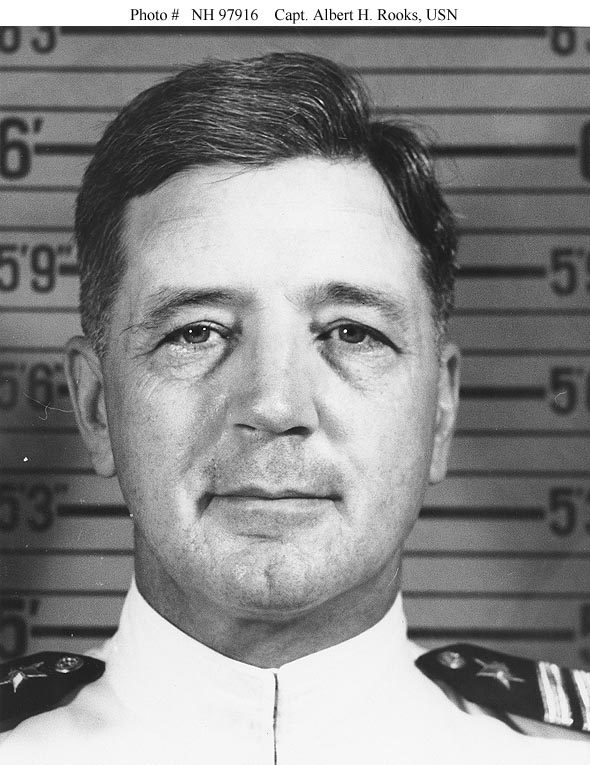
Ships
- USS Phelps (DD-360) Captain from 26 February 1936
- USS Houston (CA-30) Captain from 30 August 1941 · In command when she was lost, 1 March 1942
Albert Harold Rooks was born in Colton, Washington, on 29 December 1891. Appointed to the Naval Academy from his home state, he entered as a midshipman on 13 July 1910 and graduated with the Class of 1914. He was commissioned ensign on 6 June 1914 and joined the armored cruiser West Virginia. Over the years that included the First World War he also served in St. Louis and Mohican, and he commanded the submarines A-5, B-2, and F-2.
He later commanded the submarine H-4. In 1921 he joined the staff of the Twelfth Naval District at San Francisco and remained there until 1925, when he was promoted to lieutenant commander. Duty in the battleship New Mexico followed, and then a tour at the Naval Academy. In 1930 he helped place the new heavy cruiser Northampton in commission and served in her until 1933, when he returned to the Academy. He was promoted to commander on 27 January 1935.
Commander Rooks took command of the new destroyer Phelps on 26 February 1936, the day the ship was commissioned at the Fore River yard in Quincy, Massachusetts. Phelps (DD-360) was a Porter-class destroyer leader, laid down in January 1934 and launched in July 1935. In November 1936 she sailed with the cruiser Chester as escort to Indianapolis, which carried President Franklin D. Roosevelt to Buenos Aires for the Inter-American Peace Conference. The cruise included goodwill visits to Montevideo and Rio de Janeiro. Rooks stayed in command into 1938.
From Phelps he went to the Naval War College at Newport, Rhode Island, first as a student and then on the staff. On 1 July 1940, still at Newport, he was promoted to captain. The next year he was ordered to the heavy cruiser Houston, flagship of Admiral Thomas C. Hart's Asiatic Fleet.
Houston spent the opening months of the Pacific war in the defense of the Philippines and the Netherlands East Indies. Early in February 1942, while she moved with a mixed Allied force toward a Japanese landing, Japanese bombers found her. She came through several attacks. A later strike put one of her main-battery turrets out of action and killed about sixty of her crew. Within a few days Rooks had the cruiser ready for sea again. He sailed from Darwin as escort for a reinforcement convoy bound for Koepang, on Timor. Another air attack was fought off with little harm to the convoy, the movement was canceled, and he brought the ships back to Darwin.
On 27 February 1942 Houston fought in the Battle of the Java Sea. With the British cruiser Exeter she carried a large share of the Allied gunfire, and her salvos badly damaged one Japanese heavy cruiser and may have damaged a second. When the Allied commander broke off the action, Rooks disengaged Houston and got her clear. On the night of 28 February to 1 March, Houston and the Australian light cruiser Perth tried to pass Sunda Strait and met Japanese warships covering a landing on western Java. Both Allied cruisers were sunk in the night battle. Rooks was wounded on the bridge of Houston and died there. He went down with the ship on 1 March 1942, at the age of fifty.
The Medal of Honor was awarded to him after his death for his command of Houston from 4 through 27 February 1942, the weeks of bombing, convoy work, and surface action in which he kept a damaged cruiser fighting stronger Japanese forces. The Navy named the destroyer Rooks (DD-804) for him.