Ships
- USS Prichett (DD-561) Captain, 15 January 1944 – 25 October 1944
Origins
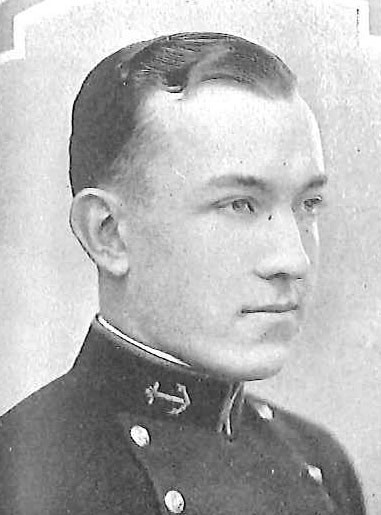
The Navy's own registers fix him before any ship does. Cecil Thilman Caufield was born on 20 November 1903, in Texas, and he entered the Naval Academy from that state on 7 July 1923. The classmate sketch in the 1927 Lucky Bag puts the birth in the city of Waco, in November 1903, and calls him another of "the Caufield tribe." The yearbook's portrait is not a service record. It is what the first class chose to print: a boy who had got through boyhood, then sat in the shade on the campus of Baylor University writing poetry to a blue-eyed girl, and left that shade for brass buttons. The sketch says the suit did not prosper. It does not name the girl, and it does not prove he was enrolled at Baylor. It does say he came to Annapolis meaning to write his name up with Dewey and Farragut.
What the registers add, and the yearbook does not, is the middle name Thilman, spelled out from the 1933 register onward, and the appointment from Texas rather than from some other state with a Waco story attached later. No register consulted here names his parents, a wife, or a child. The "tribe" in the Lucky Bag is a classmate's word, not a genealogy.
Formation
Annapolis, on the yearbook's telling, was a shock to an easy-going and somewhat dreamy Texan. Up at 6:15, in bed at 10, hustling the hours between. Four years later the trusting look had gone out of the blue eyes, the shoulders were as square as the next man's, and the class said he had lived in the shadow of the Awkward Squad, the company for midshipmen who could not yet look like the drill book. The same paragraph insists the change was only apparent. Classmates claimed they had caught him composing sonnets to another blue-eyed girl. They closed by predicting that he would drift back to the lazy, sunny South and lead a lazy, happy life in the land he called home. The service record that follows is the answer to that prediction, and it is not the life they sketched.
He was graduated and commissioned ensign on 2 June 1927. The registers carry a Spanish qualification, code 5-b, "interpreter or translator," from the 1933 register through the 1945 register. That is the only special qualification consistently attached to his name. He was not listed as a naval aviator, a submariner, or an engineering-duty-only officer.
The first named duty found for him is not a ship. The Navy Directory of 1 October 1930 lists Lieutenant (junior grade) Cecil T. Caufield on temporary duty with the National Board of Elections at Managua, Nicaragua, and the directory's roster of that board includes Lt. (jg) C. T. Caufield among the junior officers under the board's president. Spanish on his record and an election board in Managua sit next to each other in the paperwork. The directory does not say what he did there day to day.
By 1 January 1933 the Navy Register has him still a lieutenant (junior grade), date of rank 2 June 1930, on the destroyer MacLeish. The Navy Directory of 1 April 1933 repeats it: Lt. (jg) C. T. Caufield on MacLeish, in a ship's company whose commanding officer was Lt. Comdr. M. R. Derx. MacLeish (DD-220), by the Dictionary of American Naval Fighting Ships, had been on the China station since 1925 and remained in Asiatic and Pacific waters until she was decommissioned at San Diego on 11 March 1938. His name on her roster in 1933 is a tour inside that long commission, not a claim that he was aboard for the whole of it.
On 1 January 1935 the directory has moved him, still a lieutenant (junior grade), to USS Wickes. By 1 October 1935 he is ashore at the Naval Academy, Annapolis. The Navy Directory of 1 January 1936 still lists C. T. Caufield under the Naval Academy in the shore establishment, and the Navy Register of 1 July 1936 still has Cecil Thilman Caufield, lieutenant (junior grade), Spanish qualification, at the Naval Academy. The Register of 1 July 1940 dates his promotion to lieutenant at 30 June 1936, the day before that 1936 register's date. The directories of 1 January 1937 and 1 April 1937 place him among shore-establishment personnel and do not, in the text recovered here, name the station.
The Register of 1 July 1940 is more precise about the return to sea. In the lieutenant's list his present cruise is dated as begun on 29 July 1938; the previous cruise had expired in June 1935, which matches the move from Wickes to the Academy. Sea service in rank was two years and one month; total sea service was ten years and six months. The station printed beside his name is Edsall. The Navy Directory of 1 June 1940 is sharper about the job: Lieutenant Cecil T. Caufield, USS Edsall, executive officer, and the ship's roster repeats "Lt. C. T. Caufield, exec."
Between the Academy and that destroyer's quarterdeck the directory has one more ship. On 1 January 1939, Lieutenant Cecil T. Caufield is on USS Monocacy. The registers do not say what billet he held in her, and this essay does not have the DANFS page for Monocacy in hand.
War years as lived
On 1 April 1941 the Navy Directory still has him a lieutenant, signal number 3118, and it has him on the heavy cruiser Augusta. The ship's roster names the commanding officer, the executive officer, and the first lieutenant, navigator, engineer, and gunnery officer. Caufield is listed beneath them with no title attached. He is aboard. He is not, in that directory, in command of anything.
That line matters because later compilations give him command of the destroyer Fox (DD-234) from 11 January 1941 to 5 May 1942. The April 1941 directory, corrected to a date inside that span, does not put him on Fox at all. The Register of 1 July 1942 lists Cecil Thilman Caufield as a lieutenant commander, Spanish still on the qualification line, with both the temporary-rank column and the permanent-rank column dittoed to lieutenant commander from 1 July 1941, the date printed for his group on that page. His last cruise is shown as expired in May 1942, and a new cruise, or shore duty, as begun in June 1942. Sea service in the rank was one year and three months; total sea service, twelve years and four months. The duty-station column on that page did not survive the copy used here, so the register confirms a change of duty in the early summer of 1942 and does not name the ship.
The next named command is in the Dictionary of American Naval Fighting Ships, not in a directory. Kendrick (DD-612) was launched on 2 April 1942 at Bethlehem Steel, San Pedro, and commissioned on 12 September 1942, Lieutenant Commander C. T. Caufield in command. The Register of 1 July 1944, in the commanders' list, carries his temporary rank date as 1 September 1942, dittoed down the page from an explicit "1 Sept. 42" with no new date intervening before his name. DANFS nevertheless styles him lieutenant commander at the commissioning eleven days later. Both documents can be reported. They do not use the same rank title for the same month.
DANFS then follows Kendrick, not the man, but it names no other commanding officer through the night of 2 September 1943, and a Silver Star citation, as reproduced by the Military Times Hall of Valor, names Commander Cecil Thilman Caufield as commanding officer of Kendrick on that date. On that footing the ship's track from commissioning to that night is the track of his command.
After shakedown on the West Coast she cleared San Diego on 11 December 1942 and reached Casco Bay, Maine, on 28 December for antisubmarine exercises. She joined convoy UGS-4 at New York and sailed on 13 January 1943 for Casablanca, returned to New York on 13 February with another convoy, and worked patrol, escort, and training from Norfolk to Newfoundland. On 28 April she left New York on a round-trip escort to Oran and was back on 8 June. Three days later she sailed again, escorting Rear Admiral Kirk's Task Force 85, which carried Major General Troy Middleton's 45th Infantry Division. She reached Oran, the staging port for Sicily, on 22 June, sailed on 6 July, and was off the beaches at Scoglitti four days later. She guarded transports and landing craft until 12 July, then escorted troop ships back by way of Oran to New York, arriving 4 August.
She was at Oran again on 2 September 1943. That night, DANFS says, a German dive bomber came in on the starboard quarter about fifty feet off the water and launched two torpedoes before Kendrick's gunners shot it down. One torpedo hit the stern and damaged the rudder, the steering compartment, and the fantail. The crew was not harmed. The destroyer turned back toward Oran, stopped long enough to throw life rings to the crew of the plane, and reported their position. Temporary repairs were made at Oran. She was towed to Norfolk and arrived on 26 October.
The citation reproduced by Hall of Valor tells the same night differently. It awards the Silver Star to Commander Cecil Thilman Caufield, Navy service number 0-61118, for action as commanding officer of Kendrick against German aircraft during convoy escort on 2 September 1943. In that text a hostile torpedo bomber severely damaged the ship; Caufield, by seamanship, kept her in station in the convoy; the ship and her company fought the aircraft off and destroyed one torpedo plane; the stern was demolished and compartments were flooded; he kept protection over units of the Allied force and brought the ship to port under her own power. The reproduced citation's closing sentence is garbled in the Hall of Valor text ("highest credit reflect great credit") and is not quoted here as his exact words. File number 61118 is the same number the 1944 and 1945 registers print for Cecil T. Caufield, and the 1945 register's distinction code (E) is the Navy Silver Star.
What can be said without choosing a winner is narrower. On the night of 2 September 1943 he was in command. A German aircraft put a torpedo into Kendrick's stern. His gunners destroyed the plane. DANFS says no one in the crew was hurt, and that he spent time and way throwing life rings to the men he had just shot into the water and reporting where they were. The citation's "under her own power" and DANFS's tow from Oran to Norfolk are not the same sentence. One can be the limp into Oran and the other the ocean crossing after temporary repair. Neither source says which, and neither source says whether he was still the commanding officer when the tow reached Norfolk on 26 October. DANFS carries Kendrick on from there, through a convoy to the United Kingdom, gunfire along the Italian coast, and the invasion of southern France, without naming him again. Those later passages are the ship's, not, on the evidence in hand, necessarily his.
The Register of 1 July 1944 already lists him as a commander, and the name line, though the surname is mangled by the copy, still shows the birth date 20 November 1903 and the entry date 7 July 1923, with the Spanish code beside them. The Register of 1 July 1945 lists Cecil Thilman Caufield, commander, with three distinction codes defined in that volume: (E), Silver Star Medal, Navy Department; (H-1), a special letter of commendation with authority to wear the Commendation Ribbon; and (G-1), the Bronze Star Medal. The text of the commendation was not found. The Spanish code is still there.
DANFS for Prichett (DD-561) says she was laid down on 20 July 1942 at Seattle-Tacoma Shipbuilding, launched on 31 July 1943, sponsored by Mrs. Orville A. Tucker, and commissioned on 15 January 1944, "Comdr. Cecil T. Caulfield" in command. That is the one official ship history that spells him Caulfield. Every Navy Register from 1933 through 1957 that was read for this essay spells Caufield, Cecil Thilman or Cecil T. The commissioning sentence is still the best evidence that he took a new destroyer out of Seattle in January 1944, and that by then the Navy was styling him commander.
Hall of Valor reproduces a second citation, headed as coming from Commander Amphibious Forces Pacific, Serial 2175, of 14 November 1944. It awards the Bronze Star with Combat "V" to Captain (then Commander) Cecil Thilman Caufield, again with service number 0-61118, for service as commanding officer of "a United States Ship" attached to Destroyer Squadron Fifty-Six during the assault and capture of Japanese-held islands in June and July 1944. The citation praises cool direction of accurate gunfire against troops and shore installations, and says the work contributed to the landings. It does not name the ship. A Destroyer History Foundation account of Squadron 56's ships in mid-1944 does not include Prichett. The same foundation's account of Squadron 55 puts Prichett in Destroyer Division 110 with Laws, Longshaw, and Morrison. Those pages are a squadron compilation, not a war diary reproduced here. Until the serial 2175 citation or a war diary is in hand, June and July 1944 cannot honestly be narrated as a cruise of Prichett under his hand, and Prichett's later DANFS narrative, Formosa, Leyte, the bomb on her fantail off Okinawa on 3 April 1945, the kamikaze that wounded her on 29 July 1945, belongs to the ship after any command date this research can prove. The encyclopedia stub and uboat.net both end his Prichett command on 25 October 1944. Neither is a register or a deck log.
His date of rank as captain, in the Navy Registers of 1 January 1952 and 1 January 1957, is 20 March 1945. The 1 January 1956 register's digits read 30 March 1945, which is the odd one out and looks like a misread 2. Hall of Valor's "Captain [then Commander]" on a November 1944 citation fits a write-up completed after the March 1945 promotion, for work done while he was still a commander. By 20 March 1945 the war in Europe had not ended and the war in the Pacific had not ended. No register consulted here names his duty on that date.
Cost
The night off Oran is the only hour in which a source describes him under fire rather than merely present on a ship that was under fire. DANFS is plain that the torpedo wrecked the stern and spared the crew. The cost he is recorded as paying that night was the ship under his feet, not the lives of his men. The citation's version is harder on the hull, flooded compartments and a demolished stern, and harder on him as the man who would not drop out of the screen. DANFS adds a choice the citation omits: he stopped, on the way back to Oran, to put life rings in the water for the crew of the plane his gunners had killed, and he reported where those men were. That is the only decision of his, as distinct from his ship's movements, that any source describes.
He was not killed, and he was not relieved in any document found here for negligence or for the damage. The Navy's 1945 register carried the Silver Star, the Bronze Star, and a commendation ribbon beside his name. The commendation's occasion is unknown. If the ribbon was for the same night, or for the gunfire of the summer of 1944, or for something else entirely, the register does not say.
What the record does not contain is a private cost. No wife is named, no child, no letter home, no breakdown, no court-martial, no wound. The Lucky Bag had promised him a lazy return to Texas. The registers, instead, keep him on the active list for thirty years after graduation.
After
On 1 January 1952 the Navy Register lists Cecil Thilman Caufield as a captain in the line, date of rank 20 March 1945, born 20 November 1903, first commissioned 2 June 1927. The same rank, the same man, is on the active list in the registers of 1 January 1956, where his designator is 1100, and of 1 January 1957. None of those three volumes, in the portions read here, names a ship or a shore station for him. The postwar life, as the registers preserve it, is a captain's place on the lineal list and nothing more visible.
The Register of 1 January 1958 lists file number 061118, the number that has been his since the wartime registers, as a rear admiral on the retired list. The copy used here spells that line CAULFIELD CECIL T. Given the file number, the neighboring retired officers, and the unbroken Caufield spelling from 1933 through 1957, the extra L is treated here as a misreading, not as evidence that he changed his name on retirement. The 1958 register does not print the day he retired or the day he was made rear admiral. It only shows that by 1 January 1958 the officer with that file number was a retired rear admiral, and that a year earlier he had still been carried as a captain.
No obituary, no death certificate, and no grave record were found in this search. Hall of Valor and uboat.net both give 16 April 1984 at San Diego, and both give Waco and 20 November 1903, which the registers and the Lucky Bag support for the birth. The death date and place are not used here as established. What survived in the official paper is the name, the Spanish qualification carried for at least twelve years, three decorations of which two can be tied to a citation text, and the retired rear admiral's line. What the classmates predicted, the drift home to a lazy South, is not in any later record that turned up. Neither is the family, if he had one.