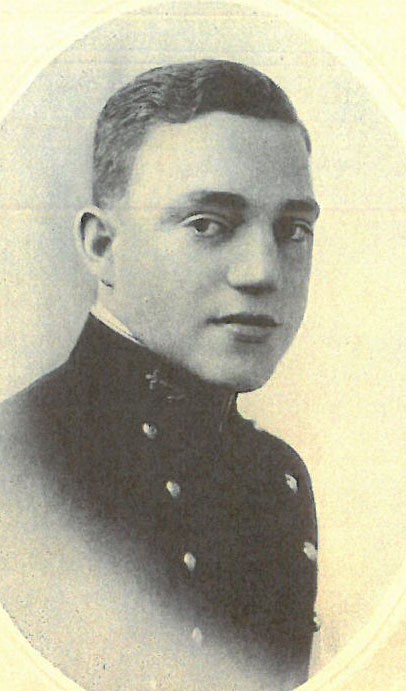
Ships
- USS Edsall (DD-219) Captain, 25 June 1935 – 4 May 1937
- USS Texas (BB-35) Captain from 10 March 1944 · Relieved on 17 August 1945
Charles Adams Baker was born in Lynchburg, Virginia, on 27 September 1893. He graduated from the United States Naval Academy with the class of 1916 and was commissioned in the Navy that June. In the First World War he served in the destroyer Gregory. Later duty took him through cruisers and battleships as well as destroyers. He was gunnery officer of the light cruiser Richmond, and he served in the second Nicaraguan campaign. He was promoted to lieutenant commander on 28 August 1926.
On 25 June 1935, Lieutenant Commander Baker became captain of the flush-deck destroyer Edsall (DD-219), then with the Asiatic Fleet. The tour was the longest seagoing command he held before the Second World War. He was promoted to commander on 1 July 1936 while still in Edsall. He left the ship on 4 May 1937. Edsall remained on the Asiatic Station and was sunk by Japanese forces on 1 March 1942.
Before the United States entered the war he was executive officer of the battleship Maryland. He then served as naval attaché in London under Ambassador John G. Winant, and he was in that post in December 1941. His promotion to captain was dated 8 December 1941. He returned to sea as captain of the battleship Texas (BB-35) on 10 March 1944. The ship had already served off North Africa. Under Baker she fought at Normandy, Iwo Jima, and Okinawa.
In June 1944 Texas joined the bombardment force for Omaha Beach, with Rear Admiral Carleton F. Bryant embarked. On 6 June Baker fought the ship in support of the landings, including the Ranger assault on Pointe du Hoc. On 25 June, off Cherbourg, Texas engaged the heavy German coastal battery known as Hamburg. From the navigation bridge Baker worked the ship through sharp turns under close fire from the casemates. A 240-millimeter shell struck the bridge and threw him to the deck. He got up unhurt, ordered the bridge cleared, and carried on the action from the conning tower while the 14-inch guns kept firing.
For his conduct on 6 June and 25 June 1944 he received the Silver Star. The award recognized the judgment with which he handled Texas under accurate battery fire, the way he closed the enemy when he could, and the steadiness with which he kept the ship to her mission. During a later overhaul at the New York Navy Yard he and Admiral Bryant were photographed with an unexploded German 240-millimeter shell that had hit the ship off Cherbourg.
After the yard period Baker took Texas to the Pacific. At Iwo Jima he directed her bombardment of Japanese positions ashore. From 25 March to 14 May 1945, during the landing and occupation of Okinawa and Ie Shima, the battleship fired a very heavy weight of 14-inch shell, ammunition brought out in four shiploads. For that service he received the Legion of Merit with a combat V. He was relieved as captain of Texas on 17 August 1945, two days after Japan announced the surrender.
On 21 April 1948 the Navy gave him one further day in command so that he could present Texas to the State of Texas as a memorial. He retired on 30 June 1949 as a rear admiral. Charles Adams Baker died in Naples, Florida, on 18 July 1970, and was buried at Arlington National Cemetery.