Ships
- USS Minneapolis (CA-36) Captain from 6 September 1942 · Relieved on 19 July 1943
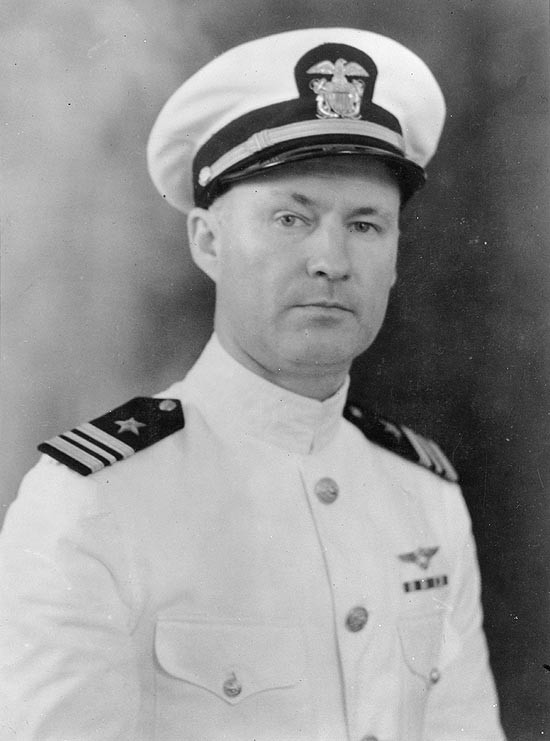
Charles Emery Rosendahl was born in Chicago, Illinois, on 15 May 1892. His family later lived in Kansas and then in Cleburne, Texas, and in 1910 he entered the United States Naval Academy as an appointee from Texas. He graduated with the Class of 1914 and was commissioned an ensign that June. His first sea duty was in cruisers and in the old battleship Oregon. In the First World War he served in the armored cruiser Huntington on troop-escort work and as an engineering officer in destroyers.
After the war he taught at the Naval Academy, then volunteered for the Navy’s rigid-airship program and trained at Naval Air Station Lakehurst, New Jersey. He joined the airship Shenandoah. On 3 September 1925 a squall over Ohio tore the ship apart and fourteen of her crew were killed. Rosendahl was in the forward section. He free-ballooned that remnant to a landing in a cornfield, and the men still with him came down alive. The landing established him as one of the Navy’s leading airship officers, and his flying brought him the Distinguished Flying Cross and the Harmon Trophy.
He served in the airship Los Angeles, advancing from executive officer to commanding officer, studied British airship practice in Europe, and flew in trials of the German airship Graf Zeppelin. He later commanded the large airship Akron. From mid-1932 to mid-1934 he returned to the surface fleet, with duty in the battleship West Virginia and the heavy cruiser Portland. He commanded Naval Air Station Lakehurst from then until 1938. On 6 May 1937 he was on the field at Lakehurst, in command of the station, when the German passenger airship Hindenburg caught fire while coming in to land. He was executive officer of the light cruiser Milwaukee in 1938 and 1939. Promoted to captain on 13 July 1940, he spent the next two years in the Navy Department on airship training and the selection of bases.
On 6 September 1942 Rosendahl took command of the heavy cruiser Minneapolis in the South Pacific. On the night of 30 November 1942, during the Battle of Tassafaronga off Guadalcanal, Japanese destroyers hit the cruiser with torpedoes. About eighty feet of her bow was blown away, three of her four boiler rooms were put out of action, and 37 men were killed and 36 wounded. Rosendahl kept Minneapolis afloat and brought her into Tulagi. He is reported to have told his executive officer, “She is like hell going to sink.” For his conduct as commanding officer through the night of 30 November and 1 December he received the Navy Cross.
He remained in Minneapolis until he was relieved on 19 July 1943. The cruiser was repaired and returned to the war. Rosendahl went back to lighter-than-air duty as chief of naval airship training, with promotion to rear admiral. From 10 September 1943 he was also the principal advisor on airships to the Deputy Chief of Naval Operations for Air. Through the rest of the war he put airship training on a firmer footing and backed a wide run of experiments in flight, engineering, and electronics for the blimps that escorted convoys and hunted submarines. The Navy Distinguished Service Medal recognized that work, including his service as chief of naval airship training and experimentation from 15 May to 14 August 1945.
Rosendahl retired in November 1946 as a vice admiral, after thirty-six years of service. In civilian life he kept arguing, in print and in public, for a return of the rigid airship. He died at the Naval Hospital in Philadelphia on 17 May 1977.