Ships
- USS Wilson (DD-408) Captain, 10 October 1943 – 1 March 1944
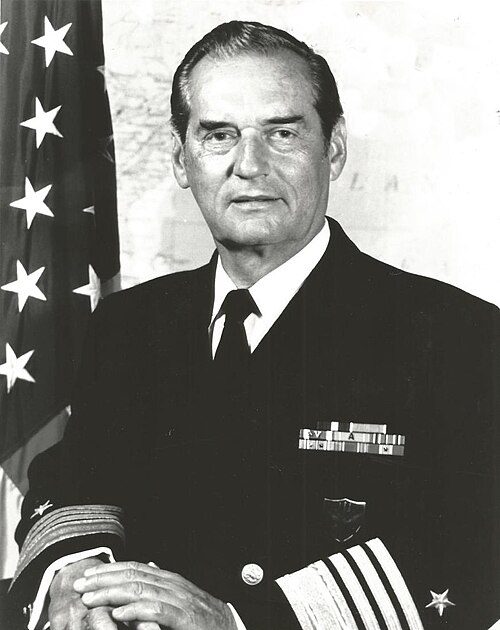
Charles Kenney Duncan (7 December 1911 – 27 June 1994) was a United States Navy officer from Kentucky who graduated from the Naval Academy in 1933 and retired in 1972 as a four-star admiral. He spent his junior years in the heavy cruiser Salt Lake City and the destroyer Schenck, then on the staff that readied the fifty destroyers transferred to Britain in 1940. In the Second World War he was the first executive officer of the new destroyer Hutchins, which fought in the Solomons approaches and the Aleutians, and then commanded the destroyer Wilson in the South and Central Pacific from the autumn of 1943 into early 1944. He received two Navy Commendation Medals with the Combat “V.” From 1944 he worked in the Bureau of Naval Personnel on officer procurement, sat on the Holloway Board that reshaped postwar officer education, and later returned to personnel work at the highest level. He commanded an amphibious transport and a destroyer division, held amphibious and cruiser-destroyer force commands, led the Second Fleet, and from 1968 to 1970 was Chief of Naval Personnel. From September 1970 until his retirement he was Supreme Allied Commander Atlantic, and concurrently Commander in Chief Atlantic and Commander in Chief of the U.S. Atlantic Fleet. He died of cancer at the Scripps Clinic in La Jolla, California.
He was born in Nicholasville, Kentucky, on 7 December 1911. The sources examined here agree on the town and the date. When he was nine his mother became a full professor at the University of Kentucky, and the family moved to Lexington. Her given name does not appear in the Navy registers, Academy yearbook, or official career sketches consulted for this account. What those sources do establish is that education framed his childhood: University High School in Lexington, then Kavanaugh Preparatory School, then a period at the University of Kentucky itself before he entered the Naval Academy.
The 1933 Lucky Bag remembered him as a Lexington boy and a Kappa Alpha from the university who arrived with “the straight dope on fine horses and good looking women.” The nicknames were “Dune,” “Sonny Boy,” and “Charlie.” Academics gave him little trouble; sleep mattered more. “Nine-thirty of ’most any night found him turned in.” The sketch credited him with a “winning personality and untold faith in self,” and predicted that he would “go far in this old world.” He wrestled for three years, worked on the yearbook staff, and was a midshipman petty officer. The register of 1941 records his Naval Academy entry in July 1932 and his graduation and commissioning date as 28 June 1933 (other summaries give 1 June). He stood in the middle of a large class. Thomas Hinman Moorer, later Chief of Naval Operations and Chairman of the Joint Chiefs of Staff, was a classmate and would cross his path again on the Salt Lake City and, decades later, at the top of the Navy.
Commissioned an ensign, he went to the heavy cruiser Salt Lake City of the Scouting Force and stayed in her for five years. The Navy Register of 1934 lists him there among the new ensigns of his class. The Navy Directory of 1937 still has him aboard as a lieutenant (junior grade). In a letter written decades later to the ship’s association, he called that company “one of the best ship companies I have ever seen” and recalled an extraordinary concentration of future flag officers in the wardroom of 1933: Jerauld Wright as gunnery officer, Thomas Moorer among the ensigns, Roy L. Johnson among the aviators attached for the scout planes. Three men from that early company, including Duncan himself, would in time hold the concurrent Atlantic commands of Commander in Chief Atlantic Fleet, Commander in Chief Atlantic, and Supreme Allied Commander Atlantic. He remembered his own junior tours in detail: a short spell as assistant turret officer in turret two, then assistant torpedo officer, six months as assistant navigator, six months in engineering, about two years as turret officer of turret four, and then assistant fire-control officer. Those years taught him habitability and the ordinary life of a big-ship crew. In his oral history he later spoke of wanting ships to be more livable, a lesson he dated to the Salt Lake City.
In 1938 he transferred to the Atlantic and to the old destroyer Schenck. The Navy Directory of 1939 lists him in her as a lieutenant (junior grade). Destroyer life was different from a treaty cruiser’s: closer to the sea, closer to the crew, and, as war approached in Europe, closer to the work of neutrality patrol. In June 1940 he joined the staff of the commander of destroyers in the Atlantic organization then taking shape. The Navy Directory of 1940 records him as lieutenant, aide and flag lieutenant on the staff of the commander of destroyers, Patrol Force, with the flag in the light cruiser Omaha. Contemporary career summaries place that assignment at the creation of Commander Destroyers, Atlantic Fleet. The work included preparing the fifty over-age destroyers that the United States transferred to Britain. The oral-history index to his reminiscences places him with that staff under Vice Admiral Ferdinand L. Reichmuth during the Halifax turnovers, and records his strong reaction to the hard, poorly supported early months of North Atlantic convoy escort.
It was on that duty that he met Sheila Taylor of Halifax, Nova Scotia. They married in Bermuda on 30 July 1941, according to the dated entry in the oral-history index. Bermuda was then becoming an American base; he was a destroyer staff officer on the edge of a war that had not yet formally claimed the United States. Pearl Harbor came four months later. By his own later account he was still with the Atlantic destroyer organization when the news arrived.
In 1942 he was ordered as executive officer to commission the new Fletcher-class destroyer Hutchins at the Boston Navy Yard. She was launched on 20 February 1942 and commissioned on 17 November 1942 under Lieutenant Commander E. W. Herron. Duncan was her first executive officer. Fitting out and shakedown filled the winter. Early in 1943, after trials in Casco Bay, she escorted tankers south, transited the Panama Canal, and reached San Diego in April. An escort voyage into the South Pacific followed—New Caledonia and Espiritu Santo—before she put into Pearl Harbor at the end of May for armament work.
There, on 25 June 1943, while testing her guns in Hawaiian waters, an electrical failure caused a gun to fire into the ship’s stack. Nine men were killed and twenty wounded. The official history records the accident without naming the executive officer; Duncan’s oral-history index lists “a tragic accident” in the Hutchins narrative at the same stage of the cruise. While the ship repaired at Pearl Harbor she was fitted with the newest Combat Information Center equipment. She returned to San Diego in July and then sailed north with an LST group to Adak. On 15 August 1943 she took part in the occupation of Kiska after the Japanese had evacuated the island. In the months that followed she patrolled the Aleutians and trained with the fleet in those cold waters. Duncan later spoke in his oral history of the Aleutian campaign’s need for radar and of the failure to equip crews properly for Arctic weather.
By then he had been selected for command. On 10 October 1943 he took over the Benham-class destroyer Wilson from Lieutenant Commander Walter H. Price. The Wilson was already a veteran. Under Price she had fought at Savo Island in August 1942, rescued survivors from the burning cruisers, and later screened carriers and bombardments through the Solomons. Some later secondary accounts confuse that earlier record with Duncan’s own command and place him in the Wilson at Savo. The ship’s chronology and the command lists do not. Duncan’s months in her began in the autumn of 1943.
What those months held can be followed in the ship’s official history, which does not name him but describes the operations that fell inside his dates of command. In mid-October the Wilson screened landing craft to Vella Lavella. In early November she was back with the carriers for the raids on Rabaul. On 5 November, during Rear Admiral Frederick C. Sherman’s strike, she picked up the three-man crew of a ditched Avenger. On 11 November, when Japanese aircraft came out against the carriers, she stayed near the Bunker Hill at nearly thirty knots through a running air battle of almost two hours and was credited with two of the twelve enemy aircraft shot down by her part of the formation. Later in November she screened carrier strikes on Nauru and covered the occupation of Makin and Tarawa in the Gilberts, steaming on the half-way line between the two islands as an antisubmarine and antiaircraft screen for the carriers. At Christmas she exercised with the battleships Washington and North Carolina. At the end of January 1944 she sailed with a strong force built around Bunker Hill, Cowpens, Monterey, Iowa, and New Jersey for the strikes on Kwajalein, then supported the carrier attacks on Truk and the first raids against Saipan and Tinian. Somewhere in that sequence Duncan’s oral history has him developing “a little CIC” on board and working through “various missions” and “flexibility in operations.”
Two compilations of commanding officers differ slightly on when he was relieved: one gives 27 February 1944, another 1 March 1944. Both agree that his successor was Colin Jack MacKenzie. The sources examined here do not preserve the texts of Duncan’s two Navy Commendation Medals with Combat “V,” only the fact of the awards, associated with his destroyer combat service. By April 1944 he was ashore in Washington as assistant director of naval officer procurement in the Bureau of Naval Personnel. He became director of that office and held the post into 1946. More than a hundred thousand officers were commissioned while he held it, according to a later biographical sketch drawn from his own career materials. He also sat as the junior member of the Holloway Board, convened near the end of the war to study the form and method of educating naval officers. In a published excerpt from his Naval Institute oral history he described the board’s work in his own words: the report went through Admiral Ernest J. King (“which wasn’t easy”) and Secretary James Forrestal (“which was easy”); it strengthened the Naval Reserve Officers Training Corps and aimed for roughly half the Navy’s officer input from sources other than the Academy; and it pointed the path for postwar procurement just as demobilization planning began. He also spoke of the wartime V-12 college program as “a very wise and statesmanlike move” that both produced talented officers and helped keep American colleges alive under wartime pressure.
The war thus ended for him not on a bridge under air attack but in an office that decided who would wear the uniform afterward. The contrast is sharp, and it is documented. The young destroyer officer who had buried shipmates after a gun accident, frozen on Aleutian patrols, and conned a screening destroyer through the Rabaul raids and the Gilberts and Marshalls spent the last year and more of the conflict choosing and schooling the next generation of officers.
After the war he became executive officer of the battleship Wisconsin, including a midshipmen’s cruise and a special mission that took the ship to the inauguration of a Chilean president in 1946. A family illness in 1947 forced him to ask for shore duty; the oral-history index records that crisis and a later one that again kept him ashore. He attended the Armed Forces Staff College, then served in the plans division of the Atlantic Fleet staff in the years when the new NATO naval command was being designed and when the outbreak of war in Korea suddenly changed every force-level calculation. He commanded a destroyer division out of Norfolk, with his flag in the Noa and the Corry, Meredith, and Leary in company. He later commanded the amphibious attack transport Chilton, his first prolonged experience of amphibious shipping, including Mediterranean duty around the time of the Suez crisis. In the mid-1950s he was executive assistant to the Chief of Naval Personnel, Admiral James L. Holloway Jr., and watched at close range the fights over early selection, graduate education, and the Navy’s relations with Hyman Rickover’s nuclear program.
Promoted to rear admiral in the summer of 1958, he took Amphibious Group One and then the Amphibious Training Command, Pacific Fleet, at Coronado. In January 1961 he became commander of the naval base at Subic Bay in the Philippines. Contemporary career sketches record that he served as president of a Philippine charitable association and as vice president of the Philippines Tubercular Association, and that he was made an “adopted son” of the provinces of Bataan and Zambales. From 1962 to 1964 he was again in BuPers as assistant chief for plans and programs. He then commanded the Atlantic Fleet Cruiser-Destroyer Force (1964–1965) and the Atlantic Fleet Amphibious Force (1965–1967). For the amphibious-force tour he received the Legion of Merit; a later synopsis in the Military Times Hall of Valor database dates that award to 15 June 1965 – 16 May 1967 and identifies him as a vice admiral and Commander Amphibious Force, U.S. Atlantic Fleet. He commanded the Second Fleet and NATO’s Striking Fleet Atlantic in 1967–1968.
From April 1968 to August 1970 he was Deputy Chief of Naval Operations (Manpower and Naval Reserve) and Chief of Naval Personnel. The oral-history summary of those years stresses manpower cuts forced by the budget, testimony before Congress, and the strain of reducing the Navy while the Vietnam War continued. On 30 September 1970 he became the seventh NATO Supreme Allied Commander Atlantic, and at the same time Commander in Chief Atlantic and Commander in Chief of the U.S. Atlantic Fleet. He held the three posts concurrently until he retired on 1 November 1972. As Supreme Allied Commander he conducted what contemporary accounts call the largest NATO naval exercises held until that time. The Netherlands awarded him the Grand Cross of the Order of Orange-Nassau with Swords; Portugal awarded him the Grand Cross of the Order of Aviz. A NATO press release of September 1972 recorded the Defence Planning Committee’s “lasting gratitude” on his relief by Admiral Ralph W. Cousins.
After retirement he lived for a time near Leesburg, Virginia, remaining on the Secretary of the Navy’s Advisory Board on Education and Training and on the Board of Advisors to the president of the Naval War College. By the late 1970s he had settled in Coronado, California. He joined the board of trustees of the San Diego Museum of Art in 1981 and in 1984 was elected to France’s Académie de Marine. He was named a Kentucky colonel and, in February 1965, had already been installed in the University of Kentucky’s Hall of Distinguished Alumni. Sheila Duncan appears with him in Coronado civic occasions in the early 1960s; a later secondary account states that he married Jean Keyser in Coronado in December 1986 and that he had two adopted children, Anne and Bruce, and two stepchildren, Casey and Amy. Those family details rest on that secondary account and are not independently confirmed in the Navy registers or the oral-history index examined here.
He died of cancer on 27 June 1994 at the Scripps Clinic in La Jolla, at the age of eighty-two. The Washington Post obituary of early July 1994, by J. Y. Smith, gives the date, the place, and the cause, and observes that Atlantic command was the capstone of a sea career but that his personnel work had set policies that “remain in effect today.” A shipmates’ association notice once printed a death date two days earlier; the newspaper’s date is preferred here. He had worn the uniform for thirty-nine years from his commissioning in 1933, forty if the midshipman year that began in 1932 is counted.
What survives of him in the open record is not a single battle citation with a paragraph of vivid action, but a long arc: a Kentucky boy who learned big-ship seamanship in a famous cruiser, learned the destroyer trade on the edge of the Battle of the Atlantic, took a new ship through a fatal gun accident and the Aleutians, commanded another through the carrier battles of late 1943 and early 1944, and then spent much of the rest of his life deciding how the Navy would find, educate, and keep its officers—and, at the end, how an alliance of navies would steam together in the Atlantic.