Ships
- USS Heermann (DD-532) Captain, 6 July 1943 – 1 May 1944
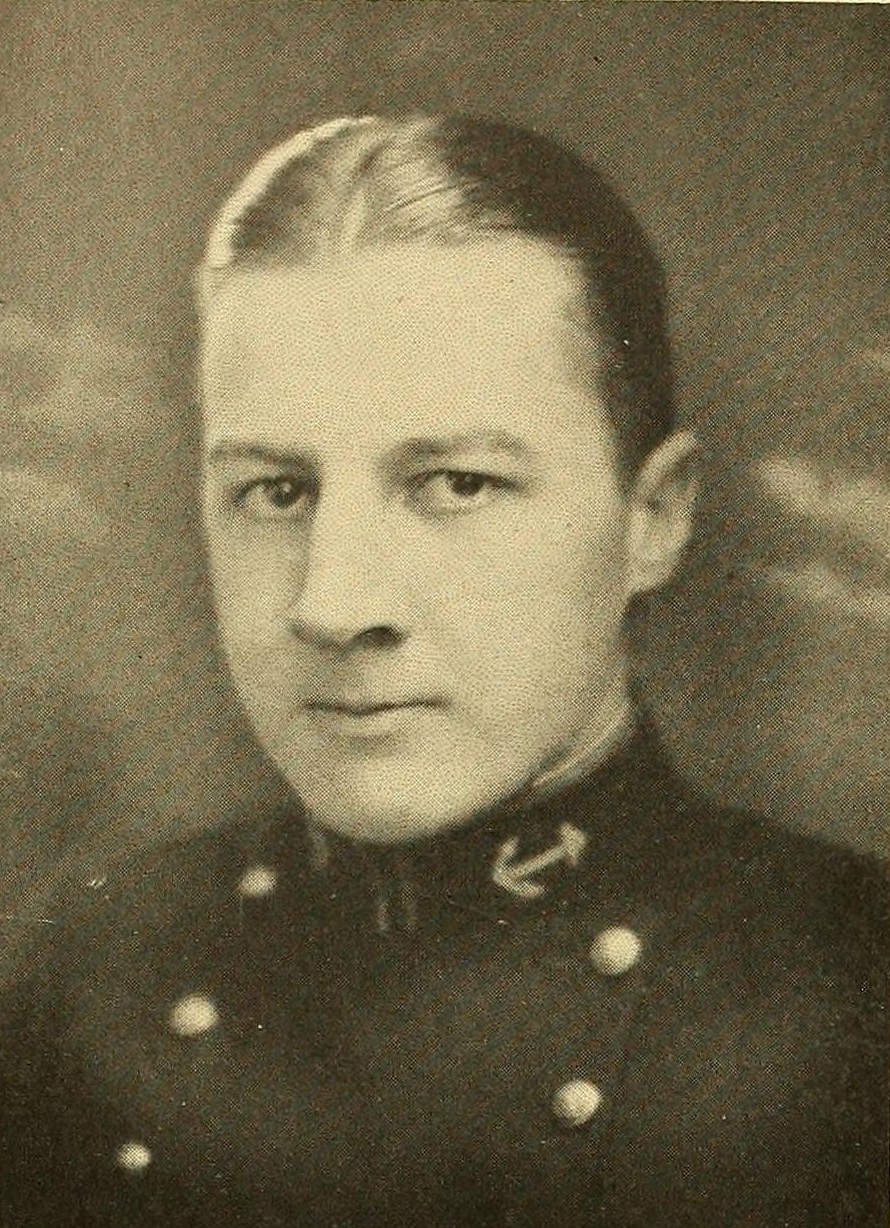
He was born on the first day of 1902 in Fredericktown, Ohio, and he died on 4 October 1969, three days before the Navy buried him at Arlington as a rear admiral. Between those dates the record is thick where the ships were and thin where the man was. What can be written without invention is still a life: an Annapolis officer who missed the opening minutes of the war on his own quarterdeck, who ran two old minesweepers out from under three Japanese destroyers and was given the Navy Cross for it, who commissioned a new Fletcher and took her through Tarawa and the Marshalls, and who was gone from her before she became famous off Samar. He left a wife who outlived him by more than twenty years and one son, born in Honolulu, who grew up to command ships of his own.
The parents, the high school, and the year or two before the Naval Academy are not secure in the sources read for this essay. A Wikipedia article names Murray Agnew and Emma Louise Follin, a Fredericktown high-school diploma, and a short stay at Denison University, and it points for all of that to a Navy biographical file that could not be recovered here. What is firm is the birth, the place, and the Academy. Hall of Valor, uboat.net, and a 1954 National Security Agency personnel sketch all put his birth at Fredericktown on 1 January 1902, and all three put him in the Naval Academy class of 1926. He was commissioned ensign that year. Uboat.net, a secondary compilation of officer registers, gives the midshipman date as 23 June 1921 and the ensign date as 3 June 1926. The five years between those dates is longer than the usual course. Whether he entered early, repeated a year, or the compilation has slipped, the registers consulted here do not settle.
The same 1954 sketch, printed while he was deputy chief of staff at NSA and still a captain, is the only connected account of the peacetime sea duty. It says that after graduation he served in Omaha, Gamble, and Nevada, and that in 1939 he was officer in charge of the naval radio station at Guantánamo Bay. The Register of Commissioned and Warrant Officers in force after 1 July 1941 lists him as a lieutenant commander, number in grade 1445, and the mangled columns beside his name include the dates 3 June 1939 and April 1939, which fit a shore tour begun that spring better than they fit a date of rank. Uboat.net dates the lieutenant commander rank itself to 3 June 1941. None of this is a portrait. There is no Lucky Bag sketch in hand, no letter, no record of how he kept a watch or ran a turret.
What the family record does hold is narrower and better. Their only child, Dwight Merle Agnew Jr., was born in Honolulu on 6 September 1931. His obituary calls him a Navy junior and the only child of Dwight M. Agnew Sr. and Thelma (Biegler) Agnew. So by the early 1930s the household was already a Pacific one, years before the war. Thelma’s dates at Arlington are 10 April 1906 to 28 March 1991; she was buried on 1 April 1991 in the same grave as her husband, Section 4, Grave 64. Their son’s obituary names her father as Colonel George H. Biegler, a Medal of Honor recipient and, in that telling, one of the founders of USAA. The Congressional Medal of Honor Society records a Lieutenant Colonel George Wesley Biegler, awarded the Medal for an action near Loac, Luzon, on 21 October 1900 — nineteen men against a much larger force — who died at the Presidio of San Francisco on 2 April 1929. The initial does not match, and USAA’s own founding account, as checked here, does not name him. The marriage itself is dated to October 1929 only by a Los Angeles Times headline cited on Wikipedia and not read for this essay. The wife, the son, and the Honolulu birth do not depend on that notice.
By the morning of 7 December 1941 he was lieutenant commander in command of USS Trever (DMS-16), a Clemson-class destroyer reclassified as a high-speed minesweeper in November 1940. She lay nested in West Loch with Zane, Wasmuth, and Perry, the whole of Mine Division 4, off the Pearl City Yacht Club. He was not on board when the attack opened. The Wasmuth action report is precise. At 0932 Wasmuth got underway following Trever. At 0937 her executive officer came aboard and took command from a junior officer who had fought the ship from the start. At 0940 Lieutenant Commander D. M. Agnew, commanding officer of Trever, reported aboard Wasmuth. He stayed there through the afternoon sweep of the entrance channel. At 1635 Wasmuth’s own captain was back, and Agnew left to join Trever. DANFS, which misinitials him once as D. A. Agnew, says the same thing in plainer language: many ships, Trever among them, went to sea without their captains, and he had gone out in Wasmuth. Where he was at 0755 — home, a boat, the naval station — is not in the reports. The ship fought without him. DANFS credits Trever’s .50-caliber guns with two Japanese aircraft in those first minutes, one into a hillside by the yacht club and one that lost its wings and crashed near Beckoning Point. That morning belongs to the people who were there. His war began as a commanding officer looking for his own ship.
A week later the deck log puts him, or at least his ship under his command, to a different kind of work. On 14 December Trever was patrolling off Oahu and Molokai. At 0355 the watch sighted lights and a flare. At 0422 they had the Norwegian motor ship Høegh Merchant in sight, sinking, her people in boats. She had been bound for Manila with general cargo and explosives, had been turned back toward Honolulu after the outbreak of war, and had been torpedoed before dawn off Makapuu Point — by I-4 or I-16, the submarine accounts disagree; Robert J. Cressman’s Navy chronology and Trever’s log agree on the date. The log records the freighter gone at 0533, then the rescue: twenty-three from two boats, six from a third, eleven from a fourth. Thirty-five crew and five passengers, all of them, transferred at 0904 to Coast Guard cutter CG-403. A Norwegian account of the captain’s report adds that Trever’s commander later told the survivors he had seen the fire from seven miles away. The log does not preserve that sentence. It does preserve the times, the courses, and the fact that by late morning Trever was back on patrol and by afternoon had gone into Pearl and out again. Forty people who would otherwise have been in open boats off Oahu a week after the raid were not. That is the first recorded thing his command did after the attack that he missed.
The next months, in the ship history, are minesweeping, local escort, and antisubmarine patrol, then a convoy to the California coast in April 1942 and a long overhaul at Mare Island. The yard took off the 4-inch guns and gave her 3-inch antiaircraft guns and 20-millimeter cannons. She was back at Pearl on 2 July. In company with Zane and others she went south into the force gathering for the first American amphibious assault of the Pacific war.
Trever arrived off Guadalcanal on 7 August 1942. She screened transports, then was sent with Hovey and Hopkins to bombard. Japanese guns on Gavutu opened at 0807. A minute later they were straddling the column. Trever’s 3-inch and 20-millimeter answered; at 0830, DANFS says, a direct hit silenced the battery. Later that day her antiaircraft fire helped drive bombers off the transport area. On the 8th, in a four-minute fight with twin-engine Bettys, she helped splash four. That night the cruisers were surprised off Savo Island and four of them were sunk. On the 9th Trever screened the transports out to Nouméa. She was back in mid-September with reinforcements, and again in October.
On 13 October, after Cape Esperance, Trever and Hovey were sent to look for survivors. DANFS says Trever took aboard thirty-four Japanese, three of them officers. One raft of eight refused to surrender and fought. The history’s sentence is blunt and does not quote the captain: the ship was given “no recourse but to destroy it and its occupants.” The prisoners who did come aboard were turned over to McCawley. The citation that later praised him does not mention this hour. It is part of the cruise anyway. The sources do not record what order he gave, or whether he gave one that the officer of the deck could not already see. They record what the ship did while he commanded her.
The action that the Navy chose to decorate came twelve days later, and the two ship histories do not tell it in quite the same voice as the citation.
Zane’s DANFS is the fuller one. At Espiritu Santo the two minesweepers loaded drums of aviation gasoline, torpedoes, ammunition, and stores, each took two motor torpedo boats in tow, and they made Tulagi at 0530 on 25 October 1942. Trever finished unloading by 0700. An air-raid alarm came at 0809. At 0955 the Tulagi signal station reported three enemy ships in the strait between Savo and Florida, entering Ironbottom Sound. Someone recommended that Agnew take his ships up the Maliala River, where the gunboat Jamestown and the damaged seaplane tender McFarland were already lying camouflaged. He would not. Zane’s history says he took a dim view of it, and gives the reason in his words: he did not want to be “trapped like rats.” Trever’s history uses the same phrase, “rats in a trap,” and adds the tactical point the recommendation ignored. Zane and Trever were not camouflaged. If they ran in beside the two ships that were, they might lead the Japanese onto all four.
He ran the other way, for Sealark Channel. They cleared the Tulagi channel at 1014. Lookouts picked up three ships at about 21,000 yards. Zane names them: the destroyers Akatsuki, Ikazuchi, and Shiratsuyu, sent to bombard Henderson Field, each armed with six 5-inch guns. The minesweepers had 3-inch guns and old machinery. The black gangs got 29 knots out of them, by Trever’s account; the Japanese, making something like 36, closed and opened fire while still outside the reach of the American guns. Zane puts the range at about 9,200 yards when the first salvos came, around 1030, and says the enemy was shooting bombardment ammunition rather than armor-piercing shell. The minesweepers zigzagged and fired back. Shells fell close aboard. One hit Zane on the number-one 3-inch mount and killed three men at once. Other shells cut rigging and halyards. The ensign stayed up.
At 1040 the Japanese turned away. They had not been driven over the horizon by two old sweepers. They went to engage the fleet tug Seminole and a small patrol craft off Lunga Point, sank both, and retired under air attack from Henderson Field. Trever and Zane hauled off to the east. Agnew had already decided, as the chase developed, that he could not make Sealark Channel and had started to turn for the shoals of Niella Channel — Trever’s history; Zane’s does not need that turn, because the enemy had already left. The two accounts can sit together. The choice to run was his, the phrase was his, three of Zane’s men died, and the superior force broke off to finish a different job.
The Navy Cross, awarded by Commander, South Pacific Area and Forces, serial 482, tells the morning as a victory of handling. It covers the whole Solomons tour, not only the twenty-fifth: repeated air attacks; the screening, fire support, and minesweeping of 7–9 August; the later supply runs; then the task unit that got its cargo into Tulagi on 25 October and, while retiring, was attacked by three Japanese destroyers. “He fought his ships with such brilliant success, that no considerable damage or loss of personnel resulted, while his vessels inflicted several hits on one enemy destroyer, setting it on fire.” The withdrawal was “skillful and seamanlike,” the conduct “in keeping with the highest traditions of the Naval Service.” The citation styles him Commander. On 7 December 1941 the Wasmuth report had styled him lieutenant commander. Uboat.net dates a temporary commander rank to 15 August 1942, before this action, and a hometown headline of 7 December 1942, cited but not read here, is “Dwight Agnew Now Commander.” The promotion’s exact day is messy. The citation’s combat claim is the sharper problem. The ship histories record three dead on Zane and do not record a Japanese destroyer set afire. A 1954 NSA personnel sketch goes further than either: a nineteen-minute battle in which one destroyer was damaged and all three were routed by the two four-stackers. The times in Zane run from a sighting at 1014 to a turn-away at 1040. Nineteen minutes can be made to fit a generous reading. “Routed” does not fit the history of Seminole.
He stayed in Trever into the new year. The ship kept running gasoline to Tulagi — 175 drums on one trip in Trever’s history, 176 in another telling — through January 1943, then went to Sydney for overhaul, arriving on the 27th. Uboat.net ends his command on 7 February 1943. DANFS does not name the relief. If that date is right, he left her during the Australian yard period, after the fighting that made his name and before the New Georgia landings the ship still had ahead of her. The next five months are a gap. The NSA sketch jumps from the Slot to Heermann. Wikipedia says he was sent to San Francisco to oversee the new destroyer’s fitting out. That is plausible and unconfirmed here. Heermann had been launched at Bethlehem, San Francisco, on 5 December 1942. She was not yet his.
She became his on 6 July 1943, when she was commissioned at San Diego with Commander Dwight M. Agnew in command. The 2019 DANFS, written close to the deck logs, is the best account of what he actually did with a new ship, and it is not a battle piece. It is a long education.
She provisioned and began shakedown in the San Diego approaches, mooring daily at buoy 18, going out for speed trials and firing drills. Trials ended on 26 August. The next day she entered San Francisco in heavy fog and moored at the builder’s pier for post-shakedown repairs. On 2 October she sailed back south. On the evening of the 4th she stood out for Pearl, through the nets at 1055 on the 10th, and spent the next ten days at daily firing practice. On 21 October she joined the Fifth Fleet and screened the carrier Bunker Hill toward the Gilberts. On the 23rd she attacked a sound contact with depth charges and got nothing. On the 28th she left formation to pick up the crew of an Indiana Kingfisher, two officers and one enlisted man, and sent them back by breeches buoy.
Tarawa was the first time the new ship shot at an enemy she could see. With Rear Admiral Harry W. Hill’s Southern Attack Force she was off the atoll on 20 November, in the transport screen. At 0559 the crew found a small vessel on a northerly course and tracked it to engage. Agnew’s own observation, preserved in the history, is the correction daylight forced on them: “With the approach of dawn and improved visibility it was seen that the ship was inside the lagoon.” Ten minutes after the sighting, Heermann opened fire at 1,200 yards, made several hits, started extensive fires, and watched the craft — estimated at 100 to 200 tons — try to beach and sink short of it. That evening a Betty came in at 8,000 yards. The guns fired. The plane got away. At 2020 the destroyer ran aground on a reef in less than two and a half fathoms. She came off hours later by backing as the tide made. The history calls the damage minor and the episode a minor embarrassment. The sound gear was left inoperative, probably from the vibration. A new ship, first action, on the reef.
Before dawn on the 21st another Betty passed close aboard to port on an opposite course, 400 to 500 yards, and dropped a torpedo. Agnew ordered “full right rudder and emergency back full on the starboard engine.” The torpedo passed close aboard, tangential to the track. The 5-inch opened, and the plane escaped, largely because the main-battery crews were confused about whether they were to fire on a target already identified. He called it “a beautiful opportunity missed.” The sentence is the most characteristic thing the logs have kept of him. He had just been missed by a torpedo at point-blank range, and what he wrote down was the shot his ship did not make.
Later that morning he took her into the lagoon for close fire support. She stayed through the night and into the next day, creeping fire in forty-yard steps against Japanese movement ashore, and at one point, the history says, her guns alone destroyed a body of troops and a machine-gun nest. He judged the shelling “very effective at moving the Japanese troops.” She replenished ammunition more than once and was still firing into the evening of the 22nd. On the 23rd the assault was essentially over. She had already left, about 1930 on the 22nd, with a task group for Pearl, and she was there on 1 December for repairs that lasted into January.
The Marshalls were the same kind of work, longer and less tidy. She sailed on 23 January 1944 with the attack-transport reserve group and was within thirty miles of Kwajalein on the 31st, when Richmond Kelly Turner’s force went ashore. She patrolled the northern transport area, anchored in the lagoon on 4 February, and was out again the next day. On the afternoon of the 7th she was sent after a disabled PBM Mariner, found it, took it in tow at four knots, and rescued the surviving crew. The next day she turned the tow and the aviators over to the minesweeper Revenge. On 17 February she entered Eniwetok and, with McCord, began shooting at Parry Island. Through that day and the next she shelled Parry, Rujiyoru, Bogon, and Engebi, then stood by for calls that mostly did not come. One request, on the 22nd, was for harassing fire. She patrolled, reprovisioned, and on 5 March was sent to Majuro.
From Majuro she went with Destroyer Division 93 to Purvis Bay, arriving 18 March, and the next morning sailed with Destroyer Squadron 47 for Emirau. She was on patrol northeast of the island by the 22nd. On the 26th, still with the division, she helped shell an abandoned freighter on a beach near New Hanover. Radar picked up aircraft closing at nineteen miles; Hoel drove them off. On the night of 2–3 April she was called to help McCord and Hoel hunt a submarine northeast of Mussau. She made a sound contact at 600 yards, dropped a full pattern, followed with five more attacks, tracked the target as dead in the water, and saw, about thirty seconds after the last detonation, a burst of flame. Those are Agnew’s observations. The 2019 history then does the decent thing: American and Japanese records, examined since, have not identified the submarine or shown that one was sunk. He wrote down a flame and a target stopped in the water. The archives will not make that a sinking. The report is his; the kill is not.
Through the rest of April Heermann screened the Emirau convoys. On 1 May 1944 she left with the division for Espiritu Santo. The later list of commanding officers dates Commander Amos T. Hathaway’s assumption of command that same day. The ship’s own war history, less exact, remembers Agnew as July 1943 to April 1944 and Hathaway from April. By 25 May the deck log is quoting Hathaway, irritated at how slowly an escort carrier could fuel a destroyer. Agnew was done with her.
He had had her ten months, from the buoy in San Diego to the Bismarck Archipelago. He had grounded her once, missed a bomber he thought he should have killed, put a small ship on the bottom inside Tarawa lagoon, shelled islands, towed a flying boat, and reported a submarine the record lost. He had not fought a fleet action. Five months after he left, on 25 October 1944 — two years to the day after the run from Tulagi — Heermann was in Taffy 3 off Samar, under Hathaway, and made the torpedo runs and the smoke and the gun duel with Chikuma that put her name into the Presidential Unit Citation. That fight is Hathaway’s, and the crew’s, including men Agnew had trained and men he had never seen. It is not his citation and not his morning. The honest thing is to say he built the ship’s first year and was not there for the hour that defined her.
Where he went in May 1944 is the largest hole in the war years. The 1954 sketch says he was transferred to the staff of Commander, Amphibious Forces, Pacific, promoted to captain, and took part in the assaults on Saipan, Tinian, and Guam. It dates the transfer to 1945. Those landings were in the summer of 1944, while the sketch still has him, correctly, in Heermann for Kwajalein, Majuro, Eniwetok, and Emirau — and, incorrectly, for Green Island, which the deck-log history does not give her. The sketch also calls Heermann DD-535. She was DD-532. A personnel paragraph can be right in outline and wrong in the dates. A staff tour with the amphibious force in the Marianas is possible. It is not established by a command list or a DANFS passage read here, and it is not narrated as fact.
What is established is the next ship. NavSource, from the standard command compilation, makes Captain Dwight Merle Agnew commanding officer of the attack transport Harry Lee (APA-10) from 12 February 1945 to 10 January 1946. Harry Lee had already been to Sicily, Tarawa, Kwajalein, Hollandia, Guam, and Lingayen under other captains. Her own chronology — a ship biography drawing on the usual Navy summaries — has her at Ulithi in February 1945, sailing on the 17th for Iwo Jima, arriving by way of Guam on the 22nd, three days after the landing, sending a reconnaissance party ashore on the 24th, putting her troops on the beach, and remaining until 6 March as a hospital evacuation ship. She then carried casualties to Saipan. If the 12 February date is right, that passage was his. The NSA sketch calls it the assault and capture of Iwo Jima and says he received the Bronze Star with Combat “V” for it. Hall of Valor, which prints the Navy Cross in full, lists no Bronze Star. The sketch is a contemporary claim by his own service biography; the public valor roll does not corroborate it. Until a citation surfaces, the medal is a claim, not a settled decoration. The work, if the dates overlap as they appear to, was not a destroyer action. It was a transport arriving after the worst of the beach, landing troops, and taking the wounded off.
After the surrender the same ship, still under his command into January 1946, went onto Magic Carpet duty, the long hauling of men home. The ship biography has her in San Francisco on 4 November 1945 and back from another Pacific round trip on 20 January 1946. He was relieved on the 10th, ten days before that second arrival. Captain Burlson Dwight Shipee finished the commission; she decommissioned in New York on 9 May 1946. Agnew had brought her through the last amphibious operation and into the repatriation, and he did not take her to the yard.
The postwar skeleton is again the 1954 sketch, and it is better than the wartime one because he was alive and in the job it describes. He attended the Naval War College. He served with the Chief of Naval Operations. He spent two years with the Joint American Military Mission for Aid to Turkey, in Ankara. He then commanded Destroyer Squadron 10 in the Atlantic Fleet and gave that command up in February 1953. A later summary puts the squadron tour at January 1952 to February 1953; the sketch itself gives only the end date. By the summer of 1954, when the newsletter was printed, he was deputy chief of staff at NSA, still Captain Dwight M. Agnew, USN. Heermann’s war history, in its crew roster, gives him an address at No. 4 Hillside Cottages, Route 1, Greenend Avenue, Middletown, Rhode Island. Middletown is the town beside the War College. The roster does not say when he lived there. It is the only street address the sources read here attach to him.
He left active duty on 1 July 1956. Uboat.net carries him from that date as rear admiral, retired. The 1954 newsletter still calls him captain, and nothing read here shows him serving in the higher rank. Arlington records the rank as RADM, U.S. Navy. The advance on the retired list is what the dates imply. The slang for it, and the statutory line that produced it, are not needed to state the fact: he retired a captain with a Navy Cross, and the gravestone rank is rear admiral.
He died on 4 October 1969. Uboat.net places the death in Alexandria, Virginia; no obituary text was found to confirm the town. He was buried at Arlington on 7 October 1969, Section 4, Grave 64. Thelma was buried with him in 1991. Their son graduated from the Naval Academy in 1954, served thirty years, commanded two ships, and died on 18 August 2019 in Hanahan, South Carolina. He was buried at Arlington the next year, a captain, in a different grave in the same section. The obituary lists a wife of thirty-six years, five children, and eight grandchildren. That is the household the 1931 birth in Honolulu eventually became. It is also as far as the evidence goes. There is no letter in which Dwight Merle Agnew says what the reef at Tarawa cost him, or the three men on Zane’s gun, or the raft that would not surrender, or the morning off Samar that belonged to the ship he had left. The sea record keeps his orders and one or two of his sentences. The rest of him is the shape of the commands, and the people who survived him.