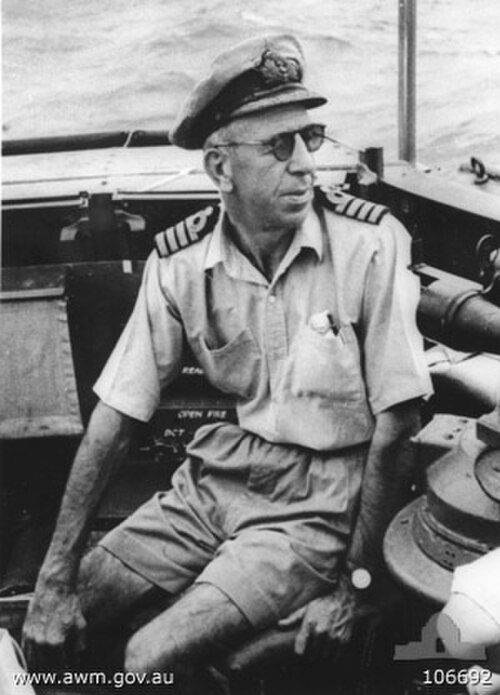
Ships
- HMAS Warramunga (I44) Captain from 23 November 1942
- HMAS Australia (D84) Captain from 9 March 1944 · Mortally wounded in command, 21 October 1944
Emile Frank Verlaine Dechaineux (3 October 1902 – 21 October 1944) was an officer of the Royal Australian Navy who commanded the heavy cruiser HMAS Australia, flagship of the Australian Squadron, from March 1944 until he was mortally wounded on her bridge in Leyte Gulf, in the Philippines, on the morning of 21 October 1944, when a Japanese aircraft crashed into her foremast. He was the son of a Belgian-born Tasmanian artist and teacher, and one of the early entrants to the Royal Australian Naval College. A torpedo specialist who was promoted ahead of his contemporaries, he commanded British warships off Dunkirk and in the North Sea in 1940 and 1941, was awarded the Distinguished Service Cross, and led Australian and American destroyers through the New Guinea, New Britain and Admiralty Islands landings of 1943 and 1944 from the destroyer HMAS Warramunga. He was known as "Dishy". He died some hours after the attack and was buried at sea that night with the others of his ship's company who had been killed. The United States appointed him posthumously an Officer of the Legion of Merit, and a Collins-class submarine of the Royal Australian Navy bears his name.
Dechaineux was born at Launceston, in northern Tasmania, on 3 October 1902. His father, Florent Vincent Emile Lucien Dechaineux, known as Lucien, had been born at Liège in Belgium in 1869 and came to Australia at fourteen with parents who, in the words of his biographer in the Australian Dictionary of Biography, had invested in "a worthless citrus orchard and a salted gold-mine". Lucien studied art at night at Sydney Technical College while working by day as a house-painter, went on to study with Julian Ashton, practised architecture and architectural sculpture, and succeeded his teacher Lucien Henry as lecturer in design at the Sydney college. On 23 December 1891, at St John's Church of England, Darlinghurst, he married a Tasmanian, Isabella Jane Briant, called Ella. In 1895 he was appointed instructor in technical art at the Launceston Technical School. There were three children of the marriage: a daughter, Marguerite, born in 1894; a son, Felix, born in 1898; and Emile, the younger son. His second and third names, Frank and Verlaine, are recorded in every official document of his life; no source explains their choice.
In 1907 Lucien Dechaineux became art master of the Tasmanian Education Department and principal of the Hobart Technical School, and the family moved south to Hobart. The move was followed by two deaths. A chronology compiled for a retrospective exhibition of Lucien's work, published by the University of Tasmania in 1986, records that Ella died in May 1908, and that in January 1909 the eldest son, Felix, died at the age of eleven "after a protracted illness brought on by a school prank". Emile was five when his mother died and six when he lost his brother. Nothing he said or wrote about either loss has survived in the sources examined here.
At the end of 1909 his father married again. Mary Giblin had been a student at his School of Art and was a painter herself; they honeymooned in the Hartz Mountains, where Lucien painted. Their son, Bertrand, was born in 1911 and a daughter, Yvonne, in 1915. The household into which Emile grew was busy with art and talk. Lucien was, the Dictionary says, "not an easy taskmaster; nothing second-rate was good enough; his credo was 'always aim at the highest'". He and his second wife were keen bushwalkers who organised large summer camping parties for artists on Tasmania's east coast and ran a book club for reading and debate. He designed the stained-glass war memorial window in Holy Trinity Church, Hobart, and the great honour roll in the Hobart Town Hall. Emile was educated at the Friends' High School in Hobart.
Dechaineux was thirteen when he entered the Royal Australian Naval College at Jervis Bay. Some summaries of his record date his joining to 31 December 1915; he was a member of the entry of 1916. He was, the Australian Dictionary of Biography records, "an average scholar and sportsman who was popular with his peers". He graduated in 1919 and was promoted midshipman in January 1920, going to sea first in the battlecruiser HMAS Australia, the first ship of the name, and then in the destroyer HMAS Anzac.
Like most young Australian officers of the time he was sent to Britain to complete his training with the Royal Navy. The Australian War Memorial quotes the report of his captain in the battleship HMS Valiant in 1922, who described the nineteen-year-old as able to "take charge well and do the right thing". He was promoted sub-lieutenant that December. He came home in 1924, joined the cruiser HMAS Brisbane and was promoted lieutenant, and moved to HMAS Melbourne in 1925.
The following years made him a specialist. Back in England from 1926 to 1929 he qualified as a torpedo officer and as a naval (air) observer, and in 1929 he was awarded the Ogilvy Medal for taking first place in the advanced torpedo course. Between 1929 and 1934 he served in turn in Anzac, in the Australian Navy's heavy cruiser Australia, and in the British destroyer HMS Kempenfelt. He was promoted lieutenant commander in September 1932, and in 1935 and 1936 was squadron torpedo officer in the heavy cruiser HMAS Canberra.
On Friday 20 November 1936, at St David's Cathedral in Hobart, he married Mary Grant Harbottle, the only daughter of the late Major Frank Harbottle and of Mrs Alan Burn of Sandy Bay. The Hobart Mercury described a "picturesque naval wedding" that drew so dense a crowd that traffic in Murray Street was almost stopped. The Bishop of Tasmania officiated. Mary's brother, Philip Harbottle, gave her away; Emile's half-brother, Lieutenant Bertrand Dechaineux of the naval reserve, was best man. They left the cathedral under an arch of crossed swords, and at the reception at her mother's house the bride cut the cake with her husband's sword. The paper added that the couple had already sailed for England "for three years", having joined the liner Orontes in Melbourne. Mary was an actress and dancer, and in England she worked with the Bromley Little Theatre.
In 1937 Dechaineux attended the Royal Navy Staff College. On 30 June that year he was promoted commander, which the Dictionary describes as "ahead of all his contemporaries" and as marking him out for high rank. From December 1937 until April 1940 he worked at the Admiralty in London, in the Tactical and the Minesweeping Divisions. He was there when war broke out in September 1939.
By the spring of 1940 the marriage was being lived across half the world. Mary had come home: in April 1940 the Mercury announced that "Mrs. Emile Dechaineux, formerly Mary Harbottle", recently returned from England, would play Alice Sycamore in the Hobart Repertory production of You Can't Take It With You. Her husband was by then at sea. Ship-command records compiled from Admiralty sources show him in command of the sloop HMS Egret from 20 April to 19 May 1940, and appointed on 20 May to HMS Eglinton, a new escort destroyer of the Hunt class that was still being completed.
Before she was ready, the evacuation of the British Expeditionary Force from Dunkirk began. During the evacuation, according to the Australian Dictionary of Biography, Dechaineux had temporary command of the old destroyer HMS Vivacious from 29 May to 3 June 1940 and made five trips. The ship's published war chronology records her landing 537 men at Dover from Dunkirk on 30 May; coming under fire from shore howitzers off Bray on 31 May and suffering fifteen casualties; landing another 427 men on 1 June; and on 3 June taking part in Operation OK, the attempt to block Dunkirk harbour with sunken ships, and bringing back the blockships' crews. In all, Vivacious carried 1,649 men to Dover during the evacuation, some of them before he took her over. One later account, published without a reference to the original, says that he was slightly wounded in the forehead when the ship was hit on 31 May, that a fragment tore the back of his trousers, and that he wrote to his wife that he was "very grateful that the ship was heading away from the gunfire, rather than towards it!" The letter itself has not been traced.
Eglinton was completed at the end of August 1940. He worked her up at Scapa Flow, where in early September she was probably among the escorts of the aircraft carrier Furious during flying exercises, and then took her to the east coast of England. For the next year she ran with the destroyer flotilla at Harwich on the convoy routes of the North Sea and the Channel, where coastal convoys were exposed to mines, aircraft and the fast German motor torpedo boats the British called E-boats. Her war chronology records that on 4 October 1940 she searched for a German destroyer reported laying mines off the South Foreland, and that in June 1941 she escorted the minelayer Plover while it laid part of the East Coast barrier. The Australian sources credit him with successful searches for E-boats. He commanded her until 17 August 1941.
In the King's Birthday honours published in a supplement to the London Gazette on 1 July 1941, "Commander Emile Frank Varlaine Dechaineux, Royal Australian Navy" was awarded the Distinguished Service Cross. The award was one of a group made, in the Gazette's words, "for outstanding zeal, patience and cheerfulness, and for never failing to set an example of whole hearted devotion to duty". The Australian honours record summarises the citation as "outstanding zeal and devotion to duty", and notes that the King presented the cross to him at Buckingham Palace on 29 July 1941.
He returned to Australia, and in October 1941 became Director of Operations at Navy Office in Melbourne. He held the post through the months in which Japan entered the war. In 1941, the year he came home, his father painted his portrait. The authors of the 1986 retrospective of Lucien's work count it among the best portraits he ever made; it hangs in the Tasmanian Art Gallery in Hobart.
On 20 November 1942 Dechaineux commissioned the new Tribal-class destroyer HMAS Warramunga, built at Cockatoo Island in Sydney. In February 1943, while she was still working up, she was sent out from Sydney to the American Liberty ship Starr King, torpedoed by a Japanese submarine about 150 miles east of the city. The crew had abandoned ship, but returned on board when Warramunga arrived, and an attempt was made to take her in tow. It failed; Starr King sank early on 11 February, and Warramunga brought her crew back to Sydney.
On 23 June 1943 Task Force 74, the Australian-American cruiser and destroyer force under the British Rear-Admiral Crutchley, was reconstituted with Warramunga, Arunta and the American destroyer Lamson as its destroyer group, Task Group 74.2, and Dechaineux, as captain of Warramunga, as its senior officer. For months the force saw nothing of the enemy. That changed at the end of the year, when General MacArthur's forces began the landings that would carry them along the northern coast of New Guinea and across to New Britain. On the night of 29–30 November 1943 Warramunga was one of four destroyers, two American and two Australian, that crossed the Solomon Sea at 27 knots to bombard the Japanese base at Gasmata on New Britain, closing an unlit and poorly charted coast in rain by radar; the Australian ships fired 909 rounds into the target area. Twelve days later the American commander of the destroyers, Commander Walker, went home, and Dechaineux took his place in command of the destroyers of the task force. On Christmas Eve he sailed from Milne Bay as senior officer of destroyers for the landing at Cape Gloucester, and on 2 January 1944 he commanded the screening unit of two Australian and two American destroyers that went ahead of the convoys to the landing at Saidor, where, he reported, the first wave hit the beach at seven in the morning without opposition. He was promoted captain on 31 December 1943, again early.
His hardest days in Warramunga came at the end of February 1944, in the Admiralty Islands, where a small American force had landed on Los Negros and was holding a perimeter at Hyane Harbour against a Japanese garrison that outnumbered it. With the American destroyers Mullany and Ammen and the minesweepers Hamilton and Long, Dechaineux escorted the reinforcement convoy that arrived on 2 March. He sent Mullany and the minesweepers to clear the entrance to the larger Seeadler Harbour, and when a Japanese gun on Hauwei Island drove them off he took Warramunga and two American destroyers to bombard the island, closing from 11,000 to 4,000 yards. The Japanese gunners held their fire while the destroyers shot and opened up again when they stopped. He hurried back to Hyane on a report of heavy firing ashore, shot at targets named by the troops, called off the minesweepers' second attempt, and covered the landing ships as they left. The next day he sent two destroyers back against Hauwei; they came under fast and accurate fire from four or five guns, retired under smoke as he had directed, and he reported to Rear-Admiral Barbey that the defences could not be silenced.
That evening a call came from ashore for heavy fire on the native skidway at the western side of the harbour. For some time he could not authenticate it, but in the end he accepted it and his three destroyers fired more than 250 rounds. Japanese bombers attacked the ships that night. At 5.15 the next morning came another call for fire on the skidway. "Warramunga responded at 5.30 with 30 rounds," he wrote in his report of proceedings. "The evident relief in the voice of the originator when fire was opened gave indication of the situation ashore." His last report from the ship ended with the judgment that the operation "was most interesting and had a splendid effect on the spirits of the Warramunga ship's company". At noon on 6 March he handed the ship over to Commander N. A. Mackinnon, and at five the next morning he left by air to take command of Australia.
The appointment was part of a larger decision. Early in 1944, with the British officers then serving as Chief of the Naval Staff and as commander of the squadron nearing the end of their terms, the Australian government settled who would succeed them. Collins was to take over the squadron from Crutchley, whose appointment was ending; Captain Farncomb, then commanding Australia, would go abroad for further experience before following Collins in the squadron; and, in the words recorded in the government's minutes, "all higher Royal Australian Navy appointments would be Australian". Dechaineux's appointment to Australia, Gill's official history notes, was "the first move" in carrying the plan out. He took command on 9 March 1944, while she was finishing a refit in Sydney, and she rejoined the task force at Milne Bay on 18 March.
She was a far larger ship than any he had commanded, and from mid-1944 she carried Commodore Collins and his staff as well. According to the Dictionary he recognised that in a ship of that size he had to rely on the skill of his specialist officers, valued his staff, and supported proposals to improve the ship's equipment and armament through unofficial American channels. Between April and September 1944 Australia supported the landings at Hollandia in Netherlands New Guinea and on the islands of Biak, Noemfoor and Morotai, and bombarded Wakde Island and Aitape.
The sources agree on how his men saw him. He was tall, and the Dictionary says his bearing was "misleadingly remote". His officers found him approachable, generous and humane; his sailors found that he expected a great deal of them and that he was fair, quick to praise anything out of the ordinary and hard on wrongdoers. He made a practice of telling the ship's company what was coming and what it was likely to mean. A photograph taken on the passage to the Philippines in October 1944 shows him on the quarterdeck with large maps, a pointer and a public-address system, briefing the crew on the war in their theatre.
In the Leyte landings Australia and Shropshire, with the destroyers Arunta and Warramunga, were part of the Allied forces covering the American landings. On 19 and 20 October 1944 the cruisers took their place in the line and fired on their assigned targets, and on the afternoon of the 20th General MacArthur waded ashore. That afternoon a single Japanese aircraft flew down the line of anchored ships and torpedoed the American cruiser Honolulu. That evening the navigator, Commander John Rayment, wrote up the captain's night order book with the courses, speeds and precautions for the night, and Dechaineux signed it. The book survives. Its entry for 20 October is the last.
The next morning was 21 October, Trafalgar Day. Australia had weighed anchor in the half-light, ready to go in and fire for the troops ashore, and was gathering way. Lieutenant-Commander Richard Peek, the gunnery officer, was on the compass platform when he saw an aircraft astern of the ship, low over the water. "Just look at this," he called to his captain, as Peek later remembered it. "She's aiming for us." Dechaineux walked over to join him at the port after corner of the platform. Captain Nichols of Shropshire reported that the aircraft had been hit by his ship's fire and touched the water, but recovered, turned back, and "although under heavy fire, passed up the port side of Australia, and crashed into the foremast at 0605". The safety stops that kept the ship's own guns from firing into her superstructure prevented most of the anti-aircraft weapons from bearing until the aircraft was almost overhead. Its wing struck the tripod foremast, and burning petrol poured over the compass platform and the air defence position above it. Peek, Rayment, the officer of the watch and the captain were drenched in it. Commodore Collins was burned and wounded. Rayment was mortally wounded. Some accounts say that a bomb carried by the aircraft failed to explode; one officer on board doubted that it carried a bomb at all.
Able Seaman Reg Walker found the captain on the bridge. "The captain was in a sitting position," he remembered, "and [he] had this hole in his stomach, and he was burnt a little, his lips were rather swollen … it was a tragic sight." Walker helped to carry him below. "And he was asking all the time whether … those that were injured were being looked after … And he kept saying, 'Look after them.' 'Just how serious are the injuries?' … That's all he was interested in … He never uttered a moan or a groan. He was an outstanding person." Peek, badly burned himself, later recalled that his next memory after the fire was "of visiting our mortally wounded captain and telling him that everything was under control".
Commander Harley Wright took command and set up an emergency conning position aft. All the charts on the bridge had been destroyed. Lieutenant David Hamer, ordered to take over as navigator and fix the ship's position, was working at it while the ship moved slowly when a message came from the surgeon that the captain had died. The Dictionary says that Dechaineux died some hours after he was hit. At eleven that morning Australia was ordered to join the damaged Honolulu, and in the afternoon the two ships sailed for the Palau Islands under escort, Warramunga, his old ship, among them. They cleared Leyte Gulf at eight in the evening. That night Dechaineux was buried at sea with twenty-nine officers and men of his ship's company who had died. The official history gives the losses as thirty officers and men killed or died of wounds and sixty-four wounded, twenty-six of them seriously. He was forty-two.
Whether the pilot meant to die has been argued over since. Men in Australia who saw the attack had no doubt that he did, and G. Hermon Gill, the Australian official naval historian, wrote that Australia "was thus the first Allied ship to be hit by a suicide aircraft". Samuel Eliot Morison, the American official historian, held that the attack was one of the isolated cases, seen since 1942, of Japanese pilots crashing damaged aircraft into ships, and dated the first organised kamikaze attack to 25 October. Later research summarised by the Naval Historical Society of Australia suggests that the aircraft may have been a Japanese Army light bomber rather than the Navy dive-bomber reported at the time. None of these arguments changes what happened on the compass platform.
His name is on the Roll of Honour at the Australian War Memorial and, because he has no grave, on the Plymouth Naval Memorial in England. When the Memorial sent his family its Roll of Honour circular, the form that recorded the dead for the national roll, it was his widow who signed it, as "M. G. Dechaineux (Wife)", giving her address as 22 Parliament Street, Sandy Bay, Hobart, and his usual place of residence as Hobart. The United States appointed him posthumously an Officer of the Legion of Merit. The citation praised his "superb seamanship and great professional skill" in command of Australia from 9 March 1944 until his death, "fighting his ship valiantly in support of our landing in the Philippines" until the suicide attack in which he was mortally wounded. A Western Australian newspaper of 23 January 1948 reported that the insignia was presented to Mrs Mary Dechaineux in Hobart the day before, on board the visiting American cruiser Birmingham, by Captain L. R. Chambers on behalf of the commander of United States naval forces in Australia.
He left his wife, a daughter and a son. In December 1943, while he was in New Guinea waters, the Mercury announced Mary's return to the Hobart stage in the Repertory production of The Importance of Being Earnest, and by 1951 she was a radio actress with, a Melbourne newspaper said, wide experience in the Australian Broadcasting Commission's school broadcasts; the paper quoted her arguing that holiday radio for children could take the place of "some of the objectionable comics". She later married Eric Stevens Purbrick, and died in Tasmania in July 2004. Their son, Peter, entered the Royal Australian Naval College in 1953 and became a commodore. Lucien Dechaineux outlived his son by twelve and a half years and died in Hobart on 4 April 1957; the 1956 extension of the Hobart Technical College was named after him, and his portrait of Emile hangs in the Tasmanian Art Gallery.
In 1990 the federal government announced that one of the new Collins-class submarines would be named after him. HMAS Dechaineux was laid down at Adelaide in March 1993 and launched on 12 March 1998 by his widow, then Mrs Mary Purbrick, more than fifty-three years after his death. She was commissioned on 23 February 2001, with other members of his family present. Her badge carries the Tasmanian tiger from the arms of Launceston, his birthplace, and her motto is "Fearless and Ferocious". On 21 October 2014, seventy years after the attack, his was the story told at the Last Post Ceremony at the Australian War Memorial. The words most often quoted about him are not his own but those of an able seaman who carried him off the bridge: "He kept saying, 'Look after them.'"