Ships
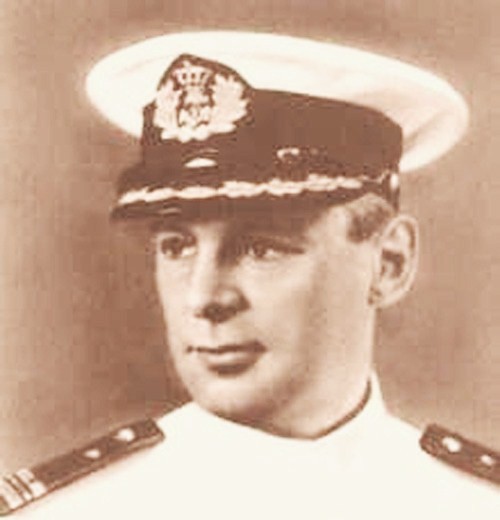
- HNLMS De Ruyter Captain, in command on 27 February 1942. Lost with the ship
Eugène Edouard Bernard Lacomblé was born in Arnhem on 26 October 1896. He finished the five-year course at the higher civic school in that city, and in 1914 he entered the Royal Netherlands Naval College at Willemsoord to train as a sea officer. On 16 November 1917 he was appointed a luitenant ter zee of the third class and sent to the Netherlands East Indies. His first ship there was the armored cruiser De Ruyter, under kapitein-luitenant N. Maats, and he was still serving in her in September 1919.
Promotion to luitenant ter zee of the second class took him into the torpedo branch, where he served in the training ship Koningin Emma der Nederlanden. Further tours in the Indies followed. In the mid-1930s he commanded the minelayer Douwe Aukes. From 13 November 1937 until May 1938 he was posted to the naval staff in the Department of Defence. On 1 June 1938 he sailed for the East Indies a fourth time, in the passenger ship Marnix van Sint Aldegonde.
On arrival he was made first officer of the light cruiser De Ruyter, then commanded by kapitein-ter-zee H.J. Bueninck. He was promoted to kapitein-luitenant ter zee on 1 February 1940. He remained in the colony after the German invasion of the Netherlands that May. By the Japanese advance through the Indies he was captain of De Ruyter, a command he had held only a short time when the decisive fighting began.
Rear Admiral Karel Doorman flew his flag in De Ruyter and directed the Allied Combined Striking Force from her, while Lacomblé commanded the cruiser. Early in February 1942, east of the Kangean islands, a large force of Japanese aircraft bombed the ship for a long stretch. He handled her so that the bombs fell clear, and the cruiser and her company came through. In the middle of the month, in Gaspar Strait, he worked the ship through another air attack that lasted six hours.
On 27 February 1942 he took De Ruyter into the Battle of the Java Sea at the head of the Allied line, against a stronger Japanese covering force. After nightfall a torpedo from the heavy cruiser Haguro struck De Ruyter amidships. Lacomblé ordered the crew to get the wounded away and to leave the ship, and he stayed on board. Doorman remained as well, together with his chief of staff. The cruiser sank in the Java Sea in the early hours of 28 February 1942, and her captain was lost with her. He was forty-five.
On 28 May 1949 a royal decree entered his name among the knights of the fourth class of the Military William Order. The citation honored the steady leadership that had kept the crew's confidence under air attack, and the example he set by sending his men off while he remained with the flagship. He also held the officers' decoration for long service. His wife, Leonie, and their twelve-year-old son left the Indies by Catalina flying boat on the night of 2 March 1942. An inshore minesweeper named for him was launched at Arnhem on 6 February 1960, and his name is recorded at the Dutch war cemetery at Kembang Kuning.