Ships
- HMAS Canberra (D33) Captain from June 1942 · In command when she was lost, 9 August 1942
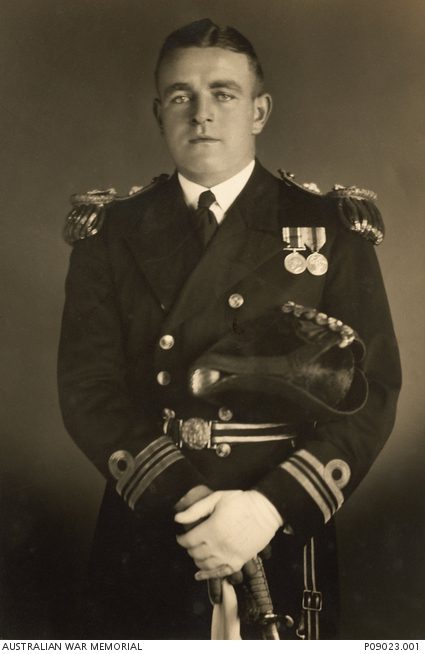
Frank Edmund Getting was born at Manly, Sydney, on 30 July 1899, the youngest of three children of Paul and Janet Getting. In 1913 he entered the first class of the Royal Australian Naval College at Osborne House, Geelong. The college moved to Jervis Bay in 1915, and he passed out in 1916 with colours for rugby and rowing. Harold Bruce Farncomb was in that same first entry and later commanded the heavy cruiser Canberra in 1940 and 1941.
In January 1917 Getting went to Britain as a midshipman for training with the Grand Fleet. He joined the light battlecruiser Glorious in April 1917 and, in September 1918, moved to the battleship Benbow, where his rank of sub-lieutenant was confirmed. After the Armistice he joined the submarine tender Platypus, which left Portsmouth in April 1919 escorting six J-class submarines out to form an Australian flotilla. He earned his bridge watchkeeping certificate in one of those boats, returned to England for further training, finished first in a torpedo class of forty-six, and was promoted lieutenant in 1920.
He served in the Australian submarine J7 until the flotilla was disbanded, then spent eighteen months in the boys’ training ship Tingira at Rose Bay and a short time in the cruiser Brisbane. In 1926 he became the first Australian officer to pass the Royal Navy’s course for submarine commanding officers. A short command of the British submarine H47 followed. In 1927 he joined the new Australian submarine Oxley as first lieutenant, and as a lieutenant commander he commanded her from the long layover in Malta through her arrival in Sydney in 1929 until she and Otway were paid off in May 1930, when the Depression ended the flotilla.
Loaned again to the Royal Navy, he served in the battleship Marlborough and as first lieutenant of the yacht Triad, completed the staff course, and was promoted commander on 31 December 1933. He then attended the Imperial Defence College. In April 1935 he joined the flagship Canberra as operations and intelligence officer to the officer commanding the Australian Squadron. The flag moved to the sister ship Australia in 1937 and returned to Canberra in 1938. On 17 June 1938 he married Hazel Jennings, née Stewart, at St Stephen’s in Sydney. He was still the staff officer in Canberra when the war with Germany began, serving under her captain, Wilfrid R. Patterson, who soon afterward wore a commodore’s broad pendant in the ship.
On 11 October 1939 Getting was promoted acting captain and appointed to command the armed merchant cruiser Kanimbla. She sailed in December for the China Station. Through 1940, working from Hong Kong, she patrolled for German merchant ships that might leave Japanese ports and carried out escort duty in the region. His rank of captain was confirmed on 31 December 1940. From May 1941 until June 1942 he was Deputy Chief of Naval Staff in Australia, and he held that post through Japan’s entry into the war. On 17 June 1942 he assumed command of Canberra, relieving George Dunbar Moore, who had commanded her since the previous December.
The cruiser had just finished a refit and a large change of crew. From the middle of July she sailed with Task Force 44, in company with Australia, Hobart, and American cruisers, on sweeps into the Coral Sea, and then joined the covering force for the United States landings at Guadalcanal and Tulagi. In the early hours of 9 August 1942, near Savo Island, a Japanese cruiser squadron approached in the dark and caught the screening ships by surprise. Getting reached the bridge, ordered the guns trained on the unidentified ships, and rang for full speed. Shells struck Canberra in a rush at close range. One burst wrecked the compass platform. Splinters shattered his right leg and wounded him in several places. He told the ship’s surgeon to treat the others first and remained where he was, giving what orders he could while the cruiser burned, lost power, and listed.
He was in command when Canberra was lost that morning. The crew and the wounded were taken off, and Allied ships sank the abandoned cruiser later in the day. Eighty-four of her company were killed or died of their wounds. Getting was carried to an American destroyer and then to the transport Barnett. He died of his wounds on 9 August on the passage toward New Caledonia and was buried at sea. He was forty-three. His name is on the Plymouth Naval Memorial. The Sydney chapter of the Submarine Old Comrades Association, which had elected him its first president in 1937, later held a memorial service for him and for other members killed in the war.