Ships
- HMAS Australia (D84) Captain from 14 August 1941
- HMAS Canberra (D33) Captain from 24 December 1941
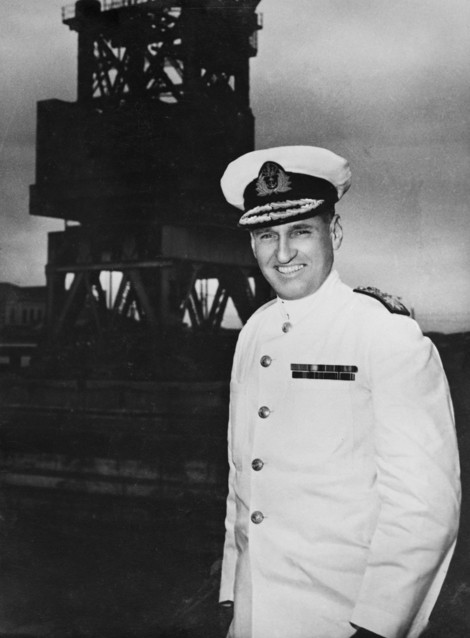
George Dunbar Moore was born at Springsure, in central Queensland, on 10 October 1893, the son of the doctor John Irwin Moore and of Susan Moore. He was educated at Southport and at Brisbane Grammar, then sent to England for the merchant-service training ship Conway, moored in the Mersey. He left Conway in August 1912 with the King’s Gold Medal and joined the Royal Naval Reserve as a midshipman. On 1 July 1913 he transferred to the Royal Australian Navy. His first training ship was the armoured cruiser Duke of Edinburgh. In February 1914 he joined the armoured cruiser Defence. At the outbreak of war Defence was in the Mediterranean while Goeben and Breslau escaped into Turkish service, and that autumn she went to the South Atlantic in the search for Admiral von Spee. She was elsewhere when von Spee’s squadron was destroyed off the Falkland Islands in December 1914.
Moore was promoted lieutenant on 1 March 1916 and a fortnight later joined the Australian cruiser Melbourne in the Caribbean. Defence went on to Jutland without him and was blown up there with her whole company. Melbourne had been watching German merchant ships in neutral ports, and in April 1916 she helped with the steamer Taff after that ship grounded at St Lucia. In the summer she joined the Grand Fleet for North Sea patrols. Moore remained in her for more than three years, including a refit at Birkenhead, and he was aboard when she helped escort the surrendered High Seas Fleet into Scapa Flow on 21 November 1918. Melbourne reached Sydney on 21 May 1919. After a short posting to the boys’ training ship Tingira he served, from September 1919 until December 1921, in the battlecruiser Australia, flagship of the Australian Squadron and, in 1920, escort to the Prince of Wales. That battlecruiser paid off in December 1921 and was later scuttled under the Washington Treaty. The heavy cruiser he commanded in 1941 was a later ship of the same name.
He returned to Tingira as physical and recreational training officer, with about two weeks in command late in 1922. On 10 January 1923 he married Doretta Ziele Russell at St Mark’s, Darling Point. Courses in England followed. He gained a first-class certificate in gunnery and was promoted lieutenant commander on 1 March 1924. He was first lieutenant of the cruiser Adelaide, then executive officer of Brisbane, and from late 1926 he served in the battleship Emperor of India. A daughter, Barbara, was born in England in 1927. He was promoted commander on 31 December 1928. In 1929 he became second in command of the seaplane carrier Albatross. Further Royal Navy duty included a year as executive officer of the minelaying cruiser Adventure. On 15 February 1932 he took command of the Hunt-class minesweeper Dunoon and kept her until January 1934, mostly from Portland and Plymouth with the 1st Minesweeping Flotilla. Back in Sydney he was deputy superintendent and the officer in charge of ships in reserve, and from June 1934 to December 1935 he was honorary aide-de-camp to the Governor-General.
Promoted captain on 31 December 1935, he commissioned the new sloop Yarra at Sydney on 21 January 1936 and used her to train reserve officers and sailors in minesweeping, gunnery, and seamanship, and to tow the battle-practice target for the fleet. In mid-August 1937 he left Yarra. On 21 August he became commanding officer of the destroyer Stuart and Captain (D) of the destroyer flotilla. The flotilla cruised north to Queensland ports and south to Victoria, and in 1938 visited Tasmanian waters, before Stuart paid off into reserve on 1 June 1938. Moore then returned to England for the senior officers’ technical and war courses. He commanded the light cruiser Curacoa from February to June 1939 and assumed command of the light cruiser Dauntless on 30 June 1939. At the outbreak of war Dauntless was with the 9th Cruiser Squadron in the South Atlantic. In December 1939 the squadron moved to the China Station, and in 1940 Dauntless served with the Malaya Force in the Indian Ocean, watching German merchant ships in the ports of the still-neutral Netherlands East Indies. On 15 June 1941 she collided with the cruiser Emerald off Malacca and put into Singapore for repairs. Moore turned her over there on 31 July and took a merchant ship to Mombasa. On 14 August 1941 he became captain of HMAS Australia (D84), the first officer of the Royal Australian Navy to command her, relieving the Royal Navy captain Robert R. Stewart.
For the next four months HMAS Australia (D84) worked mainly from Durban. She patrolled for a Vichy French convoy believed to be bound for Madagascar, escorted Allied ships toward Aden, and searched for the German raider Kormoran. Late in October 1941 she was sent to the Kerguelen and Crozet islands to look for raiders and to lay magnetic mines off the harbour at Kerguelen. The weather turned cold after months in warmer seas, snow fell on deck, and Moore required hourly temperature and barometer readings once the ship entered waters where icebergs were possible. The mines were laid on 1 November. A reconnaissance of Crozet found nothing. After maintenance at East London she sailed from Simon’s Town on 5 December and reached Sydney, by way of Fremantle, on 21 December, by which time Japan had entered the war. On 23 December he handed HMAS Australia (D84) to Harold Bruce Farncomb.
On 24 December 1941 Moore took command of HMAS Canberra (D33). The change was a straight exchange with Farncomb, who had commanded that cruiser since June 1940, when he succeeded Wilfrid R. Patterson. On 28 December HMAS Canberra (D33) sailed as escort to three troopships carrying more than 4,000 soldiers for Port Moresby, then continued to Fremantle by way of Sydney and arrived on 15 January 1942. The next day she took the troopship Aquitania toward South-East Asia, turned the escort over about 100 miles south of Singapore on 22 January, fuelled at Tanjong Priok, and was back at Fremantle on 29 January. For much of that time in Dutch East Indies waters the ship stayed closed up against air and submarine attack. On 30 January she left Fremantle with seven tankers and four cargo ships bound for Palembang, in southern Sumatra, to load oil before Japanese forces took the port. On 4 February she sighted a Japanese submarine on the surface. The submarine dived, and HMAS Canberra (D33) made a depth-charge attack that produced no confirmed result. The next day, near Christmas Island, she turned the convoy over to other escorts and shaped course for Sydney, where a refit began on 17 February and ran into the middle of May. She was therefore absent from the Battle of the Coral Sea. On the night of 31 May to 1 June 1942 she lay at No. 1 buoy in Farm Cove during the Japanese midget-submarine attack on Sydney Harbour. About two-thirds of her company was ashore on night leave. She raised steam for slow speed and was kept headed so that the shore lights would not outline her, and she took no part in the action. On 1 June she sailed with Task Force 44 for working-up exercises in Queensland waters. On 16 June 1942 Moore handed HMAS Canberra (D33) to Frank Edmund Getting. Getting was still in command on the night of 8–9 August 1942, when the cruiser was lost at Savo Island and Getting was killed.
Moore had been at sea continuously since February 1939. He was now promoted commodore second class and posted to Navy Office in Melbourne as Second Naval Member, in charge of personnel, discipline, naval stores, victualling, and medical care. In the New Year honours of 1944 he was made a Commander of the Order of the British Empire for that service. On 13 September 1944 he was promoted acting rear admiral and became Naval Officer in Command, Sydney, with effective control of Allied shipping on the east coast of Australia. When the German submarine U-862 sank the merchant ship Robert J. Walker about 160 miles south-east of Sydney on 24 December 1944, he was closely concerned with rerouting merchant traffic and with the search. In early 1945 he was deeply involved in the arrival of the British Pacific Fleet, which used Sydney as a home port. From 2 August until 20 September 1945, during the illness of Vice Admiral Sir Louis Hamilton, he was Acting First Naval Member and in that office the first Australian to command the Royal Australian Navy. On 15 August he ordered that Japan had surrendered, that offensive action was to cease, and that wartime precautions for self-defence were to remain. He flew to Manila, embarked in the transport General S. D. Sturgis, and was one of the Australian representatives at the formal surrender aboard the battleship Missouri in Tokyo Bay on 2 September 1945. General Sir Thomas Blamey signed for Australia. Moore and Commodore John Collins represented the navy in a party of eight Australian officers.
He gave up the acting appointment on 20 September 1945 and returned to his Sydney command. In October 1947 the post was renamed Flag Officer-in-Charge, New South Wales, and he also became Admiral Superintendent at Sydney and the navy’s sea-transport officer. Garden Island dockyard, the Sydney depots, and the ships in reserve came under him. He and his wife lived at the official residence, Tresco, in Elizabeth Bay. He was placed on the Emergency List on 10 October 1949 and left the service on 9 June 1950. On 19 May 1950 the Minister for External Affairs, Percy Spender, appointed him Australia’s first minister to the Philippines. He served in Manila until the middle of 1955 and was placed on the retired list on 10 October 1953 while still in the post. During a SEATO meeting in Manila in September 1954, when Richard Casey was staying at the residence, extra Philippine guards were posted outside. Told that the guards had asked the household for food, Moore said the legation had its own guard, had not asked for another, and could not undertake to feed men sent there by the Philippine government. He later allowed that he had been terse. After leaving Manila he lived at Darling Point and later at Double Bay, and in 1957 he was federal secretary of the Navy League of Australia. He died at St Luke’s Hospital, Darlinghurst, on 27 July 1979, aged 85, from a ruptured aortic aneurysm, and was cremated at the Northern Suburbs Crematorium on 31 July. His wife Doretta and their daughter Barbara survived him.