Ships
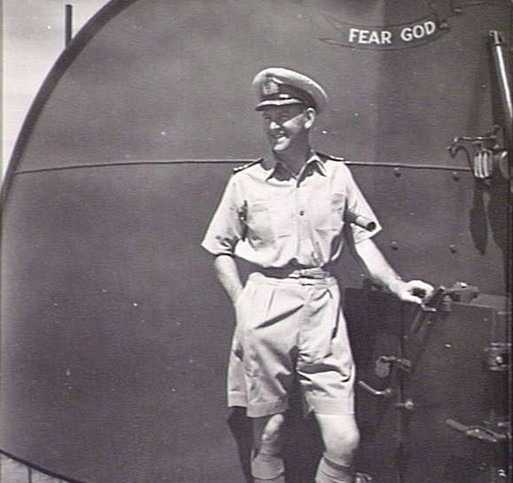
- HMAS Hobart (D63) Captain from 18 October 1943
Frederick Norton Cook, Distinguished Service Cross, Mentioned in Despatches, Royal Australian Navy, later Captain. He was born on 20 February 1905 and died on 1 August 1985. No service number was found. Royal Australian Navy officers of his generation often had none.
He is not Cook, L. B., the next line, whom the same card file marks as United States Navy. He is not his own younger brother. That brother is line 116, Cook, W. F.: William Frank Cook, called Bill, born at Numurkah in northern Victoria in 1916, a captain, Mentioned in Despatches, Lieutenant of the Royal Victorian Order, who entered the naval college in 1930 and died in November 2003, aged 87. An obituary written from the Sydney Morning Herald says Bill followed his elder brother Fred into the college, and that he was in the new light cruiser HMAS Perth, on passage home from the United Kingdom, when the war began. A letter Fred wrote him from Hampshire on 10 November 1939 is addressed to the brother then in Perth. The two men are easy to fold into one another because both were known as Fred and Bill Cook, both reached captain, and both were at sea in 1939. They are not the same officer. Frederick is the 1919 entry. William Frank is the 1930 entry. Nothing read here makes line 117's William into either of them.
Origins
The Naval Graves Project, which points at his service record and was not a substitute for opening that record, gives his birth as 20 February 1905 at Invergordon, Victoria, and his grave as the civil cemetery at Wunghnu. Invergordon in that entry is the Victorian locality, in the same northern district as Numurkah, not the Scottish harbour where, much later, one of his ships was repaired. His brother's obituary puts the family in that district by 1916, when Bill was born at Numurkah. Parents are not named in any source opened here. The service record itself was not read.
He married a woman the family called Bettie. A death notice indexed from the Sydney Morning Herald, which was not seen as a page image, records Doreen Buchanan (Bettie) Cook, of Paddington, dying suddenly in hospital on 2 May 1969, wife of Frederick Norton Cook and mother of Venetia and David, privately cremated on 5 May. In the letter of 10 November 1939 he tells Bill that a niece had been born the previous Saturday, 4 November, at 3 p.m., eight pounds, fair, the hair a little gingery, blue eyes, and that her name was Venetia Bonham Norton. A note added when the letter was published names the daughter as Venetia B. N. Jones. David appears in the 1969 notice and not in the letter. No marriage date, and no date for David's birth, was found.
Formation
He joined the Royal Australian Naval College as a cadet midshipman in 1919. The college roll of entrants lists Cook, F. N., male, entry 1919, graduated, final rank captain, with the Distinguished Service Cross and a mention in despatches. The graves project dates the entry 1 January 1919 and marks the college. The roll does not give the day he passed out, the prizes, or the ship that took him as a midshipman. A wartime commander index that prints a ladder of ranks from cadet on 1 January 1919 to captain on 31 December 1949 was not treated as a register. The dates on it that a gazette or the college roll do not confirm are not used below.
What the family published about the years before the war is an association article of 31 March 2016 by Geoffrey Cole, written from papers shown by Venetia Jones and by Rhod Cook, Bill's son. It was not checked here against a Navy List. That article says that in 1936 he was flag lieutenant to the fleet commander, Rear Admiral W. T. R. Ford, in HMAS Canberra, and that on promotion to lieutenant commander the same year he went to the destroyer HMAS Waterhen as first lieutenant, executive officer and gunnery officer. It says that in 1938 he was sent to England and to the battleship HMS Royal Oak, as commander's assistant, 4-inch high-angle control officer, and mate of the upper deck. The London Gazette of 26 September 1940 still styles him lieutenant-commander, so the 1936 promotion, if the article has the year right, had already happened before the war. No Navy List page was opened to prove the ships.
War years as lived
He was asleep in cabin 13, in pyjamas, a little after one in the morning of Saturday 14 October 1939. Royal Oak was at anchor in Scapa Flow. He woke to a bump that shook the ship the way a destroyer shakes when a depth charge goes off at slow speed. The lights below were still on. Nobody had piped anything. On the quarterdeck the officer of the watch and most of the officers were trying to decide what had happened. The first thought was a bomb in the water. The air lookouts disposed of that. The explosion had been forward, and there was a faint smell of paraffin or petrol, so they thought of the inflammable store. He put the time he reached the deck at about 0110. Ten or twelve minutes later a second explosion came, then a third and a fourth, each one nearer aft. The last, as he saw it, threw a dense cloud of black smoke up by the mainmast, and the men on the quarterdeck ducked. He thought that was about 0117. The ship heeled suddenly to starboard. That was the first sign, to the men on deck, that she was going.
His job was mate of the upper deck, and the boats. He had no reason to go below. He wrote that she had disappeared by about 0128, which left no time to launch a boat. Power and the loudspeakers went with the second explosion. The crane and the main derrick were useless. It was very dark, a few stars. The two sea-boats were turned in, so as not to block the 4-inch anti-aircraft guns. One night boat, a whaler, was hooked on the crane. He and a party tried to launch the gig on the quarterdeck. In about three minutes they could not stand on the deck. He fell, crawled to the port guardrails, kicked off his seaboots, monkey jacket and trousers, walked the port side to the accommodation ladder, and went down the standing topping lift hand over hand. Men were dropping into the water around him. The port outer screw and shaft came out of the water under him. He could not get back. He let go, slid down the side, and went between the shaft and the ship, over the barnacles. One hand was cut. The pyjama trousers and the socks took the rest. The tanky told him afterwards that the water was 49 degrees Fahrenheit. He got clear, stuffed chips of wood up the front of a sweater, struggled out of the pyjama trousers, and made for the drifter that had been alongside. She was Daisy, a Peterhead herring drifter. She had been lifted by the blister and had got clear by going full astern. He did not swim hard. He held a stool, then a thin plank. After about twenty minutes he was numb, and afraid Daisy would move off in the dark. A heaving line reached him. They pulled him in. He had been in the water nearly forty minutes. His possessions were his life, an oyster wristwatch that was still going, and the sweater. The headache, he wrote, was general. He asked the skipper for rockets, Very lights, or a flashing lamp. There were none, so he told him to make SOS on the whistle. They hauled men in until about 0300, when they were frightened for Daisy's stability. He thought they had practically 300 of what he called the 370-odd survivors. They were about eight miles from most of the fleet. They went to another ship for a few clothes, then to a transport at 0600. That transport was bombed and missed on the Monday morning. On Tuesday evening a special train took them south. The train was bumped by another, and two more of the ship's company were hurt.
The letter is his, written at the Manor House, Buriton, Hampshire, on 10 November, after nearly three weeks' leave. It is not a board of inquiry. The times, the number of survivors on Daisy, and the count of the dead are what he believed a month later. The Royal Navy, marking the eightieth anniversary in 2019, put 1,259 people on board that night and 835 dead, the last of them a man who died of burns in hospital two weeks afterwards, added to the Book of Remembrance after years in which the figure had been kept at 834. He told Bill the wireless first announced fifteen survivors, the ones who had swum ashore, and that Bettie heard it at one in the afternoon while she was knitting, and waited until four for his telegram. The local doctor, who was already attending her, put him to bed with a tonic when the reaction arrived. He was up in three or four days. Two days after he walked her to the nursing home, Venetia was born. He had ordered Bill a Gieves waistcoat, on Bill's own account, because his own had not arrived in time. He told him to keep a hammer under the bunk for scuttle clips, to get valuables ashore, and not to lash Carley floats so that men without knives, at one in the morning, could not free them. The floats, he wrote, had mostly been on the ship's side and could not be cleared in the three or four minutes they had.
On completion of survivors' leave the association article posts him as second in command and executive officer of the anti-aircraft cruiser HMS Curlew. That appointment was not read from a Navy List. Curlew had completed a refit and the fitting of Type 79Z radar at Chatham in September 1939, had worked up at Portland and Scapa, and through the winter did convoy air-defence duty in the North Sea. Geoffrey Mason's chronology, edited for naval-history.net, has her under repair at Invergordon in Scotland in December 1939, then with the Humber Force, then off Norway after the German invasion. She was at Namsos for Operation Maurice, and she was with the carriers off Narvik. On 26 May 1940, on passage off Skutenes in Lavangfjord, near Narvik, she was hit by a stick of bombs and sank in 67°32' N, 16°37' E. The Naval Historical Society's day entry says Lieutenant F. N. Cook was rescued from the sea off Narvik that day, and that it was his second sinking in less than a year. The association article, summarising a piece he later wrote as "My Service in HMS Curlew 1939–1940," says the ship was at action stations from 22 to 26 May under continuous air surveillance, that the ammunition was gone by the 26th, and that the bomb that finished her was one of a stick of three. That article of his, in the Naval Officers Club newsletter of 1 March 2015, was not opened. Mason does not give a casualty figure in the chronology used here. Cook's own count of the dead in Curlew was not read.
The London Gazette of 26 September 1940, a second supplement dated that Thursday, records the King's approval of appointments to the Distinguished Service Order and of other awards for services in Norway. In the mentions in despatches on that list is Lieutenant-Commander Frederick Norton Cook, Royal Australian Navy. The entry does not name a ship. On the same page, still inside the Norway awards, Lieutenant-Commander Ian Greig Robertson is named to HMS Curlew, and the late Paymaster Commander William Yates, also of Curlew, is mentioned posthumously. The mention is the one the college roll records. It is not a citation that says what he did on 26 May. The Naval Historical Society's later habit of calling him DSO is not this gazette. He was not appointed to the Distinguished Service Order in the notices opened here.
The association article says that, promoted commander, he was next sent to establish and command a commando and landing-craft base at the mouth of the Hamble, in Southampton Water, which he named HMS Tormentor. The rank in that sentence is early. In September 1940 the gazette still has him a lieutenant-commander. A survey of the Combined Operations Pilotage Parties, citing L. Scott's 1991 history of the base, says Tormentor was commissioned in August 1940 and does not name him. The Sea Power Centre's history of HMAS Assault is firmer about the fact of the command than about the month it began. When the Naval Board asked the Admiralty, in 1942, how a combined-operations school worked, the Admiralty proposed to send home Commander Frederick Cook, DSC, who had been commanding officer of Tormentor, to set up a training centre in Australia, and to relieve him there by Commander Alfred Buchanan, RAN, who would get the experience and follow in 1943. The Distinguished Service Cross in that sentence belongs to May 1942, so the Sea Power Centre is describing him as he stood when he was ordered home, not as he stood when Tormentor commissioned.
In mid-January 1942, the association article says, he was appointed naval commander for Operation Biting, the Bruneval raid. The Naval Historical Society's day entry for 27 February 1942 calls him lieutenant-commander and senior naval officer at the beach-head during the raid on the German radio-location station, and says the Distinguished Service Cross was for conspicuous gallantry. The gazette is plainer and uses a higher acting rank. On 15 May 1942, from the Admiralty at Whitehall, the King approved awards for daring, skill and seamanship in successful combined operations against the enemy at Bruneval. The Distinguished Service Cross went to Acting Commander Frederick Norton Cook, Royal Australian Navy, and to two temporary lieutenants of the Royal Naval Volunteer Reserve. The gazette does not recite the night.
The association's account of that night, which it says follows a monograph he wrote near the end of his life, published by the Naval Historical Society in 1997 as Operation "Biting": The Naval Story of the Bruneval Raid 27/28 February 1942, was not checked against the monograph or against a report. As that article tells it, the sea plan was his. Training was secret and difficult. On the night, HMS Prinz Albert, a Belgian passenger ship taken into the Royal Navy, carried six assault landing craft and two support landing craft, with six motor torpedo boats. Fifteen miles off the coast the craft were lowered. He was embarked. They waited a mile and a half offshore. Two German single-funnel destroyers and two E-boats passed down the coast, about a mile further out, and went on towards Le Havre. No signal came from the beach when it should have. The soldiers, who had the radar parts and were holding the beach, were waiting for the navy and watching for German reinforcements. An emergency flare brought the boats in. Instead of two at a time, all six landed together. In the confusion most of the raiders were taken off, the radar parts went to a motor torpedo boat, and destroyers and Spitfires covered the return. He was puzzled, the article says, because the beach was silent and daylight was the limit. That is the pressure the published naval story gives him: a man who had already been sunk twice, sitting off a hostile beach with the clock running and no word from shore. It is not a sentence from a report read here.
He was back in Australia that winter. The Sea Power Centre says he arrived in Melbourne on 3 June 1942. On his return he took charge of the Australian Combined Operations Section, advising the commander of Allied Land Forces, General Thomas Blamey, and the Australian chiefs of staff, and trying to keep the Australian effort in one pair of hands. Two days later, 5 June, he was at a meeting in the American general headquarters in Melbourne with Lieutenant-Colonel M. Hope of the Royal Artillery and Captain Frank Getting, the deputy chief of the Naval Staff. They were told that General Douglas MacArthur had decided combined-operations training in Australia would sit under the American headquarters. One Australian division and two American divisions were to be trained as soon as possible. The Royal Australian Navy was to produce a third of the boat crews and the naval side of the soldiers' training.
On 8 June he and Hope flew the east coast looking for a site. They recommended Port Stephens, north of Newcastle, for the land, the sea, the air, and the submarine threat as it then stood. The army was already pushing a combined training centre at Toorbul Point in Queensland. MacArthur ordered a Joint Overseas Operational Training School at Port Stephens on 9 August. By then the navy had surveyed the site and drawn plans for 60 officers, 500 sailors and 100 landing craft. The armed merchant cruiser HMAS Westralia was allotted as a temporary accommodation ship, with Ping Wo as tender. Nine motor boats were requisitioned. Landing craft were to be built in Australian yards. Only two Australian-built craft were on hand through the end of 1942. The motor boats could teach a twin-screw helm. They could not teach a beaching.
HMAS Assault was commissioned under his command on 1 September 1942, on board Westralia, two days before the ship even reached Port Stephens. Instruction started for landing-craft crews, beach parties, which the navy called commandos, and combined-operations signal teams. Six weeks later MacArthur worried about the distance between Toorbul and Port Stephens and asked for a Queensland alternative. Surveys ran through Gladstone, Emu Park, Broad Sound, Mackay, Cannon Valley, Bowen, Townsville, Lucinda Point, Cairns and Innisfail. Port Stephens stayed. The money was already in the ground, and the beaches were the right beaches. Naval crews would learn there and then go north to finish with the army. He said later, in words the Sea Power Centre prints, that the choice had proved wise: steep or shallow sand, with or without surf, and rock, mud and mangroves, all handy in the bay. The base went ashore on 10 December 1942. In February 1943 an American amphibious training group nearby was joined with it as the Amphibious Training Centre, under Rear Admiral Daniel E. Barbey, United States Navy, commander of the South-West Pacific Amphibious Force. From then the training included American soldiers and marines as well as Australian soldiers and the navy's own men. Kanimbla, Manoora and Westralia were converted to infantry landing ships during 1943. Manoora and Westralia ferried Americans between Port Stephens and Melbourne.
The place had been drawn for about 560 and held as many as 870. Sixty-seven galvanised buildings went up, a hospital and a workshop among them. The old jetty was rebuilt out to 510 feet, with an L of 162 feet for the boat compound. A slip and a boatshed were finished in August 1943. The hospital did the injuries of hard training, and on 24 May 1943 it took a survivor from a Catalina that had crashed at Shoal Bay on a rough-water trial out of Rathmines. Seven of the nine in the aircraft were killed. The Sea Power Centre does not say he was on the beach that morning. It does say the training was the commando kind: assault courses, weapons, explosives, hands. Beach parties surveyed landing places in their clothes, in the water, for hours, and they learned to lay metal roadway that would take a tank.
By the beginning of October 1943 the Sea Power Centre's count of naval people trained at Assault was more than a thousand: 100 officers, 100 coxswains, 120 beach commandos, 40 landing-craft signalmen, 453 boat crew, 250 stokers. That was besides 20,000 American soldiers and 2,000 Australian soldiers who had their main training on the American side of the centre and also passed through Assault. New naval training stopped that October. He described what came next as the second phase: a supply and spare base for landing craft, and a pool of trained men, while the base still helped train Americans. Most of the trained Australian sailors, and Kanimbla, Westralia, Manoora, and most of the craft, went to Toorbul. A later occasional paper on the same base calls the commanding officer T. W. Cook. That initial is wrong. The Sea Power Centre, the gazette, and the college roll are Frederick.
The Sea Power Centre's list of commanding officers of HMAS Hobart puts Commander Frederick Cook, DSC, RAN, in the ship from 18 October 1943 to 7 November 1944, between Captain Henry Showers, who had her from 8 June 1942, and Captain Roy Dowling, who took her on 8 November 1944. Those are table dates, not a log read here. They matter because of what the ship was doing. On 20 July 1943 a Japanese submarine torpedoed Hobart on the way to Espiritu Santo. Thirteen officers and sailors were killed and seven injured. She reached Espiritu Santo under her own power, was escorted to Sydney by Warramunga and Arunta, and arrived on 26 August. The repairs kept her out of service until December 1944. She was back at sea for trials on 15 December 1944, under Dowling, not under Cook. His listed command is the long dockyard stay in Sydney, not Cebu, not Tarakan, not Wewak, not Brunei, not Balikpapan, and not Tokyo Bay. The association article says that from late 1943 he served in Hobart as executive officer and then lists those 1945 operations and the surrender on 2 September. The command table and the ship's dates do not support that sentence. If he remained on board as executive officer after Dowling assumed command, no report opened here says so. The 1945 cruise is not narrated as his.
After
The association article, again from the family and not from a Navy List read here, says that after the war he commanded HMAS Arunta from 1947 to 1949, was promoted captain, and commanded HMAS Bataan from 1949 to 1950 in Japan. It then gives him naval attaché in Washington from 1951 to 1953, during the Korean War; captain of the port of Sydney from 1953 to 1956; naval officer in charge of Northern Australia from 1956 to 1958; and commanding officer of HMAS Penguin from 1958 to 1960. It says he retired on 19 February 1960, after 41 years, ten of them with the Royal Navy, and that he was called Freddie, and that he died on 1 August 1985.
The Sea Power Centre's history of Arunta covers 1947 and 1948, in Japan and then on a western Pacific cruise, and does not name the captain. Its history of Bataan commissions the ship under Commander Henry Burrell on 25 May 1945, takes her to the surrender and to the occupation, and by June 1950 has her on a fifth Far East tour as the Korean War opens. It never names Cook. A list of Bataan's commanding officers compiled by M. Brice and dated 12 June 1997, reproduced on a private naval site, puts Commander F. N. Cook, DSC, RAN, in her from 29 September 1949 to 26 January 1950, between Commander A. S. Storey and Commander W. B. M. Marks. Brice styles him commander, not captain, and the command he gives is four months, ending before Korea. The association's "promoted captain and commanded Bataan" and Brice's short command as commander are not the same statement. Neither was checked against the Navy List. The Korean operations of Bataan, including the patrols, the Inchon cover, and the later hit in the captain's cabin, belong to other commanding officers. They are not his.
The graves project agrees with the association on the discharge: 19 February 1960, engagement expired, rank captain, service from 1919. It also marks "died during service: yes," which cannot sit with a discharge in 1960 and a death in 1985, and it heads the page "Cook DSO," which the gazettes opened here do not support. The Naval Historical Society's day book for 1 August 1985 says Captain F. N. Cook, DSC, RAN, died in Sydney, and then repeats a short public version of the life: Tormentor, the Bruneval raid, the recall to command the amphibious training centre at Assault. It does not mention Hobart, Arunta, Bataan, or Penguin.
Bettie had died in 1969. He outlived her by sixteen years. Venetia and David are the children named in the notice of her death. The graves project places him at Wunghnu Civil Cemetery, back in the district the birth entry calls Invergordon. It does not say whether that was a burial or a cremation. He was eighty.