Ships
- USS Hoggatt Bay (CVE-75) Flag, not her captain, 2 April 1945 – 28 September 1945
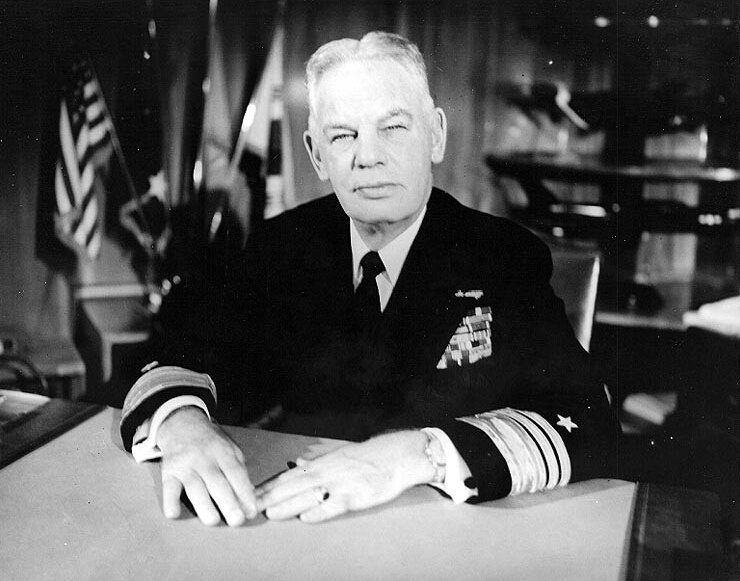
Harold Montgomery Martin was born on 18 January 1896 in Bay Mills, Michigan. He spent a year at the University of Illinois, then went to the Naval Academy. The First World War shortened the course, and he graduated in June 1918 with the Class of 1919. His first ship was the destroyer Winslow. After the armistice he served as an ensign in the battleship Nevada. In 1921 he left her for flight training and qualified as a naval aviator.
For the next ten years he flew from ships and with squadrons. In the mid-1930s he commanded VS-2B and VP-10F. Duty in the Navy Department and on the staff of Commander Scouting Force followed. By the time the Pacific war opened he was a captain in charge of the new Naval Air Station at Kaneohe Bay, Hawaii, a command he held through 1941 and 1942. In 1943 he commanded the naval air station on Midway.
He next became commanding officer of the light carrier San Jacinto and took her into combat in the Central Pacific during 1943 and 1944. On 13 October 1944, near the Philippines, a Japanese torpedo bomber attacked the ship. His conduct that day brought him the Silver Star, and a Legion of Merit recognized his record as her captain in the Western Pacific. He then served as chief of staff and aide to Commander Air Force, U.S. Atlantic Fleet.
In March 1945, as a rear admiral, he took command of Carrier Division 23. On 2 April 1945 he raised his flag in Hoggatt Bay, after the escort carrier had been fitted on the West Coast to carry a flag officer. He was not her captain. Josephus Asa Briggs had the ship. From 4 May to 3 September 1945 his carriers operated against Japanese forces at Okinawa, in the Ryukyus. Their planes struck defenses on the island and airfields and aircraft in the Sakishima group, and they gave close support to the troops ashore. A second Legion of Merit marked that command.
He was then assigned to command Task Force 49, a force meant to support Soviet operations in the northwestern Pacific. Martin left Hoggatt Bay in Tokyo Bay on 28 September 1945.
After the war he commanded two fleet air wings, led Carrier Divisions 2 and 5 from April 1947 to November 1948, and served as Chief of Naval Air Technical Training. Promoted to vice admiral early in 1951, he briefly commanded the First Fleet, then took the Seventh Fleet while it was fighting the Korean War. He later commanded the Pacific Fleet. He retired in February 1956 as an admiral and died on 3 December 1972.