Ships
- IJN Tone Captain from 1 December 1943
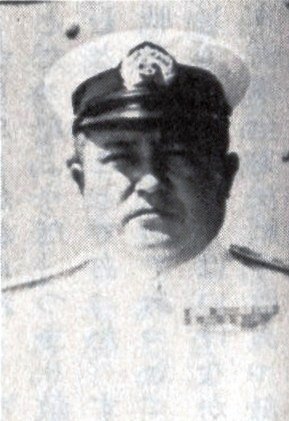
Haruo Mayuzumi was born on 2 October 1899 in Tomioka, in Gunma Prefecture, the eldest son of a family in the silk trade. After local schooling and a middle school in Yokohama, he entered the Imperial Japanese Naval Academy and graduated with the 47th class in October 1919. He made the training cruise as a midshipman and was commissioned an ensign on 1 August 1920.
Gunnery became his specialty. In November 1925 he finished the advanced course at the Naval Gunnery School and joined the battleship Ise as a division officer. A year later the school took him back as an instructor. He completed the 28th A-course at the Naval Staff College in November 1930, then served as secondary-battery officer in Hyuga and in the training ship Asama. Promoted to lieutenant commander on 1 December 1931, he held the same sort of gunnery post in the carrier Akagi during 1932 and returned to the Gunnery School that November.
In 1934 the Navy General Staff gave him intercepted radio traffic from United States fleet practices off southern California and had his section at the school work it over. The study concluded that Japanese heavy guns were scoring about three times as often as the American ships in those shoots, and the section sent revised figures for gun power and protection to the General Staff and the Staff College. That summer he left Yokohama for the United States East Coast as a resident officer, with his post at Philadelphia. In 1935 the naval attaché in Washington called him in and handed him a copy of the United States Navy's 1934 gunnery report, obtained through an agent. Set beside the radio intercepts, it confirmed the same comparison in his mind. He returned to Japan in June 1936.
Shore billets followed in the Navy Ministry and again at the Gunnery School, with a staff tour at the 4th Base Force and duty as executive officer of the heavy cruiser Furutaka. He was executive officer of the new battleship Yamato during her fitting out and carried out the work of her first gunnery officer. In October 1941, while on the staff of the 3rd China Expeditionary Fleet, he was promoted to captain. After the Pacific War began he commanded the seaplane tender Akitsushima, served on the staff of the 11th Air Fleet and the 8th Fleet, did a turn with the Naval General Staff, and became vice principal of the Yokosuka Gunnery School.
On 1 December 1943 he took command of the heavy cruiser Tone. She was the name ship of a class that carried all eight 8-inch guns forward and kept a long quarterdeck for floatplanes, and she had already been through the early Pacific campaigns under earlier captains, among them Tametsugu Okada. At the start of 1944 her old cruiser division was dissolved and she joined Cruiser Division 7. In February she helped shift forces from Truk toward Palau. From 1 March she went into the Indian Ocean on a shipping raid, Operation SA No. 1, under the 16th Squadron. On 9 March a floatplane from Tone sighted the British merchant ship Behar, hundreds of miles from the Cocos Islands. Tone closed, sank her, and took the survivors out of the water. A group of them was put ashore at Batavia as prisoners.
Rear Admiral Naomasa Sakonju, who directed the raid from the cruiser Aoba, had ordered that prisoners beyond those wanted for questioning be killed. On 18 March Tone was detached from his squadron to rejoin Cruiser Division 7 and shaped course for Singapore. During the night of 18–19 March the prisoners still on board, about sixty-five people, were killed. A British military court in Hong Kong tried Sakonju and Mayuzumi together in 1947. Sakonju said his order had covered the operation itself. Mayuzumi said he had acted on the admiral's order, and the record of the case also shows that he had asked more than once for the prisoners to be spared. On 29 October 1947 the court sentenced Sakonju to death and Mayuzumi to seven years. He remained in custody until September 1951. During that time occupation authorities in Japan provisionally barred him from public office.
Tone sortied with the Mobile Fleet for the defense of the Marianas and came through the Battle of the Philippine Sea in June 1944 without serious damage. She refitted at Kure from late June into early July, receiving radar and more light antiaircraft guns, and then worked from the Lingga anchorage near Singapore. On 22 October 1944 she left Brunei with Cruiser Division 7 in Vice Admiral Takeo Kurita's force, in company with Chikuma, Kumano, and Suzuya, for the Leyte operation. In the Sibuyan Sea on 24 October, while she was near the battleship Musashi, one bomb hit Tone and failed to go off. Off Samar the next morning she engaged American escort carriers. Strafing swept the bridge and wounded Mayuzumi, and the cruiser fired several hundred 8-inch shells. Chikuma was lost in that action. When the order came to break off, Mayuzumi prepared a recommendation to Rear Admiral Shintaro Hashimoto that the ships still fit to fight keep after the carriers, and then let the withdrawal stand. In November Tone returned to Japan and entered dock. On 6 January 1945 he turned her over to Yusaku Okada. Carrier aircraft sank Tone at Kure on 24 July 1945.
In January 1945 Mayuzumi became vice chief of staff of the Yokosuka Naval District. He then served with the Navy's chemical-warfare department, also sitting with the Naval General Staff, and he was head of that department at the surrender. He went on the reserve list in November 1945. After his release he joined the whaling company Kyokuyo as a technical adviser, taught harpoon gunners to work out the shot with trigonometry and graphs, and had a powered, rocking practice mounting built at the firm's Ayukawa office in Miyagi Prefecture. He published a history of naval gun battles in 1972 and a history of shipboard gunnery in 1977. For the rest of his life he held to the prewar finding that Japanese battleship practice produced about three times the hits of American practice, and he argued that the Navy should have sought a gun action between fleets. He died on 29 October 1992, at the age of ninety-three.