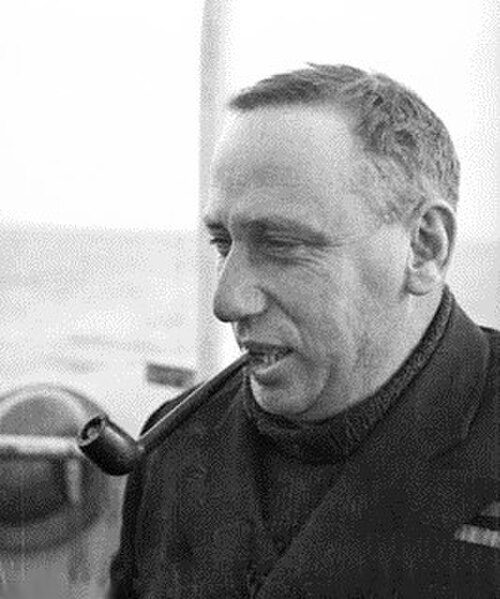
Ships
- HMAS Stuart (D00) Captain from 1 September 1939
- HMAS Perth (D29) Captain from 24 October 1941 · In command when she was lost, 1 March 1942
Hector MacDonald Laws Waller was born on 4 April 1900 at Benalla, Victoria, the youngest of ten children of William Frederick Waller, a storekeeper, and Helen Waller, née Duncan. His names recalled General Hector MacDonald, a soldier of the South African War. He grew up far from the coast. On 31 December 1913 he entered the Royal Australian Naval College as a cadet midshipman. He passed out in 1917 as chief cadet captain and received the King's Medal for his character and his standing among the other cadets.
He reached Britain in time to serve with the Grand Fleet in the last year of the First World War, and he returned to Australia in 1919. Through the long peace he specialised in communications, serving as signals officer in British and Australian ships and going back to Britain for further training. In December 1937 he received his first seagoing command, the destroyer HMS Brazen. For about fourteen months Brazen watched the Spanish Civil War, covered merchant ships, and took crews off vessels in trouble. That duty completed his apprenticeship as a destroyer captain. A short appointment at Navy Office in Melbourne followed.
On 1 September 1939 Waller took command of the destroyer leader HMAS Stuart. The ship was old, and so were the four Australian destroyers that sailed with her. The group reached the Mediterranean in December. German propaganda dismissed them as a scrap-iron flotilla. The ships' companies kept the name and wore it as a badge. Early in the campaign his handling of the disabled tanker Trocas showed the seamanship that senior officers came to trust. In May 1940 he was appointed to command the 10th Destroyer Flotilla, newer British destroyers alongside the Australian ships. On 30 June he was promoted captain. Italy had entered the war. In July Stuart fought in the Battle of Calabria, and in September Waller was awarded the Distinguished Service Order for courage, enterprise, and devotion to duty.
The following year pressed him harder. Stuart bombarded positions at Bardia and supported Australian troops in the advance on Tobruk. In March 1941 she took part in the Battle of Cape Matapan, and Waller received a bar to the Distinguished Service Order. He was mentioned in despatches twice for the Mediterranean fighting. Destroyer men called him Hard Over Hec, from the sharp helm orders he used in action. When Prime Minister Robert Menzies visited Egypt, Admiral Sir Andrew Cunningham brought Waller forward and spoke of him as a captain of the first rank.
Waller left the Mediterranean and reached Australia in September 1941. On 24 October he became captain of the light cruiser HMAS Perth. Japan's entry into the war sent the ship into the American-British-Dutch-Australian command, which was trying to hold the Netherlands East Indies. On 27 February 1942 an Allied squadron met a stronger Japanese force in the Java Sea and was broken up. That night Waller took Perth and the United States heavy cruiser Houston clear of the defeat. The Dutch commander, Admiral C. E. L. Helfrich, later objected that the order had been to fight on until the last ship. Waller, with two years of fleet fighting behind him, kept in hand the two cruisers that could still steam.
On the night of 28 February, Perth and Houston tried to pass the Sunda Strait toward Australia and ran into a Japanese invasion convoy with a strong escort. Waller was the senior officer, and Perth led. A little after eleven o'clock he ordered the cruiser to open fire. The odds in ships were heavily against the Allies. The two cruisers hit vessels of the convoy, transports among them, and kept firing until the main ammunition was gone. The six-inch guns were down to practice rounds, and the four-inch guns were firing star shell. Torpedoes struck Perth. Waller ordered the ship abandoned. Men who got clear last saw him on the bridge in his lifejacket, looking down at the silent guns. A shell then hit the bridge and killed him. In the early hours of 1 March 1942 Perth sank. He had been her captain since 24 October 1941 and was in command when she was lost. Houston went down soon afterward.
More than 350 of Perth's company were killed or drowned. Many who survived the sinking were taken prisoner, and a great number of them died in captivity. Waller was posted missing, presumed killed, and he was mentioned in despatches again after his death. He was forty-one. His wife and two sons survived him. Cunningham, who had used him at the centre of the destroyer war in the Mediterranean, counted the loss a heavy blow to the Royal Australian Navy. Sailors who had served under him in Stuart and in Perth remembered a captain who fought the ship in front of him until the ammunition was spent and who stayed on the bridge at the end.