Ships
- USS Gambier Bay (CVE-73) Captain from 28 December 1943
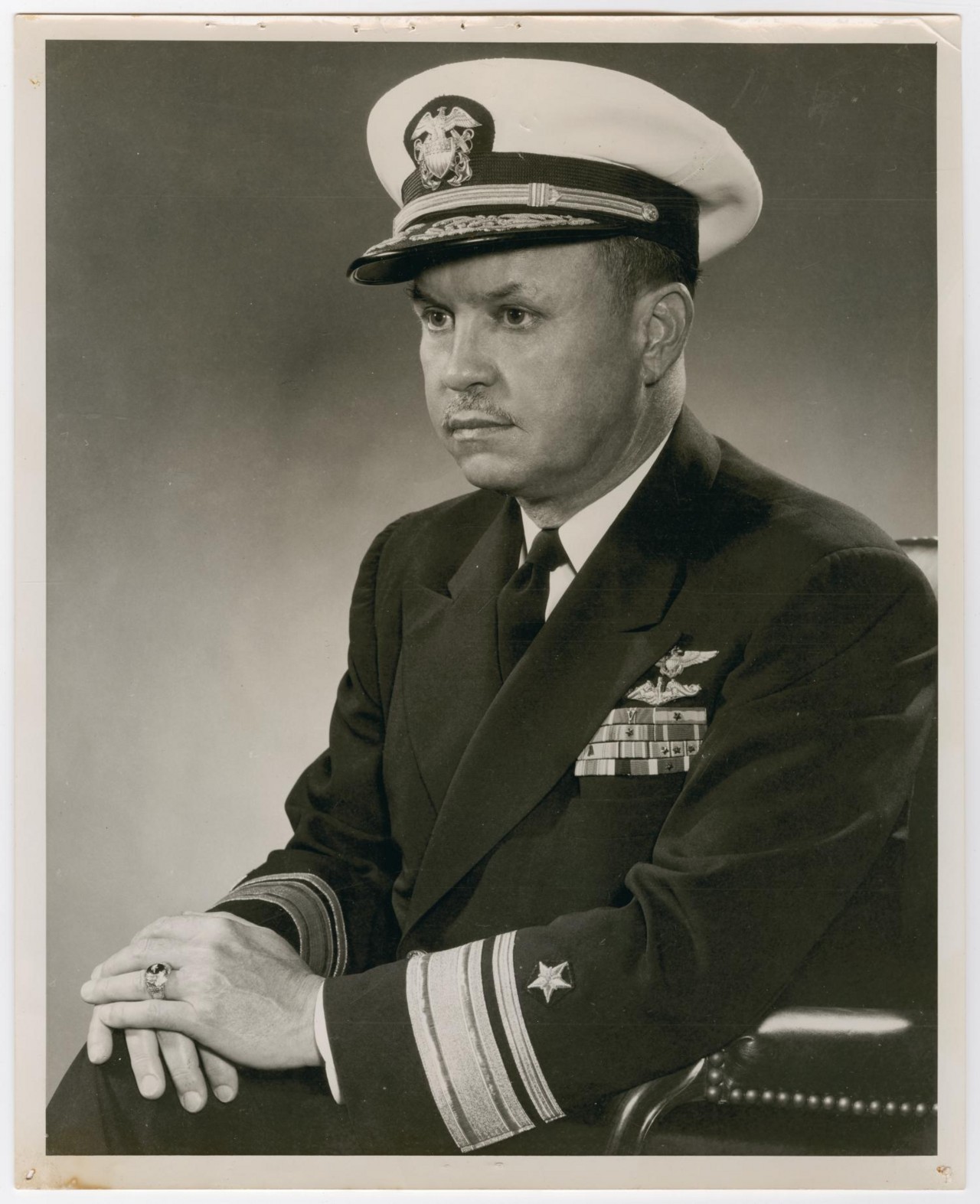
Hugh Hilton Goodwin was born in Monroe, Louisiana, on 21 December 1900. He joined the Navy during the First World War and graduated from the Naval Academy in 1922. Over the next twenty years he served in battleships, destroyers, submarines, and aircraft carriers, qualified both as a submarine commander and as a naval aviator, and completed tours in the Navy Department along with study at the Naval War College and the National War College. Shipmates called him Huge. He stayed on active duty through 1957 and retired as a vice admiral.
Early in the Second World War he was an adviser to the Argentine Navy Department. Late in 1943 the Navy ordered him to Astoria, Oregon, for a new escort carrier. The Casablanca-class Gambier Bay (CVE-73), built by Kaiser at Vancouver, Washington, was commissioned there on 28 December 1943 with Captain Hugh H. Goodwin in command. He was her first commanding officer.
He drove the new crew hard while the ship worked up. He told them that lookouts, gunnery, engineering, and the time it took to reach general quarters were all improving, and that he still wanted more. After shakedown from San Diego, Gambier Bay sailed on 7 February 1944 with about 400 troops embarked for Pearl Harbor, then flew 84 replacement aircraft out to the fleet carrier Enterprise off the Marshalls. Composite Squadron 10 came aboard as her air group. His son, Hugh H. Goodwin Jr., visited during this period to watch how a commanding officer handled the ship and flight operations.
In June 1944 Gambier Bay supported the Marianas landings. On 15 June her aircraft struck gun positions, troops, tanks, and trucks as Marines went ashore on Saipan. Two days later a raid of about 47 Japanese aircraft headed for the task group. Fighter direction turned back or destroyed most of them, and the ship's gunners shot down two of the three that broke through. On 18 June, with another raid inbound and the formation's antiaircraft fire already filling the sky, eight pilots of Composite Squadron 10 launched anyway and helped break up the attack. Goodwin treated those takeoffs as proof of what young aviators could do under fire. The carrier remained in the fighting for the Tinian and Guam operations, and on 23 July he was photographed on the bridge beside flags marking aircraft shot down in the June raids.
He left Gambier Bay on 18 August 1944, when Captain Walter V. R. Vieweg relieved him. On 25 October 1944, off Samar, Japanese surface ships caught the escort carriers of Taffy 3 and sank Gambier Bay by gunfire. Goodwin was already ashore from that command, serving on the staff of Commander, Carrier Division Six, and later on the staff of the Philippine Sea Frontier during the Philippines campaign. Men who had trained under him, among them aviation technician Anthony Potochniak, later said the standard he set—every job done right, every time—carried the crew through that last action and saved lives.
He ended the war in command of the light carrier San Jacinto. Afterward he served on the staff of the Commander in Chief, Atlantic Fleet, and in December 1947 published an essay on what Japan's collapse meant for Russia. As a flag officer he was vice commander of the Military Air Transport Service, commander of Carrier Division Two, and commander of the naval air forces assigned to the Continental Air Defense Command. He died in Monterey, California, on 25 February 1980.