Ships
- USS Iowa (BB-61) Captain, 28 November 1944 – 25 July 1945
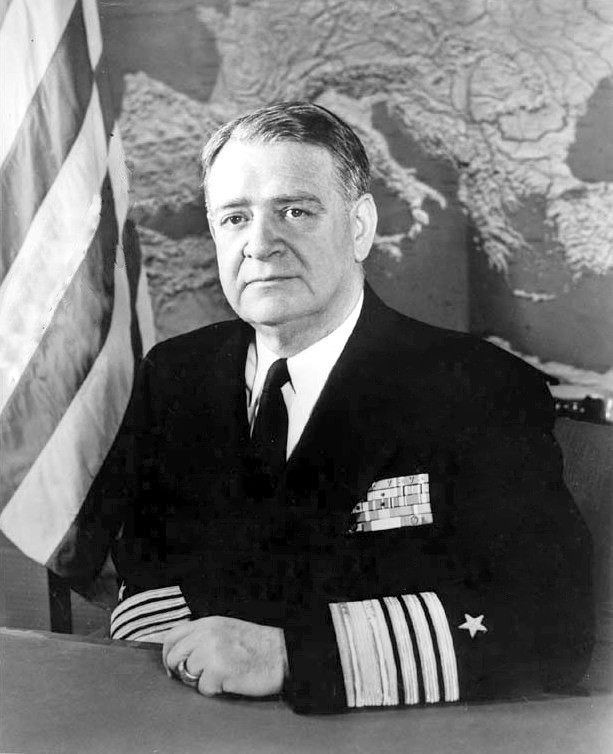
James L. Holloway, Jr., was born in Fort Smith, Arkansas, on 20 June 1898. He entered the United States Naval Academy in 1915 and graduated in 1918, when the First World War cut the course short. His first ship was the destroyer Monaghan, on duty in European waters, including a period based at Brest.
After the armistice he served as the junior member of a United States government mission to Brazil, Uruguay, and Argentina. In the years that followed he rotated through destroyers, battleships, and the Naval Academy, and he held staff billets with Commander Battleship Division Two, the President of the Naval War College, Commander Cruisers, Scouting Force, and the Atlantic Fleet. At the outbreak of the Second World War he was in Washington, heading the gunnery section in the Office of the Chief of Naval Operations.
In May 1942 he took command of Destroyer Squadron Ten, a newly formed unit of the Atlantic Fleet, and in June he was promoted to captain. That November the squadron screened the landings at Casablanca during Operation Torch. In the spring of 1943 he organized the destroyer and destroyer-escort shakedown group at Bermuda, bringing new ships up to fleet standard before they joined the Atlantic war. The Legion of Merit recognized that work. In November 1943 he returned to the Bureau of Naval Personnel as Director of Training.
On 28 November 1944 he assumed command of the battleship Iowa, flagship of Battleship Division 7. With the fast carrier forces under William Frederick Halsey, Jr., Iowa took part in the Luzon operations. Late in December she went into the floating dry dock at Seeadler Harbor, Manus, and then sailed for Pearl Harbor. From March until he left the ship on 25 July 1945, she joined the strikes against the Japanese home islands. A Gold Star in lieu of a second Legion of Merit marked that command.
He next commanded the Pacific Fleet training command and served as senior member of the board set up to decide how the postwar Navy would educate its officers. The resulting program became known as the Holloway Plan. As an assistant chief of the Bureau of Naval Personnel he then directed the demobilization of more than three million officers and enlisted personnel, work that was completed by 1 September 1946.
From 1947 to 1950 he was Superintendent of the Naval Academy. He served as Chief of Naval Personnel from 1953 to 1957. In November 1957 he took command of United States naval forces in the eastern Atlantic and Mediterranean, with his headquarters in London, and in July 1958 he also assumed the new Middle East specified command. He retired in 1959 as a full admiral. The Navy Distinguished Service Medal was among his decorations. His son, James L. Holloway III, became a naval aviator and later Chief of Naval Operations, and the two were the only father and son to serve on active duty as four-star admirals. Holloway died on 11 January 1984 and was buried in the Naval Academy Cemetery at Annapolis.