Ships
- USS Cushing (DD-376) Captain, 19 August 1937 – 24 May 1940
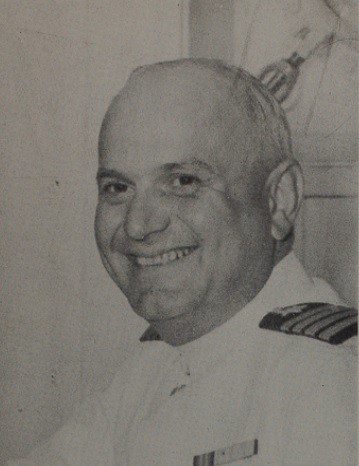
Jesse Rink Wallace was born in Beardstown, Illinois, on 17 July 1899, the son of George C. Wallace, a division accountant on the Burlington Railroad, and Clara Wallace. He finished Beardstown High School in the summer of 1918, passed the examinations for the United States Naval Academy, and entered Annapolis that June. There he played football and soccer and ran track. He graduated with the Class of 1922 and was commissioned in the Navy.
On 19 August 1937 he took command of the Mahan-class destroyer Cushing (DD-376), relieving Edwin Thomas Short. The ship was barely a year old. Puget Sound Navy Yard had launched her on the last day of 1935, and she had been commissioned on 28 August 1936, the third Navy ship named for Commander William Barker Cushing. Wallace was promoted to lieutenant commander in October 1937, early in the tour. From San Diego, Cushing stayed with the Pacific Fleet for gunnery drills, tactical exercises, and the fleet problems, broken by short training periods at Pearl Harbor and one cruise to the Caribbean. He left her on 24 May 1940, when William Bennett Jackson relieved him.
His next orders took him to Naval Station Tutuila as attorney general on the staff of the naval governor of American Samoa, Commander Edward Hanson. When Hanson’s term ended, Wallace served as governor from 30 July to 8 August 1940, the short interval before Laurence Wild arrived. He then went to the Office of the Judge Advocate General and remained in that duty until August 1944. While there he was promoted to commander on 1 March 1942 and to temporary captain on 21 June 1942.
Cushing went to war under later captains. Christopher Noble had her in the first months of the fight for Guadalcanal. On the night of 13 November 1942, under the captain who followed Noble, she stood at the head of an American column in the first surface action of the Naval Battle of Guadalcanal. Japanese gunfire wrecked her south of Savo Island. Her crew abandoned the burning ship, and she sank that afternoon. Wallace’s command had ended in May 1940.
In August 1944 the Navy sent him back to the Pacific as commanding officer of the amphibious command ship Eldorado. She flew the flag of Vice Admiral Richmond K. Turner, and Wallace took her through the landings at Iwo Jima and Okinawa. After Japan’s surrender he moved to the heavy cruiser Augusta, in command from 27 August 1945 until April 1946.
He then served as chief of staff at the Naval Academy from 1946 to 1949, and afterward as chief of staff and aide to the commandant of the Ninth Naval District. He retired on 1 July 1952 after thirty years of commissioned service. He left active duty as a captain and was advanced to rear admiral on the retired list for having been specially commended for combat service.
In Milwaukee he joined the A. O. Smith Corporation, a maker of heavy equipment, as assistant treasurer, and in 1954 the company made him its secretary. He died in Milwaukee on 29 January 1961, at sixty-one, and was buried in the Naval Academy Cemetery.