Ships
- USS Ammen (DD-527) Captain, 12 March 1943 – 22 April 1943
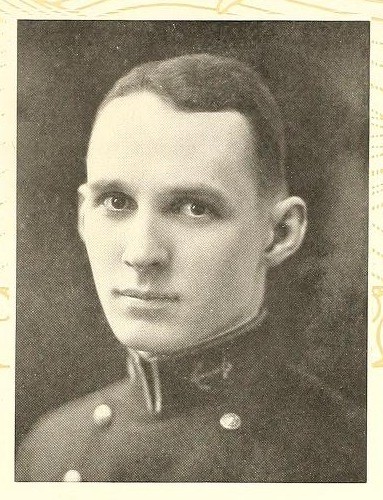
John Cheshire Daniel (1 November 1899 – November 1992) was a United States Navy officer from Philadelphia and a member of the Naval Academy class of 1924. He spent most of his career in destroyers. On the evening of 8 May 1942, in the Battle of the Coral Sea, he took a destroyer's whaleboat around the burning, listing carrier Lexington to make sure no men were left in the water. For that he became one of the first naval officers awarded the new Navy and Marine Corps Medal. He commissioned the destroyer Ammen in March 1943. That May he was made officer in charge of the first unit of the Navy's new Naval Demolition Project, the start of the training that produced the Navy's combat demolition units. In 1945, as commander of Destroyer Squadron Forty-Five off Okinawa, he won the Silver Star for standing by the kamikaze-struck escort carrier Sangamon and the Navy Cross for his command of a radar picket unit under suicide attack. After the war he commissioned the heavy cruiser Salem. As a rear admiral he sat on the United Nations Command delegation at Panmunjom, led the liaison talks that arranged the April 1953 exchange of sick and wounded prisoners, and stayed on the delegation through the armistice. He commanded the Sixth Naval District at Charleston, retired in 1960, and died in Fort Lauderdale, Florida, at the age of ninety-three. He should not be confused with Henry Chesley Daniel, another Philadelphian, who was in the same Naval Academy class and also became a destroyer captain. No source examined here says the two men were related.
The Navy's registers give his birth date as 1 November 1899, and the Naval Historical Center's officer biography file, as summarized in the National Archives catalog, gives his birthplace as Philadelphia. His New York Times obituary says he was born in Philadelphia and grew up there. The Academy yearbook lists his home as Philadelphia, and the 1921 Register of Commissioned Officers shows that his appointment was credited to Pennsylvania.
Almost nothing else about his early life is on record. The sources examined do not name his parents. They do not say what his father did, where the family lived in the city, or what schools he attended before the Academy. His middle name, Cheshire, sounds like a family surname, but no source examined explains where it came from. His family enters the record only at the end of his life, in the three sentences of an obituary.
According to the 1921 Register, he was admitted to the Naval Academy on 2 July 1919. That would ordinarily have made him a member of the class of 1923, and in January 1921 the Register lists him among the third classmen. He graduated with the class of 1924 instead. The 1924 Lucky Bag, the Academy yearbook, explains the extra year in the half-joking style of such entries. "Some of the greatest men that have ever boasted of a real career have bilged once, and in some instances twice, during their course at the Academy. However, once was enough for 'Joe.'" To bilge was to fail academically. The book's account of the cause is that "due to a complete inability to worry, 'Joe' allowed his Academic bark to come dangerously near the rocks." He was turned back a year, and then, the entry says, "he's finally succeeded in safely passing the farewell buoy of the seemingly endless grind, and has entered the open sea of his lifelong ambition—the Service."
His classmates called him Joe. They described him as "optimism personified," a man "just full of song and sunshine," and warned that "if you want to feel rhino" (Academy slang for gloomy) "this is no hombre to hang around with." They also claimed that his attitude toward women came down to an old verse: "What care I how fair she be, if she does not care for me—let the devil take her." Among the sayings the entry attaches to him is "No, by G—d." He played class soccer for two years, captained the class team one year, and made the varsity soccer squad. The yearbook's soccer review records that in his final season Daniel was one of three players who left the squad in mid-season when "the Academics took their toll." It says nothing more. Even near the end of his course, then, his grades were still costing him something.
Allowing for the teasing that every Lucky Bag entry contains, the picture is a cheerful, physical young man who was not a natural student, who nearly failed out, and who recovered. The record is too thin to say more about his character at twenty-four. The man the later citations describe, steady and willing to take risks in a crisis, fits the yearbook's man who did not worry, but that link is a reading, not a fact on record.
The same pages record a coincidence that can cause confusion. Directly beside his entry is that of Henry Chesley Daniel, also of Philadelphia, also class of 1924, whom the class called "Ches." The two men served through the same decades, and both commanded new destroyers in 1943. They were different officers with different careers, and no source examined here says they were kin.
He was commissioned ensign on 5 June 1924, according to the Naval Historical Center biography file summarized by the National Archives. His Times obituary says his first tour was in a destroyer, but the Navy Directory tells it differently. Early in 1925 it lists Ensign John C. Daniel, along with Ensign Henry C. Daniel, in the battleship Arkansas. Early in 1926 it lists him on sick leave, with no further detail. From 1926 through 1930 the directories place him in the battleship Arizona, where he became a lieutenant (junior grade). In 1930 and 1931 he was in the destroyer Bernadou.
In 1932 the directory lists him under instruction at the Naval Academy, where the Navy's Postgraduate School was then located, and the registers of later years credit him with the postgraduate course in general line duties. The 1933 and 1934 directories list him under instruction at the Bureau of Navigation in Washington, and the 1933 Register gives the bureau as his duty station. From 1934 to 1937 he was a lieutenant in the destroyer Worden, and the 1937 directory names him as her gunnery officer. In 1939 he was ashore at the Naval Mine Depot at Yorktown, Virginia. He was promoted to lieutenant commander on 1 July 1939.
His first command came that winter. The old flush-deck destroyer Abel P. Upshur had been laid up at the Philadelphia Navy Yard. She was recommissioned on 4 December 1939 for the Atlantic Neutrality Patrol, which the United States had set up after war broke out in Europe. The 1940 Register lists Daniel as her commanding officer, and a compiled list of commanders dates his command from 31 December 1939 to 9 September 1940. On that last date, according to the Dictionary of American Naval Fighting Ships, the Upshur was decommissioned at Halifax, Nova Scotia, and handed over to Great Britain under the destroyers-for-bases agreement. She became HMS Clare. The sources do not say whether Daniel himself took her to Halifax. If the compiled dates are right, his first command ended with the ship going to another navy's war a year before his own country entered it.
By late 1940 he was in the Pacific. The 1940 and 1941 directories list him on the staff of the commander of Destroyer Squadron One, embarked in the squadron's flagship, the destroyer Phelps. The sources examined do not give his staff job, and none places him aboard on 7 December 1941.
Five months after Pearl Harbor, Phelps was in the Coral Sea, carrying Captain Early, Commander Destroyer Squadron One, in the screen of the carrier Lexington. On the morning of 8 May 1942, Japanese carrier planes attacked Lexington with torpedoes and bombs. By late afternoon she was burning and being abandoned. Destroyers came alongside or stood close to take off her men, and hundreds more were in the water among life rafts and boats.
The Navy's wartime combat narrative of the battle, prepared by the Office of Naval Intelligence, describes what Daniel did as the light failed. At 1739, Phelps and Dewey were ordered to close the carrier and help with the rescue. They stopped about a thousand yards to windward and put boats in the water. "At 1810, after it was quite dark, Lt. Comdr. John C. Daniel, in a Phelps whaleboat, made a hazardous turn around the Lexington and along her lee side to make certain no more people were in the water there. The carrier had just been rocked by a particularly heavy explosion which tossed planes from her deck high into the air, was afire from stem to stern and listing about 30°. No more survivors were found."
His Navy and Marine Corps Medal citation, issued under a Commander in Chief, Pacific, serial of 3 July 1942, gives more detail. About twenty survivors had been seen in the water near the carrier. A Lexington boat that was trying to reach them appeared to have broken down. Daniel "volunteered and was directed to take the PHELPS whaleboat and rescue them." When he was almost there, he saw the Lexington boat get clear with the men aboard. By then it was too dark to tell whether everyone had been picked up. He kept going. "In spite of the fact that the ship had a list of 20 to 30 degrees, her flight deck was afire from stem to stern, a severe explosion had just thrown planes and debris into the air and other planes on the deck were in imminent danger of sliding off the top of the boat," he took the whaleboat down the carrier's whole port side, the windward side, and then along the starboard side "to the point where smoke prevented anything being seen." Only when he was satisfied that no one else was in the water did he go back to Phelps. Less than an hour later, Phelps was ordered to sink the burning carrier with torpedoes. Lexington went down at 1952.
The citation also makes clear what the trip involved. The men he went to rescue had already been saved. Everything after that was a search in the dark, close under a ship that was exploding, in a boat small enough to be crushed by an aircraft sliding off the flight deck above it, for men who might or might not be there. No one was found. The search was worth making precisely because no one could know that until it was done. The Navy and Marine Corps Medal was new. A note on the Military Times Hall of Valor record says that Congress authorized it three months after the Lexington rescue, and that Daniel and Ensign Robert Arnold Sweatt were the first naval officers to receive it. The Register of 1944 marks his name with the symbol for the medal.
His Times obituary says he also fought at Midway the next month. The sources examined do not say where he was or what he did there. On 17 July 1942, according to a compiled record of his ranks, he was given the temporary rank of commander.
In early 1943 he was at the Bethlehem Steel yard in San Francisco, where the new destroyer Ammen was nearly finished. The Dictionary of American Naval Fighting Ships records that she was commissioned on 20 March 1943 with Commander John C. Daniel in command. She sailed for shakedown at San Diego on 30 March and left San Diego on 20 April. A compiled list of commanding officers ends his command on 22 April 1943. That was before Ammen sailed north in the screen for the Attu landings, so her Aleutian campaign belongs to the officer who relieved him. He had trained her crew for a month and then left the ship.
He had been picked for something new. On 6 May 1943, according to the history published by the National Navy UDT-SEAL Museum, which cites the original correspondence, the Commander in Chief, United States Fleet, ordered a "Naval Demolition Project" to "meet a present and urgent requirement." The first phase was an Operational Naval Demolition Unit and Naval Demolition Unit No. 1, to be set up at the Amphibious Training Base at Solomons, Maryland. Commander John C. Daniel was named officer in charge. Six officers and eighteen enlisted men, all from the Seabee camp at Camp Peary, Virginia, reported on 14 May. Under Lieutenant Fred Wise they were given a four-week course and sent to the invasion of Sicily.
On 27 May, Daniel sent the Commander, Amphibious Force, Atlantic Fleet, a report with his recommendations for permanent units. In it he proposed an organization, a basic training syllabus, and a list of equipment, and he recommended moving the training from the Chesapeake to the Amphibious Training Base at Fort Pierce, Florida, where the weather allowed training all year. On 6 June 1943 the Naval Combat Demolition Unit school opened at Fort Pierce under Lieutenant Commander Draper Kauffman. Units trained there later went ashore at Normandy. The Army's official history of the Korean armistice talks, describing the admiral who later sat at the table at Panmunjom, says that he "had organized and commanded the Navy's first underwater demolition team for the Sicily invasion." (The history gives the year as 1945, an evident slip for 1943.) This confirms that the commander at Solomons and the destroyer officer were the same man. His part in the program lasted a few weeks, and others carried it on. His recorded contribution is the first unit and a report recommending the move to Florida.
On 1 June 1943 he was made a temporary captain. The 1952 Register confirms that date of rank. The sources examined are almost silent about the next year and a half. A compiled list of squadron commanders puts him in command of Destroyer Squadron Forty-Five from December 1944, under a garbled form of his name. Whatever the exact date, he had the squadron by the spring of 1945, and his award citations confirm it. The squadron's flagship was the destroyer Fullam. By coincidence, she had been commissioned two years earlier by his classmate Henry C. Daniel.
On 4 May 1945, off Okinawa, the escort carrier Sangamon finished rearming at Kerama Retto and got under way at dusk. Japanese aircraft were already inbound. The Dictionary of American Naval Fighting Ships says that the first attacker crashed in the sea close aboard. At 1933 a second plane released its bomb and crashed into the center of the flight deck. The bomb and wreckage went through the deck and exploded below. Fires broke out on the flight deck and the hangar deck. Within fifteen minutes the carrier had lost communications from her bridge, and she was soon out of control. As she swung through the wind, the fire spread. Men went over the side.
Daniel's Silver Star citation, issued by the Commander, Amphibious Forces, Pacific Fleet, under a serial of 9 November 1945, describes what he did: "he brought his flagship alongside the carrier, sent out call for assistance, directed the fire fighting of vessels alongside, supervised the rescue of persons in the water, continued screening activities and handled all communications for the crippled vessel whose own communications were at a total loss." The carrier's official history confirms this from its own side. When Sangamon's communications were restored, it was "at first through Fullam's radios." A destroyer history published by the Tin Can Sailors association states that rescue operations were directed by the commander of Destroyer Squadron Forty-Five aboard Fullam. By 2230 the fires were under control. Sangamon had eleven dead, twenty-five missing, and twenty-one seriously wounded, and she made her way back to Kerama Retto under her own power.
One document from that night survives in a collection kept by a Sangamon veteran. It is a message form received aboard the carrier at 0620 on 5 May 1945, from Fullam to Sangamon: "CONGRATULATIONS ON A COURAGEOUS FIRE FIGHTING JOB IT WAS THE WORST I HAVE EVER SEEN AND I SAW THE LEXINGTON. WE DID OUR BEST TO STOP THAT LAST ONE AS HE DOVE OVER OUR MAST BUT HE CAME SMACK OVER OUR STACK BUT HE WOULDNT SPLASH." The form names only the ship, not the man. The veteran's caption attributes it to Fullam's captain, a lieutenant commander. The squadron commander was also aboard Fullam, and he was a man known to have seen the Lexington burn from a whaleboat under her side. Who wrote the message cannot be settled from the document. Its point stands either way: the officers in that destroyer judged Sangamon's fire against the worst carrier fire they knew.
Twelve days later Daniel's squadron took up a harder job. From 16 May to 21 June 1945 he was "Officer in Tactical Command of Destroyer Squadron FORTY-FIVE (Desron 45), a Radar Picket Station Unit." So reads the citation for the Navy Cross awarded him under a Commander, Destroyers, Pacific, serial of 24 December 1945. Radar picket ships were posted on stations around Okinawa to give early warning of incoming raids and to direct the combat air patrol against them. Because they were the first ships the Japanese pilots met, they took some of the heaviest kamikaze punishment of the war. The citation says that "with his unit under frequent and determined Japanese suicide attack, Captain Daniel handled his surface units and the planes of the combat air patrol assigned his command with superb skill and determination and, by his decisive actions and aggressive fighting spirit, was instrumental in the destruction of forty enemy aircraft." That sentence is all the sources examined say about those five weeks. No action report of his was read, and the ships, stations, and days behind the figure of forty aircraft have not been reconstructed here.
His Times obituary says that in September 1945 he was present at the surrender ceremony aboard the battleship Missouri in Tokyo Bay. No other source examined records that, or in what capacity he was there.
The sources examined do not trace his duty from the surrender to 1949. On 14 May 1949 he commissioned the heavy cruiser Salem. A list of her commanding officers printed in the ship's 1955 cruise book shows him in command from that day until 2 February 1950. In 1952 the registers still list him as a captain, with date of rank 1 June 1943. He was promoted to rear admiral with date of rank 1 March 1952.
That summer he was sent to Korea. Walter G. Hermes's Truce Tent and Fighting Front, the Army's official history of the armistice negotiations, records that on 22 June 1952 Rear Admiral Ruthven E. Libby attended his last meeting at Panmunjom and was replaced the next day by Rear Admiral John C. Daniel. He joined negotiations that had been running for a year and had stalled over prisoners of war. The United Nations Command would not send back captured Chinese and North Koreans against their will, and the Communist side insisted on the return of all. Photographs in the official history show him at the table with the delegation in July 1952 and again in April 1953. When the talks went into indefinite recess in the autumn of 1952, he kept a second job. A Navy chronology of the Korean War records that on 12 December 1952 he took command of the Military Sea Transportation Service, Western Pacific Area, and was to remain senior naval delegate if and when the talks resumed.
The next step ran through the liaison group he headed. In early 1953 both sides agreed to exchange their sick and wounded prisoners first. On 6 April 1953, Hermes writes, "Admiral Daniel and General Lee Sang Cho led the liaison officers groups when they gathered at Panmunjom." Daniel opened with the United Nations Command's offer: facilities at Panmunjom built at once, and delivery of five hundred prisoners a day within a week of agreement. He proposed that both sides exchange lists of names and nationalities. On 7 April he told the Communist side that the United Nations Command would repatriate every prisoner eligible under the relevant articles of the Geneva Convention, "subject to the proviso that no individual would be repatriated against his will." That proviso was the issue on which the armistice talks had been stuck for a year. On 8 April General Lee offered 450 Korean and 150 non-Korean sick and wounded, and Daniel called the figure "incredibly small." Hermes notes that it was in fact proportionally a little larger than the UNC's own offer. According to Hermes, Daniel reported to General Clark, the United Nations commander, that the enemy liaison officers "relaxed their strained attitudes visibly" once the UNC figures were on the table, and that he felt he should press strongly for a higher total. The agreement was signed on 11 April. The Times obituary says that it was Daniel, as head of the liaison group, who signed the agreement for the United Nations side.
The exchange, Operation Little Switch, ran from 20 April to 3 May 1953. On 26 April General Lee announced that his side had finished. Daniel protested that the United Nations Command had evidence of about 375 more sick and wounded prisoners who could be released. Lee called the charge groundless, and the matter went no further. The United Nations Command finished its own deliveries on 3 May. Prisoners came home under the arrangements he negotiated. The further men he asked for did not. Archival film of Little Switch preserved at the National Archives shows him speaking to reporters.
Plenary sessions resumed on 26 April with Daniel among the delegates, and he stayed on the delegation until the armistice was signed on 27 July 1953. His Legion of Merit, awarded by the Army in General Orders No. 84 of 3 November 1953, covers the whole period from 20 June 1952 to 27 July 1953. It describes him as senior member of the Liaison Group and adviser to the chief delegate, Lieutenant General William K. Harrison Jr., on "matters of major decisions, policy and planning." It credits him with working "under constant pressure" in "daily meetings" with "enemy negotiators." The language is formal. Behind it was more than a year of sessions across the table from the other side, interrupted by long recesses.
The record of his last years of service is thin. The Times says he later commanded the Atlantic Fleet. No source examined supports that, and it does not fit the grade of rear admiral he held in the registers through 1958. That claim has been left out. The Naval Historical Center's biography file, as summarized by the National Archives, records that he was commandant of the Sixth Naval District, with headquarters at Charleston, South Carolina, from February 1958 to October 1959. He retired in 1960. The Times obituary calls him a retired vice admiral, and so do later compilations, but the sources examined do not say when or on what grounds he received that rank.
He then moved to Fort Lauderdale, Florida. The Times says he was married three times and that his last wife, Gervaise, died in 1981. The other two marriages and the reasons they ended are not recorded in any source examined. He was survived by two sons, John C. Daniel Jr. of Walnut Creek, California, and Tim D. Daniel of Pleasant Hill, California, and by six grandchildren and seven great-grandchildren. He died at North Beach Hospital in Fort Lauderdale of complications of pneumonia and heart problems, at the age of ninety-three. The Times says he died on a Monday, which in that week was 23 November 1992. The National Archives summary of his Navy biography file gives 21 November. He is reported to be buried at Arlington National Cemetery.