Ships
- USS Iowa (BB-61) Captain, 22 February 1943 – 16 August 1944
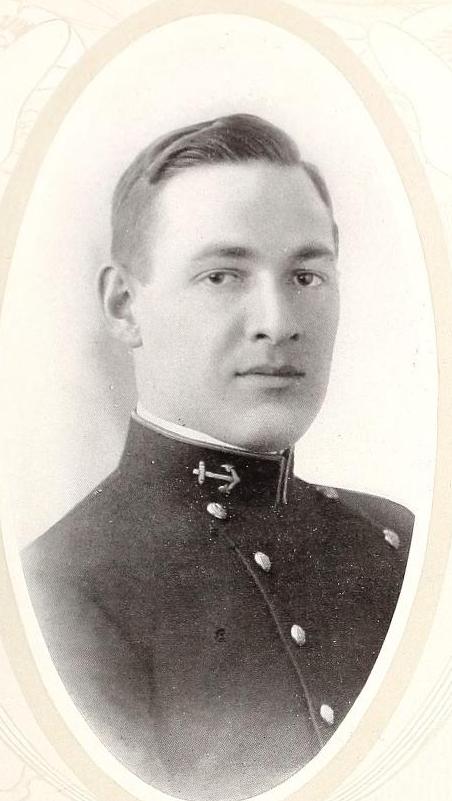
John L. McCrea was born on 29 May 1891 in Marlette, Michigan, where his father practiced medicine. He entered the United States Naval Academy and graduated in 1915. His first ship was the battleship New York. He served in her a little more than four years, through the First World War. On 21 November 1918, as watch officer, he wrote into the ship's log the surrender of the German High Seas Fleet.
After the armistice he served in the battleship New Mexico, in destroyers, and as executive officer of the oiler Ramapo. He completed the Naval War College course in 1923 and in 1924 commanded the minesweeper Bittern. He then took up naval legal work in the Office of the Judge Advocate General, earning a bachelor of laws from George Washington University in 1929 and a master of laws there in 1934. Between those degrees he was flag secretary of the Special Service Squadron in Central America and an aide to the Judge Advocate General. Sea duty followed in the cruiser Astoria. As a commander he was executive officer of the naval station on Guam and then of Pennsylvania, flagship of the United States Fleet, where he ran frequent battle drills in the belief that war in the Pacific was coming.
In September 1940 McCrea joined the staff of Admiral Harold R. Stark, Chief of Naval Operations. He carried a revised set of war plans to senior commanders in the Pacific. After Pearl Harbor he served as the Navy's secretary at the Arcadia Conference in Washington, where American and British leaders settled their first combined strategy. Early in 1942, as a captain, he became naval aide to President Franklin D. Roosevelt. At the White House he organized the Map Room, the office in which the president followed the daily reports of fleets and armies. In January 1943 he went with Roosevelt to the Casablanca Conference and kept the notes of the talks.
The president then released him for command at sea. On 22 February 1943 McCrea became captain of the new battleship Iowa, commissioned that day at the New York Navy Yard, and he remained her captain until 16 August 1944. He set her organization, took her through trials, and trained a crew of nearly three thousand. In November 1943 Iowa carried Roosevelt and the American service chiefs across the Atlantic to Algeria on the way to the conferences at Cairo and Tehran, and she brought the party home in December. On the outward voyage, during an antisubmarine drill, the destroyer William D. Porter accidentally fired a live torpedo toward Iowa. McCrea turned the battleship clear. The torpedo exploded in the wake, and the voyage continued.
In 1944 Iowa went to the Pacific. Under McCrea she operated with the fast carrier forces in the Central Pacific, screening carriers and bombarding shore targets in the Marshall Islands campaign and the strikes that followed. In June 1944 she was with that force at the Battle of the Philippine Sea.
He left Iowa on 16 August 1944 and, as a rear admiral, took command of Cruiser Division 3 and of Task Force 92 in the North Pacific under Admiral Frank Jack Fletcher. From the Aleutians his ships bombarded Japanese positions in the Kuril Islands through the last months of the war. Fletcher gave him room to make the plans for those raids and asked to be kept informed. McCrea regarded Fletcher as a good officer who trusted a subordinate. He received the Legion of Merit for his command of Iowa and a second award for the North Pacific task force.
After the war he served as a deputy chief of naval operations, as deputy commander in chief of the Pacific Fleet, and as director of the Navy's Personnel Policy Board. He closed his career as commandant of the First Naval District in Boston and retired in 1953 as a vice admiral. He then joined the John Hancock Mutual Life Insurance Company as a vice president and left that work in 1966. John L. McCrea died in Needham, Massachusetts, on 25 January 1990, at the age of ninety-eight.